Star Ceiling Panels for Drop Ceilings: How Fiber Optic Star Tiles Work in a T-Bar Grid, from Layout to Light Engine
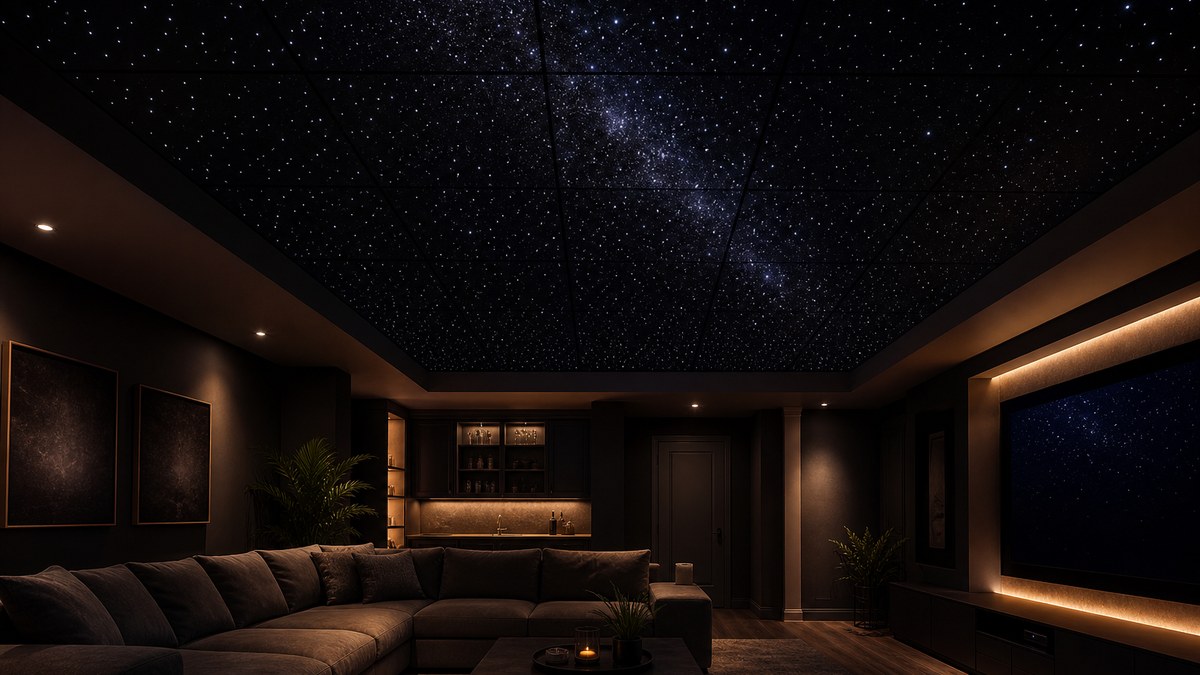
Star ceiling panels for drop ceilings are one of the easiest ways to put a real fiber optic night sky over a room, because the ceiling is already built to open, close and hide cables. Instead of drilling hundreds of holes into drywall from an attic, you swap ordinary acoustic tiles for star tiles that already have fiber optic strands installed, drop them into the existing T-bar grid, and run the fiber tails across the plenum to a light engine that sits right above the ceiling.
This guide is the dedicated drop-ceiling chapter of our complete starlight ceiling guide. It explains how star ceiling tiles for a T-bar ceiling work, which grid and tile sizes to plan around, how to lay out stars across a grid so it reads as one sky rather than a checkerboard, where the light engine goes, what to check about weight, supports and code, and how a basement, home theater, office or bar project typically comes together. Wiedamark LED supplies the fiber optic starlight components, so the focus is on the decisions that make a drop ceiling star sky look right and stay easy to service.
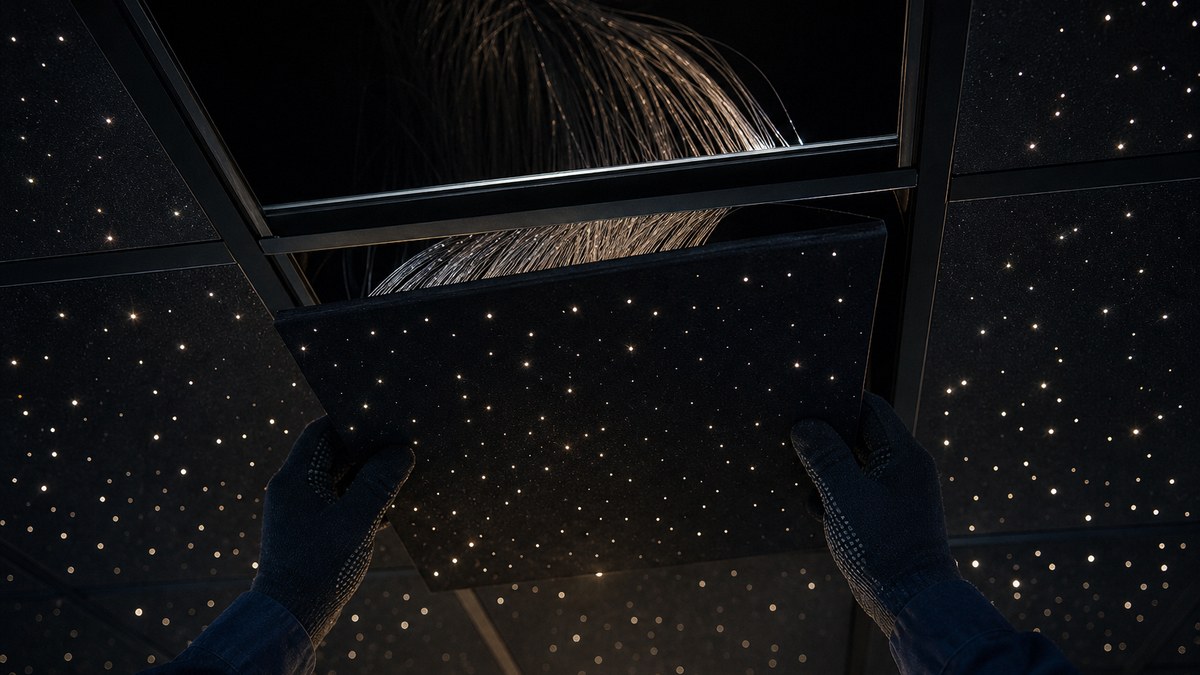
Yes, you can put a fiber optic star ceiling in a drop ceiling, and it is often the simplest install there is. Star ceiling tiles sized for a standard T-bar grid (commonly 2 ft × 2 ft or 2 ft × 4 ft) replace your existing tiles; their fiber tails run across the space above the grid to an LED light engine that sits on or above the ceiling where you can reach it.
- No drywall work: lift out old tiles, drop in star tiles, route fibers above the grid.
- Full access: the light engine and every fiber stay reachable by lifting a tile.
- Mix tiles: star tiles can fill the whole grid or just a center field, with plain dark tiles around it.
- Hide the grid: a black or dark grid, dark tile faces and random star layouts keep the sky from looking like squares.
- Check support and code: follow the grid maker's load guidance and local code, especially in commercial spaces.
- Pricing: project-specific; it depends on tile count, star density, effects and engine count. Request a quote.
What a drop ceiling star tile actually is
A drop ceiling (also called a suspended ceiling, T-bar ceiling or grid ceiling) is a metal grid hung on wires below the structure, with lightweight tiles resting in each opening. A star ceiling tile is a panel made to fit one of those openings, with fiber optic strands already pushed through its face and trimmed flush. Behind the tile, the strands are gathered into a tail that runs to a light engine.
The stars themselves work exactly like any other fiber optic sky. An LED in the light engine shines into the end of a fiber bundle, the light travels down each strand, and each polished tip becomes a point of light. A twinkle wheel or electronic control varies the light so stars shimmer, and the engine can dim, change color temperature or run color effects. If you want the full technical picture, our explainer on how starlights and fiber optic light engines work covers it in detail, and what LED star light ceilings are and how they work is a good primer.
The parts of a drop ceiling star system
- Star tiles: grid-sized panels with fibers installed. Faces are usually black, deep navy or a dark fabric so the stars stand out.
- Plain companion tiles: matching dark tiles without stars, used around the edges or between star zones.
- Fiber tails: the bundle of strands behind each tile, gathered and routed across the plenum to the engine.
- Light engine (illuminator): the LED source with twinkle, dimming and often color, sized for the number of fibers it lights.
- Controls: a remote, wall control, app or integration with lighting and smart-home systems.
- Grid finish: optional black or dark-painted T-bar so the metal lines disappear at night.
Star tiles vs drilling your existing ceiling tiles
Some DIYers buy a fiber optic kit and thread fibers through their existing mineral-fiber tiles. It can work, but ordinary tiles are soft, can crumble around holes, sag over time and are rarely dark enough to make the stars pop. Purpose-built star tiles start with a stable, dark face designed to hold fibers. If you do want to build your own, our DIY star ceiling kit installation guide explains threading and trimming, and our star ceiling kit vs panels comparison helps you decide which route fits the room.
Grid and tile sizes: measure before you choose
Before anything is ordered, confirm what grid you have. Most suspended ceilings in North American homes and offices use one of two module sizes, but older and imported grids can differ, and the visible face of the grid varies too.
| What to check | Why it matters | How to check |
|---|---|---|
| Module size | Star tiles must match the grid openings (commonly 2 ft × 2 ft or 2 ft × 4 ft nominal) | Measure center to center of the grid tees, not the tile itself |
| Metric vs imperial | Metric grids (600 mm modules) are slightly different from 24 in modules | Measure in both units; note any mismatch |
| Grid face width | Standard (wider) and narrow grid faces affect how the tile edge sits | Measure the flat face of the tee you see from below |
| Tile edge type | Square-lay-in edges sit flush on the grid; tegular (reveal) edges drop below it | Lift a tile and look at the edge profile |
| Plenum height | You need room above the grid for fiber tails and the light engine | Measure from grid to the structure or ductwork above |
| Obstructions | Ducts, pipes, sprinkler lines and fixtures limit routing and engine placement | Lift several tiles and sketch what is above |
| Grid condition | Bent tees or sagging sections make tiles sit unevenly and show gaps | Sight along the grid with a flashlight; check hanger wires |
| Power location | The light engine needs an outlet or circuit within reach | Find the nearest outlet or junction box above or near the ceiling |
A quick sketch with the room size, number of tiles in each direction, plenum height and anything in the way tells a supplier almost everything needed to size star tiles, fiber tail lengths and light engines.
Layout: making a grid read as one sky
The biggest risk with star ceiling tiles is that the sky looks like a set of squares. Real skies have no edges, so a good drop ceiling layout works hard to make the grid disappear once the room lights are down.
Full grid or a star field?
- Full grid: every opening gets a star tile. Best in small rooms and dedicated theaters where the whole ceiling should become sky.
- Center field: star tiles fill the middle of the room and plain dark tiles run around the perimeter, like a border. A common choice for basements, bars and lounges, and easier on the number of fibers.
- Zones: separate star areas over a seating group, a bed, a bar or a dance floor, each able to run its own scene.
- Feature band: a strip of star tiles down the center of a corridor, hallway or long room, often with a Milky Way running along it.
Hiding the grid
- Dark grid: a black or dark-finished T-bar disappears against dark tiles. Grid paint or replacement black tees both work.
- Random stars near edges: stars placed right up to (and on both sides of) a tile edge stop the eye from finding a border.
- No repeating pattern: each tile should have a different layout, or tiles should be rotated and mixed so no pattern repeats across the room.
- Mixed fiber sizes: a few bright stars and many faint ones, spread unevenly, read as a natural sky.
- Continuous features: a Milky Way band or constellation that crosses several tiles needs those tiles designed as a set and installed in the right order.
For design ideas like Milky Way bands, constellations, twinkle and shooting stars, see our starlight effects guide. For a broader look at fiber stars versus LED panels and projectors, our LED star ceiling lights guide and fiber optic vs projector comparison are useful.
Where the light engine goes in a drop ceiling
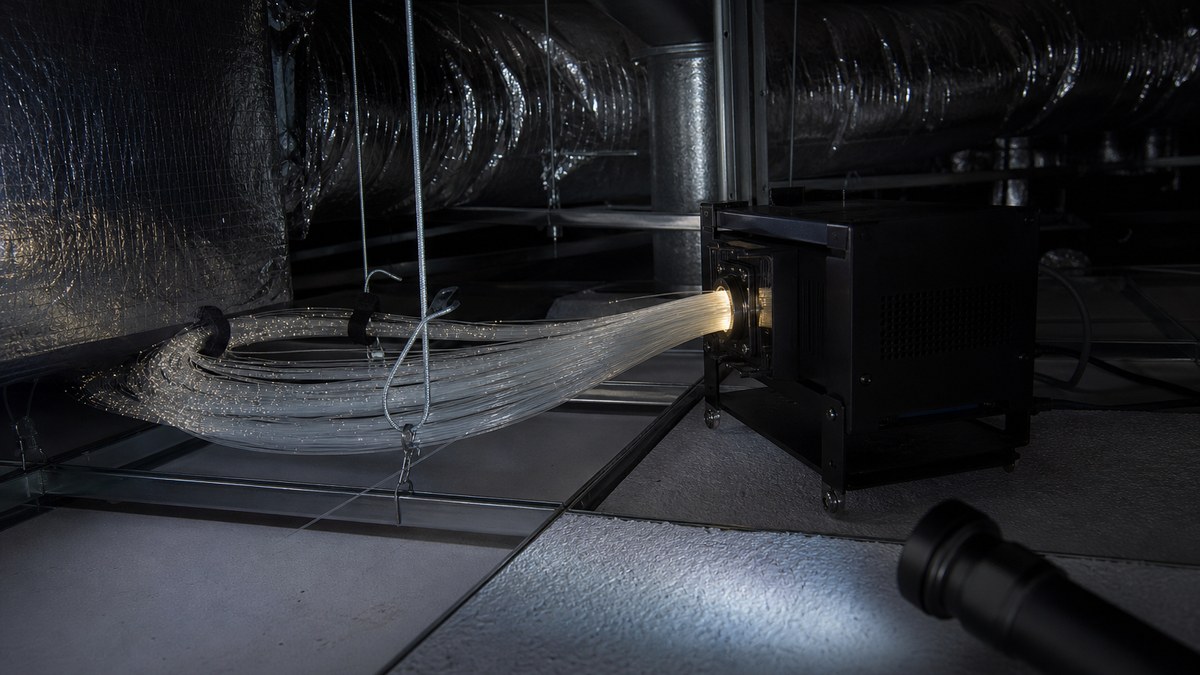
A drop ceiling gives you something most star ceilings lack: easy access. The light engine can usually sit right above the grid, close to the star tiles, with a tile that lifts out for service. That said, a few rules keep it reliable.
- Support it properly: do not rest the engine on a ceiling tile. Mount it to the structure, a shelf or a support that does not load the grid, following the grid maker's guidance.
- Keep it ventilated: light engines make some heat and usually have a fan. Leave space around the housing and avoid burying it in insulation.
- Keep it reachable: place it above a tile you can lift without moving furniture or a screen, ideally away from the main star field.
- Mind the noise: in a theater or bedroom, put the engine where any fan or twinkle-wheel sound will not carry into the room, or choose a quieter design.
- Plan fiber reach: every tile's tail must reach the engine without tight bends. Larger rooms often use more than one engine, each serving a zone.
- Power and control: plan the outlet or circuit, and how the engine will be controlled (remote, wall control, app or a lighting system).
Some projects place the engine in an adjacent closet or mechanical room instead, which keeps fan noise and heat out of the space and makes service even easier. Our guide to choosing a fiber optic star ceiling kit and light engine covers engine types, fiber counts, low voltage and color options.
Weight, support and code: what to check first
A drop ceiling is designed to carry lightweight tiles, not heavy equipment. Star tiles are typically light, but they are not identical to the tiles they replace, and fiber tails and engines add load if they are not supported separately.
- Check the grid's load guidance: grid manufacturers publish how much the system can carry. Ask your supplier for each star tile's weight and compare.
- Support the engine and heavy items independently: common practice is to hang heavier components from their own wires or supports rather than the grid.
- Do not drape fiber bundles on tiles: lay tails on supports or tie them to the structure so tiles can still lift out freely.
- Plenum rules: in many commercial buildings the space above the ceiling is a return-air plenum with rules on which cables and devices can go there. Ask the building and your electrician before you install.
- Fire and finish requirements: commercial ceilings may need tiles and materials that meet specific ratings. Confirm requirements with the building owner or code official, and ask your supplier for product documentation.
- Sprinklers and detectors: never block or move sprinkler heads, smoke detectors or access panels. Plan star tiles around them.
For homes, a basement drop ceiling is usually straightforward. For offices, bars, restaurants and hotels, involve the building and a licensed electrician from the start.
Have a drop ceiling? Let's size your star tiles.
Send us the room size, grid size, a photo from below and a photo of the space above the tiles. We will help you plan the star field, fiber tails and light engines and send a project-specific quote.
How a drop ceiling star install comes together
- Survey the ceiling: measure the grid, count tiles, check plenum height and obstructions, and find power.
- Plan the sky: decide on full grid, center field or zones; mark any Milky Way band, constellation or shooting star paths across tiles.
- Size the engines: match the number of fibers and the tail lengths to one or more light engines, and pick effects and controls.
- Prepare the grid: straighten or replace damaged tees, and darken the grid if you want it to disappear.
- Mount the engine: install it on its own support above an easy-to-lift tile, with power and ventilation.
- Set the star tiles: working from one side, lift each tile into the plenum, feed its tail toward the engine, and lower it into the grid in the planned order.
- Route and dress the tails: lay bundles on supports with gentle bends, keep them off the tiles, and label them by zone.
- Connect and mix: gather the tails into the engine's port, mixing fibers from different tiles so twinkle looks random across the sky.
- Fill the border: drop in plain dark tiles around the star field and around fixtures, vents and sprinklers.
- Test and tune: power up with the room dark, check for dead or overly bright stars, and set brightness, twinkle speed and color.
Compared with a drywall install, there is no hole-by-hole threading on site and no dust from cutting. For more on the whole process, see our star ceiling installation guide and, if you are comparing ceiling types, our star ceiling panels guide.
Drop ceiling star tiles by room
Finished basements
Basements are where drop ceilings are most common, because ducts, plumbing and shutoffs need to stay reachable. That makes them a natural fit for star tiles: the sky goes up without hiding anything you might need later. Low basement ceilings benefit from a center field of stars with darker tiles around the edges, which makes the room feel taller at night. Our basement ceiling star lights guide and basement home theater star ceiling guide go deeper on low ceilings, ductwork and soundproofing.
Home theaters and media rooms
In a theater with a suspended ceiling, star tiles can replace plain tiles over the seating, with dark border tiles near the screen to keep light off the image. Acoustic star tiles help absorb sound in hard-surfaced rooms. Keep the engine away from the main listening position. See the home theater star ceiling design guide for layout and control ideas.
Bedrooms, kids' rooms and gyms
Drop ceilings are less common in bedrooms, but basement bedrooms, kids' rooms and home gyms often have them. Warm white stars on a dimmer suit sleep spaces; color scenes and brighter twinkle suit play rooms and workout spaces. Our star light bedroom ceiling ideas and home gym star ceiling guide have room-specific layouts.
Bars, restaurants, lounges and hotel spaces
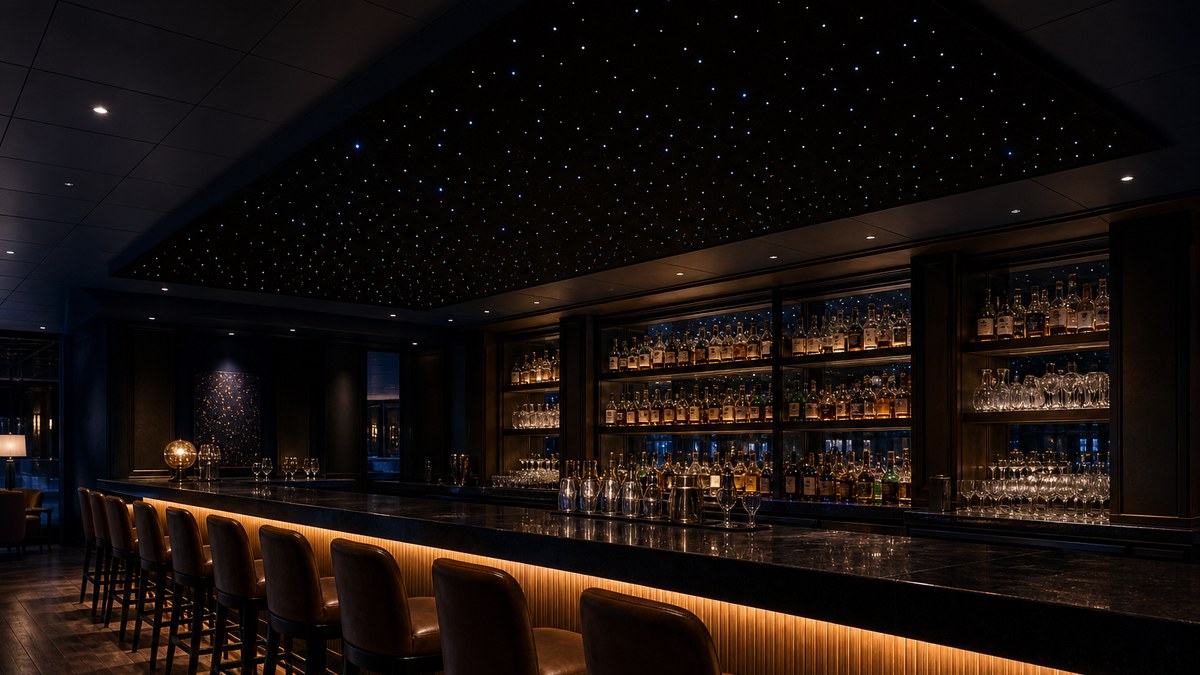
Many commercial interiors already use suspended ceilings, so star tiles are an efficient way to add atmosphere to a bar area, private dining room, lounge or hotel corridor without major construction. Zones work well here: a star field over the bar, a separate scene over seating, and plain tiles over service areas. Commercial projects need extra attention to plenum rules, fire ratings and maintenance access, and they often tie the engines into the venue's lighting control. For broader commercial lighting, see our commercial lighting services; for large hotel, venue and facade projects, our sister company WDM Lighting handles large projects.
Offices, wellness rooms and waiting areas
Offices and clinics are full of T-bar ceilings. A small star field over a break room, quiet room, spa treatment room or waiting area changes the feel of the space with minimal disruption, and every tile can still come out for building maintenance.
Effects and controls for a drop ceiling sky
Effects come from the light engine, not the tiles, so a drop ceiling sky can do everything a drywall sky can.
- Twinkle: mechanical twinkle wheels or electronic twinkle vary each star's brightness.
- Dimming: essential in theaters, bedrooms and lounges.
- Color: warm white, cool white, or RGB/RGBW engines for color scenes and slow color shifts.
- Shooting stars: a line of fibers lit in sequence; the path must be planned across tiles before they are built.
- Zones and scenes: separate engines for separate areas let a bar, lounge or theater run different looks.
- Control: handheld remote, wall control, app, or integration with lighting control and smart-home systems (including DMX in commercial settings).
Color changing star ceiling panels are popular in game rooms and bars; warm white with gentle twinkle is the usual choice for theaters and sleep spaces.
Common mistakes with drop ceiling star tiles
- Leaving the grid white: bright white tees outline every tile against a dark sky. Darken the grid or choose dark replacement tees.
- Repeating layouts: identical tiles side by side create an obvious pattern. Ask for varied layouts.
- Resting the engine on tiles: it loads the grid, blocks access and can cause tiles to sag or crack.
- Tails too short: measure the route from the farthest tile to the engine, including going around ducts, before ordering.
- Tight bends and pinched bundles: sharp bends and zip ties pulled too tight dim or damage fibers.
- Ignoring building rules: plenum, fire and sprinkler requirements matter in commercial spaces. Check first.
- Too much room light: stars disappear under bright fixtures. Put other lighting on dimmers or separate scenes.
What drives the quote for a drop ceiling star ceiling
Wiedamark LED is quote-only, because every ceiling is different. These are the factors that shape a drop ceiling star tile quote:
| Factor | How it affects the project |
|---|---|
| Number of star tiles | Full grid vs center field vs zones changes how many tiles and fibers are needed |
| Star density | More fibers per tile means a denser sky and more engine capacity |
| Fiber sizes and features | Mixed diameters, crystal or sparkle tips, Milky Way bands and constellations add detail |
| Effects | Twinkle, color, shooting stars and zones change the engine choice and count |
| Tile finish and acoustics | Acoustic or fabric-faced tiles differ from rigid tiles |
| Grid work | Repairs, a dark grid finish or a new grid add scope |
| Controls | Remote, wall control, app or integration with lighting and smart-home systems |
| Installation | DIY, your contractor, or a professional installer; commercial rules and after-hours work |
For general cost background, see what drives star ceiling pricing and our custom star ceiling cost factors. For your room, the fastest route is a project-specific quote.
Drop ceiling stars vs other ceiling types
If you are still choosing a ceiling type, here is how a T-bar star ceiling compares in practice. A drywall ceiling with attic access gives the most seamless sky but needs threading from above. A finished drywall ceiling with no access usually calls for surface-mounted panels or a build-down layer; our guide to a star ceiling without attic access covers six ways to do it. A drop ceiling sits between the two: access is built in and install is fast, and with a dark grid and good layouts it looks like a continuous sky once the lights are low.
DIY or professional install?
Drop ceiling star tiles are the most DIY-friendly star ceiling there is: if you can lift a ceiling tile and work safely on a ladder, you can set star tiles. The careful parts are supporting the engine, routing the tails neatly, mixing fibers for natural twinkle and dealing with power. A professional makes sense for large rooms, commercial spaces, multi-zone or color systems, hard-wired controls, or any project with plenum and fire requirements. For custom installation, our partner American Starlight Ceilings handles design and install, and our licensed installation partner has completed over 200 major sports and commercial projects across the US and Canada — NFL, NBA, NHL, MLS, NCAA and NASCAR.
Why plan your drop ceiling stars with Wiedamark LED
Wiedamark LED supplies fiber optic starlight ceiling components and kits, fiber optic lighting and commercial and architectural LED, with trade pricing for contractors, designers and integrators. Our team brings 15+ years as an authorized architectural lighting dealer and project coordinator. We help you confirm grid sizes, plan a star field that hides the grid, size fiber tails and light engines, and choose effects and controls before anything is ordered. Browse our gallery, read more on the Wiedamark LED blog, or call (702) 738-2218.
Frequently Asked Questions
Can you put a star ceiling in a drop ceiling?
What size are star ceiling tiles for a T-bar ceiling?
Do I need to drill holes in my existing ceiling tiles?
Where does the light engine go in a drop ceiling?
How do I stop the grid from showing in a star ceiling?
Can a drop ceiling hold star ceiling tiles?
Can I use star tiles in only part of my drop ceiling?
Are color changing star ceiling panels available for drop ceilings?
Can star ceiling tiles be used in commercial buildings?
How much do star ceiling panels for a drop ceiling cost?
Turn your T-bar ceiling into a night sky
Tell us the room size, your grid size, how much of the ceiling you want covered and the effects you like. We will plan the star tiles, fiber tails and light engines and send a project-specific quote.
Related
Our lighting network: starlight ceiling installation, 360° fiber optic lighting, premium pool lighting, WDM Lighting large projects, Dallas commercial LED lighting, Texas LED lighting, Plano LED lighting, LED signage, modular building solutions and Dallas modular structures.