Best Fiber Optic Star Ceiling Kit & Panels: A Buyer's Guide to Light Engines, Fiber Counts, Low Voltage & Color Changing Options
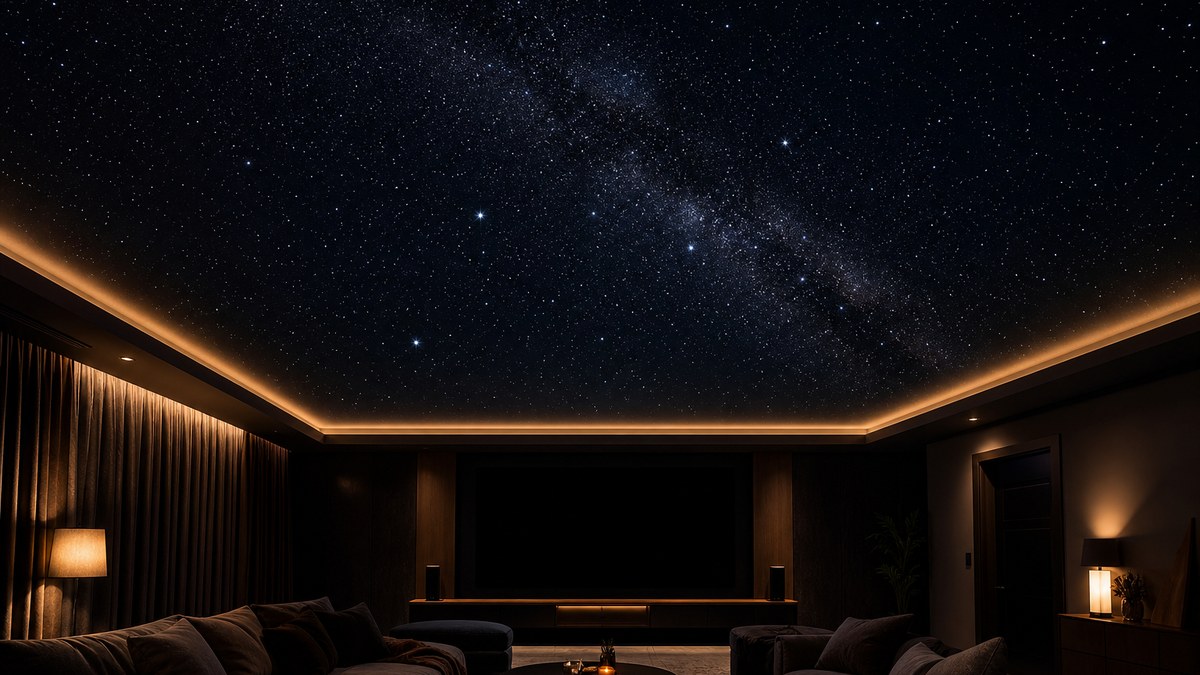
Searching for the best fiber optic star ceiling kit usually leads to the same thing: long "top 10" lists, star counts in bold, and very little explanation of why one system looks like a real night sky while another looks like a grid of dots. The truth is that there is no single best kit or panel for every room. The best star ceiling is the one whose light engine, fiber count, fiber mix, mounting system and controls match your ceiling, your room and the way you will actually use it.
This buyer's guide shows you how to judge any fiber optic star ceiling kit or set of star ceiling panels like a lighting professional. You will learn what the specifications on a product page really mean, how to read star ceiling panel reviews without being misled, when low voltage and color changing options are worth it, and which questions to ask before you buy. Wiedamark LED supplies starlight ceiling components and kits on a quote-only basis, so you will not find a price list here, just the criteria that decide whether a system is right for your project. If you are new to the topic, start with our complete starlight ceiling guide.
The best fiber optic star ceiling for your room is the one sized and specified for it. Judge any kit or panel system on these points, in this order:
- Light engine: LED source quality, quiet cooling, smooth dimming and a twinkle method you like
- Fiber count and coverage: enough strands for a natural density across the area you want starred
- Fiber diameter mix: several sizes for depth, not one size for every star
- Fiber length: long enough to reach every part of the ceiling from the engine location
- Mounting system: drill-through kit, pre-made panels, drop ceiling tiles or acoustic panels
- Color and controls: white only, RGB or RGBW color changing, remote, app, wall control or DMX
- Support: replaceable engines, available parts and someone to call when you need help
Why "best star ceiling" lists rarely help
Most ranking articles compare products the way you would compare phone chargers: wattage, star count, a star rating and a price. Those numbers are easy to print and easy to inflate, but they do not tell you how the ceiling will look at night. A few common problems with typical star ceiling kit reviews:
- Star count is not density. A kit with many strands spread across a large ceiling can look thinner than a smaller kit used in a small room. What matters is stars per area, not the total on the box.
- Wattage is not brightness. A bigger number on the engine says little about how efficiently light is coupled into the fibers or how bright each star will appear.
- Photos are not your room. Product images are often long-exposure photographs or renderings. Real stars look smaller and more subtle, which is usually a good thing.
- Reviews come early. Many reviews are written in the first week. Fan noise, color consistency and long-term reliability show up later.
- Car kits and room kits get mixed together. Many lists combine automotive headliner kits with kits for bedrooms and theaters, which have very different needs for fiber length, coverage and control.
Instead of chasing a ranking, use the criteria below. They work for any brand and any budget, and they are the same questions we ask when we specify components for a project.
Criterion 1: the light engine
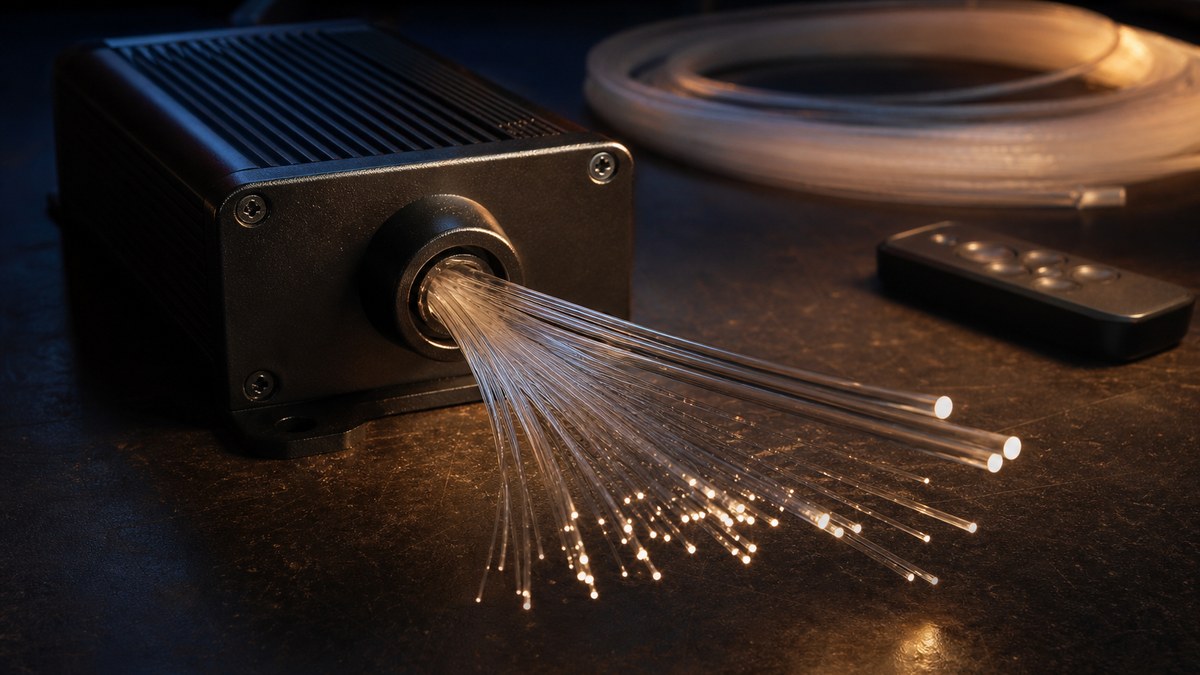
The light engine, also called an illuminator, is the box that holds the LED light source and the fiber harness. Every star on the ceiling is lit by it, so it has more influence on the final look than any other single component. If you want the full technical background, read how starlights and fiber optic light engines work. When you compare engines, look at:
Light source and color quality
Modern star ceiling engines use LED sources. Ask whether the engine is white only, RGB, or RGBW. A dedicated white channel in an RGBW engine usually produces a cleaner, more natural white than mixing red, green and blue, which matters if most of your evenings will be spent with a white or warm white sky. Ask what white tones are available, and whether you can see a sample or a video of the actual engine in a dark room.
Cooling and noise
Some engines are cooled by a fan, others rely on passive heat sinks. A fan is not a problem by itself, but in a quiet bedroom or a home theater even a soft hum can be noticeable. Ask how the engine is cooled, where it can be mounted, and what clearance and ventilation it needs. The best place for an engine is a ventilated, reachable spot such as an attic, a closet, a soffit with an access panel or an equipment rack, away from the listening position.
Twinkle method
Twinkle is created in one of two ways. A mechanical twinkle wheel spins in front of the light source and varies the light reaching different fibers; it can look organic but adds a moving part. Electronic twinkle varies LED output instead. Ask to see the twinkle speed range and whether it can be turned off. Many owners end up using a slow, subtle twinkle, or none at all, so the ability to tune it matters more than a dramatic demo.
Dimming
Smooth dimming down to a very low level is one of the most underrated features. A star ceiling looks best dim, and a bedroom sky often runs at a small fraction of full output. Check whether dimming is smooth or steps visibly, and whether the engine can be dimmed from the same control you will use for the rest of the room.
Serviceability
Because the fibers carry only light, the engine is the one part of the system that may need service. Ask whether the engine can be replaced without touching the ceiling, whether the fiber harness detaches cleanly, and whether replacement engines and parts are available. This single question separates a long-term system from a disposable one.
Criterion 2: fiber count, density and coverage
Each star is the polished end of one optical fiber, so the fiber count is the star count. The question is whether that count is enough for your ceiling. Too few stars and the ceiling reads as "lights in the ceiling"; a natural density reads as a sky.
- Start with the area you want starred, not the room. A tray ceiling may only need the recessed field. A theater may want extra density in a Milky Way band.
- Decide on the character of the sky. Bedrooms usually suit a calmer field; theaters and lounges often go denser.
- Plan for engines per area. Each engine can feed a limited bundle of fibers, so larger or denser ceilings may need more than one engine, or separate engines for effects such as shooting stars.
- Ask how the count is stated. Some listings count spare strands or count "stars" differently. Ask for the number of usable fibers in each diameter.
Our LED star ceiling lights guide shows how density changes the feel of bedrooms, theaters and basements.
Criterion 3: the fiber diameter mix
A real night sky is not uniform. A few stars are bright, many are medium and most are faint. Star ceilings recreate that depth by mixing fiber diameters: thicker fibers carry more light and appear as brighter stars, fine fibers create a haze of faint ones. A kit with a single diameter can look flat and regular, especially on a large ceiling. When you compare kits or panels, ask:
- How many diameters are included, and in what proportion?
- Are the brighter stars placed deliberately, or scattered at random?
- Is there an option for a denser band of fine fibers to suggest a Milky Way?
- Are crystal or faceted end fittings available for a few sparkle accents?
Diameter mix is one of the most cost-effective ways to make a ceiling look premium. It costs relatively little compared with adding more stars, yet it changes the realism dramatically. See the visual difference in our star light effects guide.
Criterion 4: fiber length and routing
Fiber length is easy to overlook and painful to get wrong. Every strand must run from the engine to its position on the ceiling, often with detours around joists, ducts and recessed lights. If the fibers are too short, the far corners of the room stay empty or the engine ends up in a poor location.
- Measure the distance from the planned engine location to the farthest corner of the starred area, then add allowance for routing and slack.
- Ask whether the fibers are all the same length or graduated, and whether custom lengths are available.
- Check the bend guidance. Fibers tolerate gentle curves; sharp kinks reduce light and can damage the strand.
- Plan the engine location first. A good location shortens runs, keeps noise away from the room and makes service easy.
Criterion 5: kit vs pre-made panels vs tiles
Many people searching for the best star ceiling panels are really deciding between three mounting systems. Each can produce a beautiful result; the right one depends on your ceiling and access.
| System | How it works | Best for | What to check |
|---|---|---|---|
| Drill-through fiber kit | Fibers are threaded from above through holes drilled in the existing ceiling, then trimmed flush | Seamless drywall skies with attic or open-joist access | Fiber length, diameter mix, access above, finish and paint plan |
| Pre-made star ceiling panels | Fibers are installed in panels before delivery; panels are mounted to the ceiling and connected to the engine | Theaters, media rooms, finished ceilings with no access | Panel sizes and seams, edge trim, how panels connect, layout across panels |
| Drop ceiling star tiles | Star tiles replace standard tiles in a suspended grid | Basements, offices and commercial grids | Tile size, grid compatibility, fiber routing above the grid |
| Acoustic star panels | Fabric-wrapped panels with stars that also absorb sound | Home theaters and listening rooms | Fabric color, acoustic core, fiber tips flush with fabric |
Our star ceiling panels guide compares panels and kits in detail, and if you have no access above the ceiling, read star ceiling without attic access first.
Criterion 6: low voltage star ceiling panels and power
"Low voltage" shows up often in searches for star ceiling panels, and it is worth understanding. In a fiber optic star ceiling, the fibers themselves carry only light. There is no electricity at the stars, which is one of the main reasons fiber is chosen for bedrooms, children's rooms, bathrooms and spas. The electricity stays at the light engine.
Many engines and panel systems are powered through a low-voltage power supply, which simplifies wiring at the engine location and can make it easier to coordinate with other low-voltage systems in the room. Whatever the system, the power connection for the engine should be planned with your electrician and installed to local code. When you compare products, ask:
- What power does the engine require, and does it plug in or need to be hard-wired?
- Where will the power supply live, and does it need ventilation?
- For panel systems, does any power run to the panels themselves, or only light through fibers?
- Can the system be switched or dimmed from an existing circuit or control?
Some products marketed as "star ceiling panels" are actually LED panels with small light points that carry electricity across the ceiling surface. They can work well, but they are a different technology from fiber optics. If no-electricity-at-the-ceiling matters for your room, confirm that the stars are fiber optic tips.
Criterion 7: color changing star ceiling panels and effects
Color changing star ceilings use RGB or RGBW engines to shift the sky through blues, purples, sunset tones or full color scenes. They are popular for media rooms, kids' rooms, bars and lounges. Before choosing color, think about how the room will be used most nights:
- White-first rooms: bedrooms and quiet theaters are often used in white or warm white most of the time. A high-quality white engine may serve you better than full color.
- Entertainment rooms: game rooms, bars and lounges benefit from color scenes, slow fades and party modes.
- RGBW over RGB: if you want both color and a clean white, the dedicated white channel matters.
- Separate effect zones: shooting stars, a Milky Way band or a perimeter horizon glow usually need their own engines or drivers.
Effects are where scope tends to grow. See what each effect involves in our custom star ceiling cost factors guide, which explains how effects change a quote.
Not sure which kit or panels fit your room?
Send us your ceiling dimensions, photos and the look you want. We will recommend the engine, fiber count, diameter mix and mounting system, then send a project-specific quote.
Criterion 8: controls and integration
The control method decides how often you will actually enjoy the ceiling. A remote that lives in a drawer leads to a sky that stays off. Options typically include:
- Handheld remote: simple and common in kits; check range and whether it needs line of sight to the engine.
- App control: convenient for scenes and timers; ask how the app connects and whether it works without an account.
- Wall control or keypad: the most natural for everyday use, especially in bedrooms.
- Integration: theaters and premium rooms often tie stars into a lighting control or smart-home system so the sky fades when the film starts. Commercial and architectural projects may use DMX control.
- Timer: a sleep timer is one of the most-used features in bedrooms and kids' rooms.
For theater-specific control ideas, read our home theater star ceiling design guide.
Criterion 9: support, parts and documentation
This is the criterion most often missing from fiber optic star ceiling reviews, and the one you will care about most a few years from now. Before you buy, ask:
- Is there a clear installation guide or layout plan for your ceiling type?
- Can you reach a person who knows the product if something goes wrong?
- Are replacement engines, remotes and power supplies available separately?
- Is the fiber harness compatible with a replacement or upgraded engine?
- What warranty applies, and who handles it?
The star ceiling buyer's checklist
Use this table to compare any two kits or panel systems side by side. If a supplier cannot answer a line, that tells you something too.
| Question | Why it matters | Good sign |
|---|---|---|
| White, RGB or RGBW engine? | Decides the quality of white and color | Clear spec and a real-room video |
| How is the engine cooled? | Noise in bedrooms and theaters | Stated cooling method and mounting guidance |
| Usable fibers per diameter? | Real density and depth | A breakdown, not just one big number |
| Fiber length? | Reaching every corner from a good engine spot | Length stated; custom lengths possible |
| Twinkle method and speed? | Subtle vs distracting sky | Adjustable and can be turned off |
| Dimming range? | Stars look best dim | Smooth to a very low level |
| Mounting system? | Fit with your ceiling and access | Options for drywall, panels or tiles |
| Power requirements? | Planning with your electrician | Clear power spec at the engine |
| Control options? | Everyday use | Remote plus wall, app or integration options |
| Replaceable engine and parts? | Long-term ownership | Engine swaps without opening the ceiling |
Matching the system to the room
Bedrooms
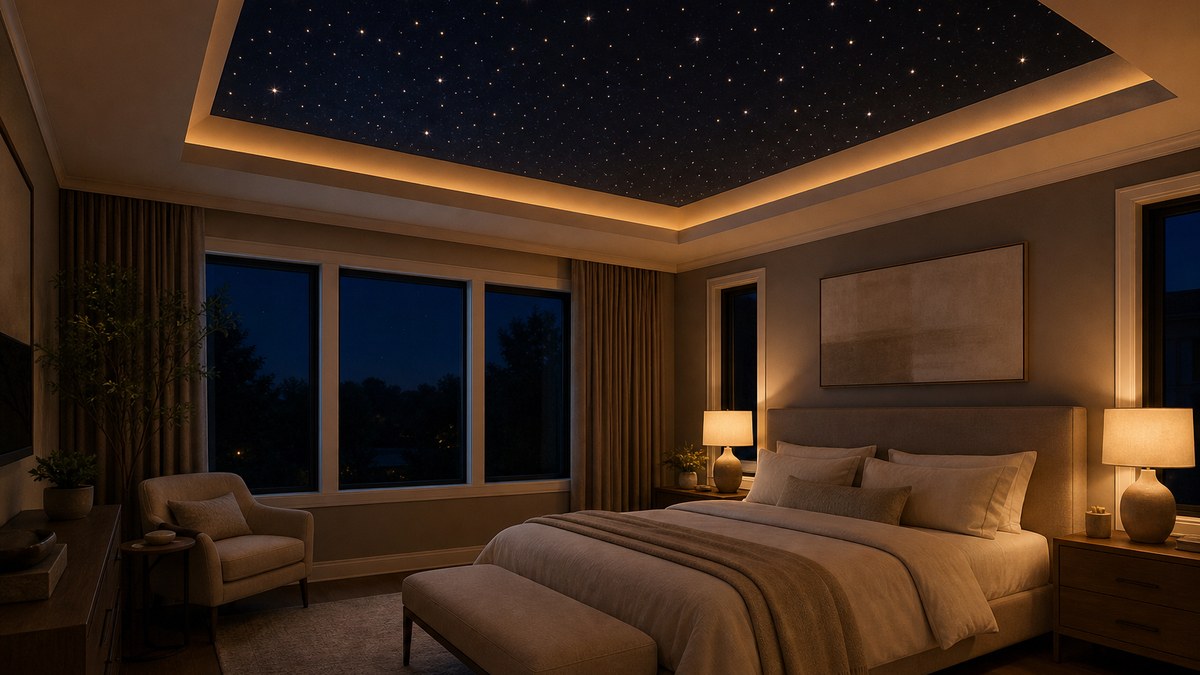
Prioritize a quiet engine placed away from the bed, natural density, a good diameter mix, warm white or soft blue, slow or no twinkle, smooth dimming and a sleep timer. A drill-through kit with attic access gives the most seamless look. Ideas and layouts are in our star light bedroom ceiling guide.
Kids' rooms and nurseries
Fiber optics are a natural fit because there is no electricity at the ceiling. Choose a simple control a parent can use in the dark, a timer, and a calm color palette. Constellations are a popular personal touch.
Home theaters and media rooms
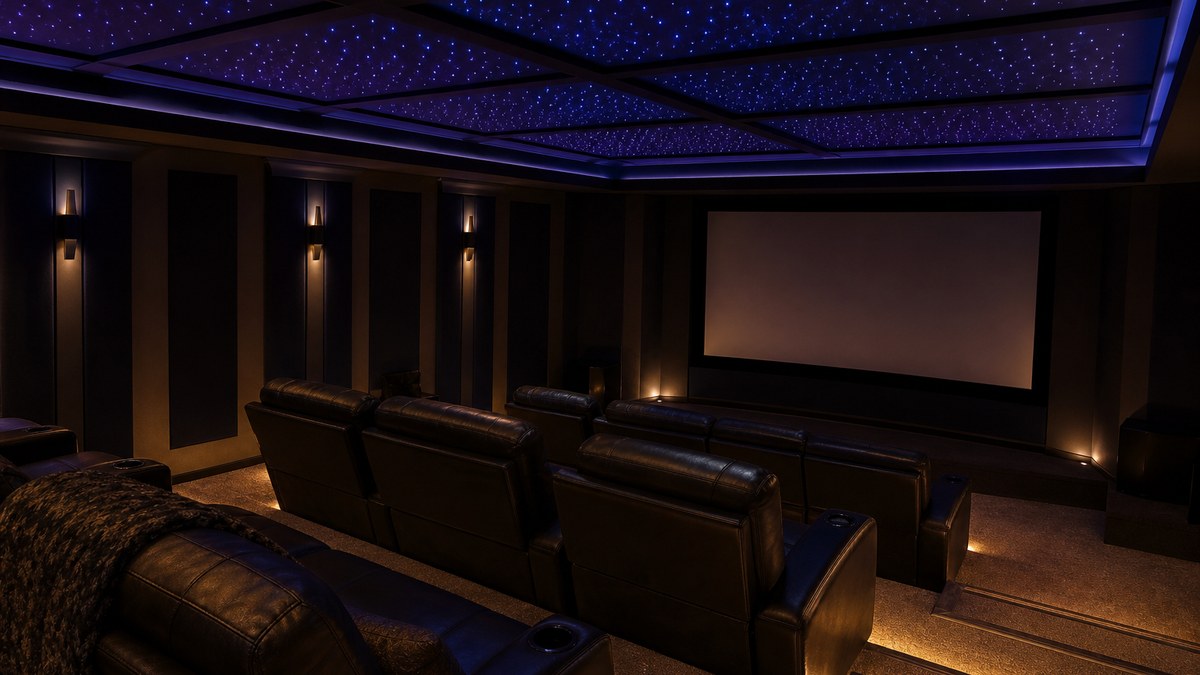
Look for acoustic star panels or drill-through stars combined with acoustic treatment, a quiet engine in the equipment area, a denser field with a Milky Way band, shooting stars kept away from the screen and integration with the theater controls. Basements have their own considerations, covered in our basement home theater star ceiling guide.
Basements and drop ceilings
Drop ceiling star tiles or panels are often the simplest route, and open joists make fiber routing easy. See the options in our basement ceiling star lights guide.
Home gyms, game rooms and bars
Color changing engines, brighter scenes and app or wall control suit active rooms. A star ceiling over a home gym or bar works best with a clear way to switch between a bright working scene and a dim night sky.
Spas and bathrooms
Fiber carries no electricity into the wet area. Plan moisture-appropriate ceiling materials and a dry, ventilated, accessible location for the engine outside the wet zone.
Restaurants, bars and commercial spaces
Commercial projects need durable engines, controls staff can operate, larger coverage and often DMX integration. Our commercial and architectural LED page covers what we supply for trade clients, and for large hospitality and venue projects our sister company WDM Lighting handles project-scale lighting.
Red flags when reading star ceiling panel reviews
- Only a star count and wattage are listed. No diameter breakdown, fiber length or engine details.
- Photos look like a galaxy poster. Long exposures and renderings set expectations no real ceiling meets.
- Every review is from the first week. Look for comments on noise, color and reliability over time.
- Car headliner kits sold as room kits. Short fibers and small engines rarely cover a full room well.
- No mention of the engine location. If the listing does not discuss where the engine goes, routing and noise were probably not considered.
- No way to reach support. A kit with no documentation or contact is hard to fix when something goes wrong.
Common buying mistakes and how to avoid them
- Buying too few stars. Adding stars later usually means reopening the ceiling. Size the fiber count for the area first.
- Choosing color over white quality. If most nights will be white, prioritize a clean white channel.
- Ignoring the engine location. Plan where the engine will live, how it is ventilated and how you will reach it.
- Skipping the dark ceiling finish. A deep navy or black ceiling makes every star read sharper.
- Forgetting controls. If the sky is hard to turn on, it will not get used.
- Underestimating installation. Read our star ceiling installation guide and the DIY star ceiling kit guide before deciding who installs.
Fiber optic kit vs LED panels vs projectors
Some buyers comparing kits are still deciding between technologies. Fiber optic stars give pinpoint points of light with no electricity at the ceiling and no projector shadows. LED panels with integrated light points are another approach. Plug-in galaxy projectors are inexpensive and portable but cast a pattern that falls on walls, furniture and people. Our comparison of a fiber optic star ceiling vs LED projector walks through the trade-offs, and what LED star light ceilings are and how they work explains the basics.
What to send for an accurate component recommendation
Because the best system depends on the room, the fastest way to the right components is to give a supplier the details up front:
- Room dimensions and ceiling height, plus the area you want starred.
- Ceiling type: flat, tray, vaulted, drop ceiling, open joists or a finished ceiling.
- Access above the ceiling and possible engine locations.
- Photos of the ceiling, the room and the access space.
- The look you want: density, white or color, twinkle, Milky Way, shooting stars, constellations.
- Your preferred system: drill-through kit, pre-made panels, tiles or acoustic panels.
- Controls: remote, wall control, app, smart-home or theater integration, DMX.
- Who will install: you, your contractor or integrator, or a referral to an installer.
For a general look at what drives pricing, see what drives star ceiling cost.
Why choose components from Wiedamark LED
Wiedamark LED supplies fiber optic starlight ceiling components and kits, fiber optic lighting and commercial and architectural LED, with trade pricing for contractors, designers and integrators. Our team brings 15+ years as an authorized architectural lighting dealer and project coordinator. We help you size the engine, fiber count and diameter mix for your ceiling rather than selling a one-size-fits-all box. When you need custom installation, we work with American Starlight Ceilings. Our licensed installation partner has completed over 200 major sports and commercial projects across the US and Canada — NFL, NBA, NHL, MLS, NCAA and NASCAR.
Explore our starlight ceiling products, our full product range, the project gallery, the Luminance design-build program and the rest of the Wiedamark LED blog.
Frequently Asked Questions
What is the best fiber optic star ceiling kit?
Are star ceiling panels better than a fiber optic kit?
How many stars do I need for a star ceiling?
What are low voltage star ceiling panels?
Are color changing star ceiling panels worth it?
What is the difference between RGB and RGBW star ceiling engines?
How do I read fiber optic star ceiling reviews?
Is a fiber optic star ceiling safe for a child's bedroom?
Can I replace the light engine later?
Does Wiedamark LED sell star ceiling kits and components to contractors?
Get the right components the first time
Tell us about your ceiling and the sky you want. We will recommend the engine, fibers and mounting system and send a project-specific quote, or schedule a call.
Related
Our lighting network: starlight ceiling installation, 360° fiber optic lighting, premium pool lighting, WDM Lighting large projects, Dallas commercial LED lighting, Texas LED lighting, Plano LED lighting, LED signage, modular building solutions and Dallas modular structures.