Starlight Ceiling: The Complete Guide to Fiber Optic Star Ceilings, Design, Components & Installation
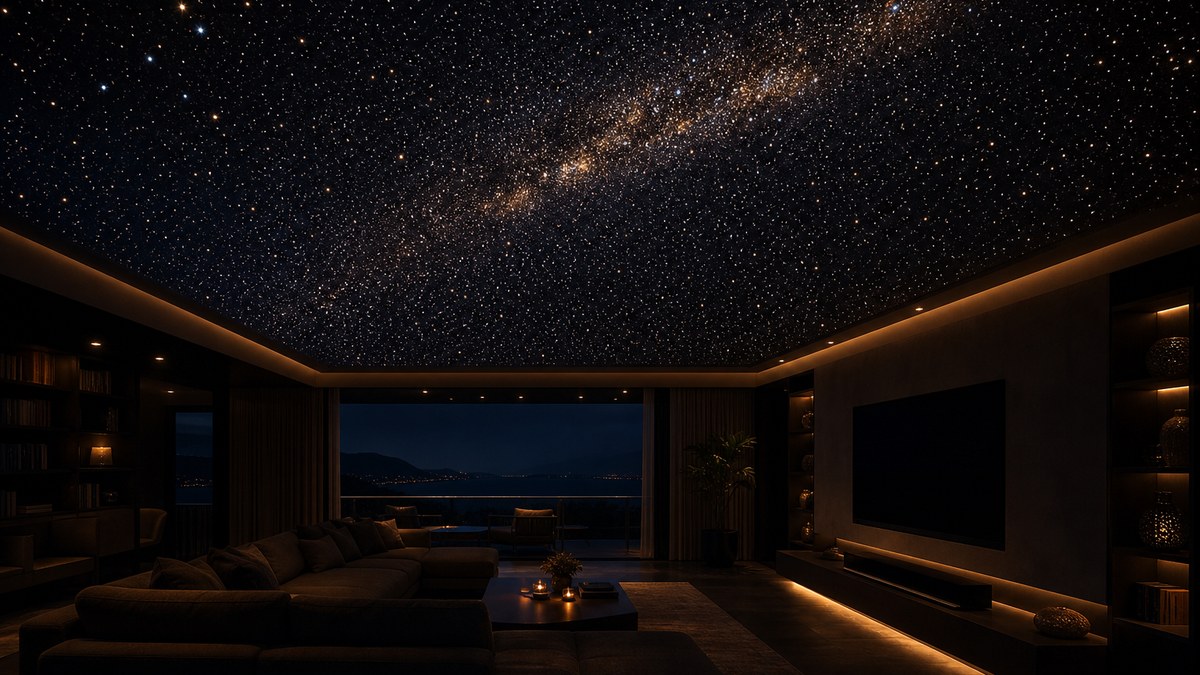
A starlight ceiling is a ceiling fitted with hundreds or thousands of tiny points of light that recreate a real night sky. Most permanent starlight ceilings use fiber optics: a hidden LED light engine sends light through thin strands, and the tip of each strand glows as a single star in the ceiling. Done well, the effect is calm, deep and surprisingly realistic, which is why star ceilings show up in home theaters, bedrooms, basements, spas, restaurants, lounges and luxury cars.
This is our pillar guide to the star ceiling. It covers what a starlight ceiling is, how the parts work together, the different ways to build one, how to design a sky that looks real rather than "dots on a ceiling," what to plan room by room, how installation works, and how to choose components. If you are a homeowner, designer, AV integrator or contractor planning a starlight project, start here and then follow the links to our deeper guides.
A starlight ceiling (also called a star ceiling or starry sky ceiling) uses fiber optic strands fed by an LED light engine to place pinpoint stars across a ceiling. Mixed fiber sizes create bright and faint stars, and effects such as twinkle, shooting stars, color and a Milky Way band make it feel like a real sky.
- Core parts: light engine, fiber optic harness, ceiling surface (drywall, panels, tiles or stretch fabric), controls
- Build options: fibers in an existing ceiling, pre-made star panels, star drop-ceiling tiles, stretch ceilings, DIY kits
- Why fiber optics: no electricity or heat at the stars, sharp pinpoints, the light source can be serviced without touching the ceiling
- Best spaces: home theaters, bedrooms, kids' rooms, basements, spas, restaurants, bars and hotel spaces
- Pricing: project-specific, driven by ceiling size, star density, effects and installation method — request a quote
What is a starlight ceiling?
"Starlight ceiling," "star ceiling," "starry sky ceiling" and "fiber optic star ceiling" all describe the same idea: a ceiling that becomes a convincing night sky. The look depends on three things the eye uses to recognize stars outdoors. First, stars are points, not blobs, so each light source has to be very small. Second, stars vary in brightness, with a few bright ones and many faint ones. Third, stars shimmer slightly as the atmosphere moves, which is what the twinkle effect imitates.
Fiber optics handle all three well. A fiber tip in a ceiling is a tiny, crisp point of light. Using several fiber diameters creates natural variation in brightness. And because every fiber is fed by the same light engine, the engine can add twinkle, slow color changes and dimming across the whole sky at once.
Not every product sold as "star ceiling lights" works this way. Plug-in projectors shine a pattern onto the ceiling, and some LED fixtures use small lenses that read as little lamps. Those have their place, and we compare them in our LED star ceiling lights guide, but when people talk about a true starlight ceiling, they almost always mean fiber optics.
How a fiber optic star ceiling works
Every fiber optic starlight ceiling has the same building blocks, whether it covers a small bedroom or a large commercial lounge.
The light engine
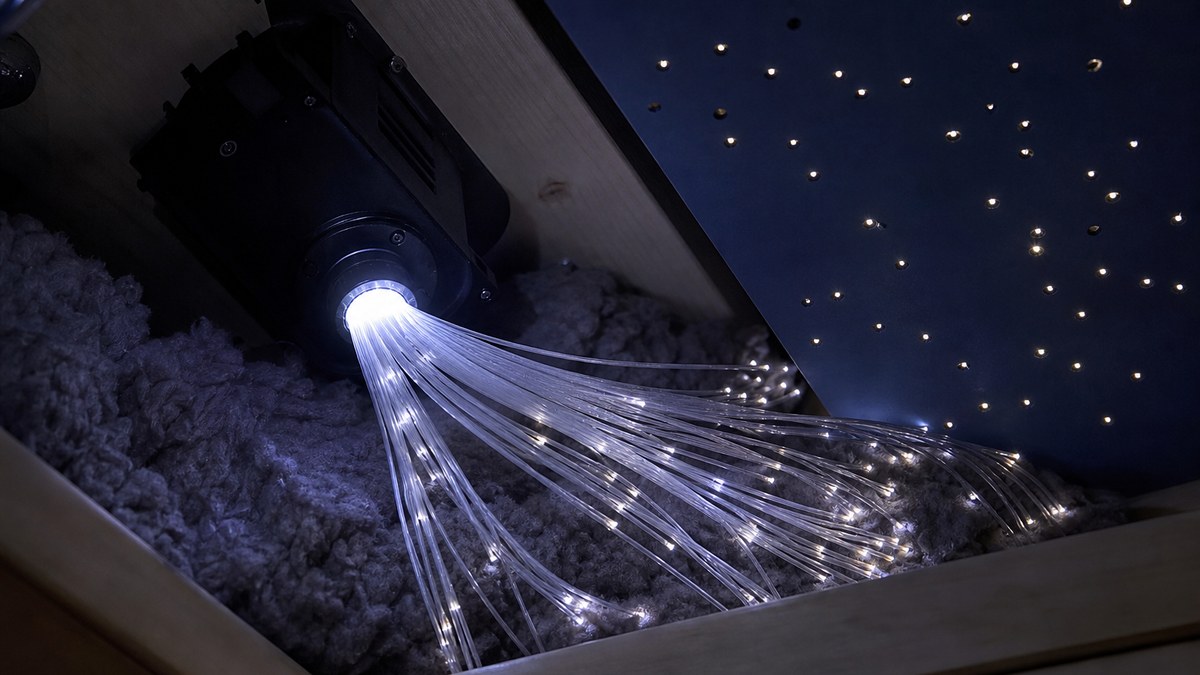
The light engine (also called an illuminator or light source) is a box that contains an LED, optics that focus light into the fiber bundle, and the electronics or mechanics that create effects. It sits out of sight: in an attic, a closet, a soffit, above a drop ceiling or in an equipment rack. Engines differ in brightness, color capability (white, RGB or RGBW), how many fibers they can feed, whether they use a fan, and how they are controlled. Large ceilings often use several engines, each feeding its own zone.
The fiber optic harness
The harness is the bundle of individual fibers that runs from the engine to the ceiling. At the engine end, the fibers are gathered into a common end fitting that locks into the engine's port. At the ceiling end, each fiber is loose so it can be pushed through its own hole. Fibers are commonly made of acrylic (PMMA) plastic, with glass fiber used in some premium and high-temperature applications. A harness that mixes several diameters gives you bright anchor stars, medium stars and a field of faint background stars.
The ceiling surface
The fibers end in a surface that hides everything behind it: painted drywall, acoustic or decorative star panels, drop-ceiling tiles, wood or stretch fabric. A dark finish, such as deep navy or black, makes the stars stand out and hides the small holes when the stars are off.
Controls and effects
Controls range from a simple handheld remote to wall keypads, apps, smart-home integration and DMX for commercial lighting systems. Common effects include twinkle, shooting stars (a short run of fibers lit in sequence), color changes and fades, and slow dimming at bedtime. In theaters the starlight ceiling usually ties into the room's scene control so the sky dims when the film starts.
The fibers carry only light. There is no wiring or heat at the ceiling surface, which is why fiber optic stars are a good match for bathrooms, steam rooms, saunas and pool houses, provided the light engine is mounted in a dry, ventilated location outside the wet area.
Ways to build a star ceiling
There is no single "right" construction method. The best one depends on the ceiling you have, whether there is access above it, the size of the room and how much on-site work you want.
| Method | How it works | Good for | Things to plan |
|---|---|---|---|
| Fibers through existing drywall | Holes drilled in the ceiling, fibers fed from the attic and trimmed flush | Rooms with attic access above; bedrooms, theaters | Attic work, careful hole layout, painting before or after |
| Second ceiling layer | A thin new layer (board or panels) installed below the existing ceiling with fibers behind it | Finished ceilings with no access above | Slightly lower ceiling height, trim details |
| Pre-made star panels | Panels arrive with fibers already installed, mounted like ceiling panels | Theaters, media rooms, faster installs | Panel layout, seams, engine location |
| Star drop-ceiling tiles | Tiles with fibers replace standard grid tiles | Basements, offices, commercial spaces with grid ceilings | Grid condition, tile size, engine above the grid |
| Stretch ceiling with stars | Fibers pass through a tensioned fabric or film membrane | Large, curved or commercial ceilings | Specialist installation, perimeter track |
| DIY fiber optic kit | A light engine and fiber harness installed by the owner | Kids' rooms, small bedrooms, accent ceilings | Patience, fiber length, attic comfort |
For a deeper look at effects such as twinkle, shooting stars and Milky Way bands, see our star light effect ceiling guide. For the basics of the technology, read what LED star light ceilings are and how they work.
Designing a sky that looks real
The difference between a beautiful starlight ceiling and a disappointing one is almost never the hardware. It is the design. These principles come up on nearly every project.
Vary star size and brightness
A real sky has very few bright stars and a huge number of faint ones. Use a small share of larger fibers for anchor stars, more medium fibers, and many fine fibers for the background. A ceiling with only one fiber size looks flat and artificial, no matter how many stars it has.
Randomize, then cluster
Grids and evenly spaced patterns are the fastest way to ruin the illusion. Lay stars out randomly, then let some areas grow denser and others thin out, the way the sky looks away from city lights. Many installers mark the ceiling with a loose pattern before drilling so the density stays natural.
Add a Milky Way band
A soft diagonal band of dense, faint stars instantly reads as "night sky." It works especially well in theaters and long rooms, where the band can run corner to corner. Some designs add a subtle glow or very fine fiber clusters inside the band for depth.
Shuffle the fibers
Fibers that sit next to each other in the bundle tend to twinkle together. Mixing fibers from different parts of the harness before they reach the ceiling makes neighboring stars twinkle independently, which looks far more natural.
Choose the right color temperature
Warm white feels cozy and residential, cool white feels crisp and astronomical, and a soft blue-white is popular in bedrooms and theaters. RGB and RGBW engines add color scenes, which are fun for kids' rooms and hospitality spaces, but most owners end up using a natural white sky most of the time.
Personalize with constellations
Constellations, a sky map from a birthday or wedding date, or the night sky over a favorite place make the ceiling personal. Keep constellations subtle: slightly brighter fibers, not lines or outlines, so they reward people who look for them without dominating the room.
Frame the sky
Tray ceilings, coves and floating "cloud" panels give the starfield edges. A soft perimeter glow from hidden LED strip lighting creates a horizon effect and helps the room feel finished when the stars are dimmed.
Planning a starlight ceiling with Wiedamark LED?
Send us the room size, ceiling type and the effects you want. We will recommend components, a kit or an installation partner and follow up with a project-specific quote.
Starlight ceiling ideas by room
Home theaters and media rooms
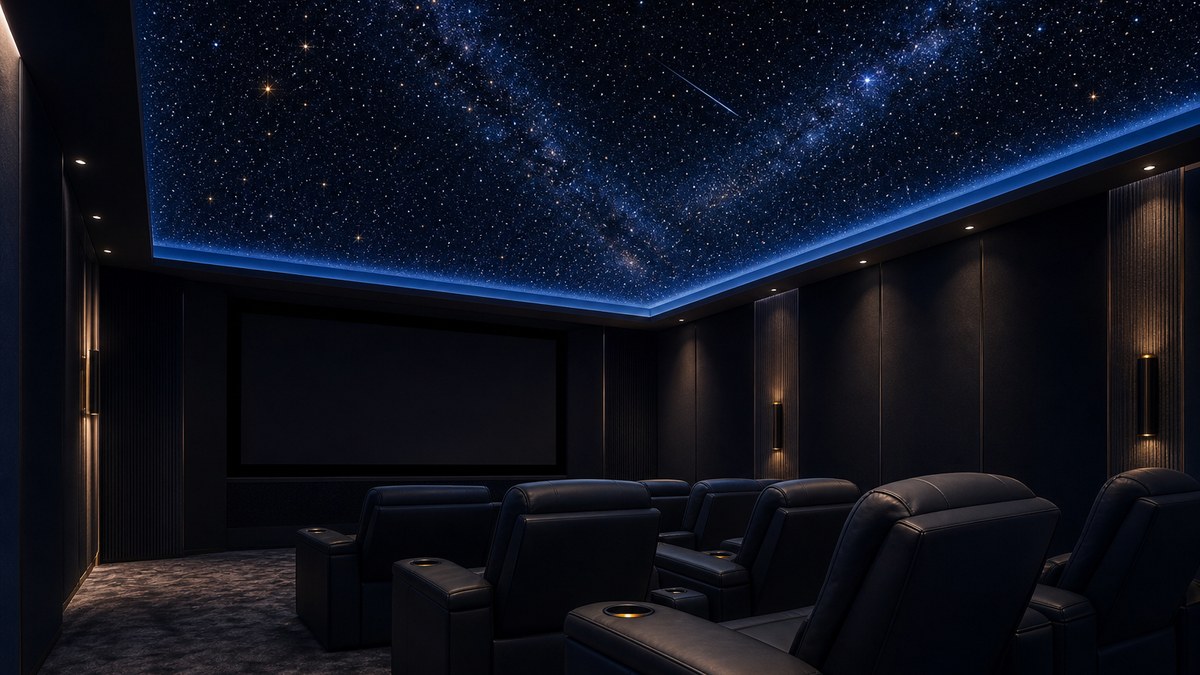
The home theater is the classic starlight ceiling. Go denser than you would in a bedroom, use a wide mix of fiber sizes, add a Milky Way band and keep shooting stars away from the screen area so they do not distract during a film. Acoustic star panels add sound absorption, and integrating the light engine with the theater's control system lets the sky dim automatically. Keep the light engine quiet or out of the room: fan noise is noticeable in a quiet theater.
Bedrooms and master suites
A star light bedroom ceiling should feel restful. Choose a natural, moderate density, warm or soft blue-white tones and a slow twinkle, with a remote or wall control by the bed and a timer that fades the sky after you fall asleep. Over a bed, a framed section of stars in a tray ceiling can look more elegant than covering the entire ceiling.
Kids' rooms and nurseries
Kids love shooting stars and color. Keep brightness low enough to act as a nightlight, and keep the light engine, cords and controls out of reach. A DIY fiber optic kit or a small star panel is often enough for a child's room.
Basements
Basements are ideal for star ceilings because they often have drop ceilings or open joists. Star tiles can replace standard grid tiles, and open joists make it easy to route fibers before drywall goes up. In a finished basement with no access above, a second ceiling layer or surface-mounted star panels avoid opening the existing ceiling.
Bathrooms, spas, saunas and pool houses
Fiber optic stars suit wet and warm rooms because the stars themselves carry no electricity. Place the light engine outside the wet area in a dry, ventilated spot, use fibers suited to the temperature of the space, and follow local electrical codes. In saunas and steam rooms, confirm the fiber and ceiling materials are rated for the heat and humidity.
Restaurants, bars, lounges and hotels
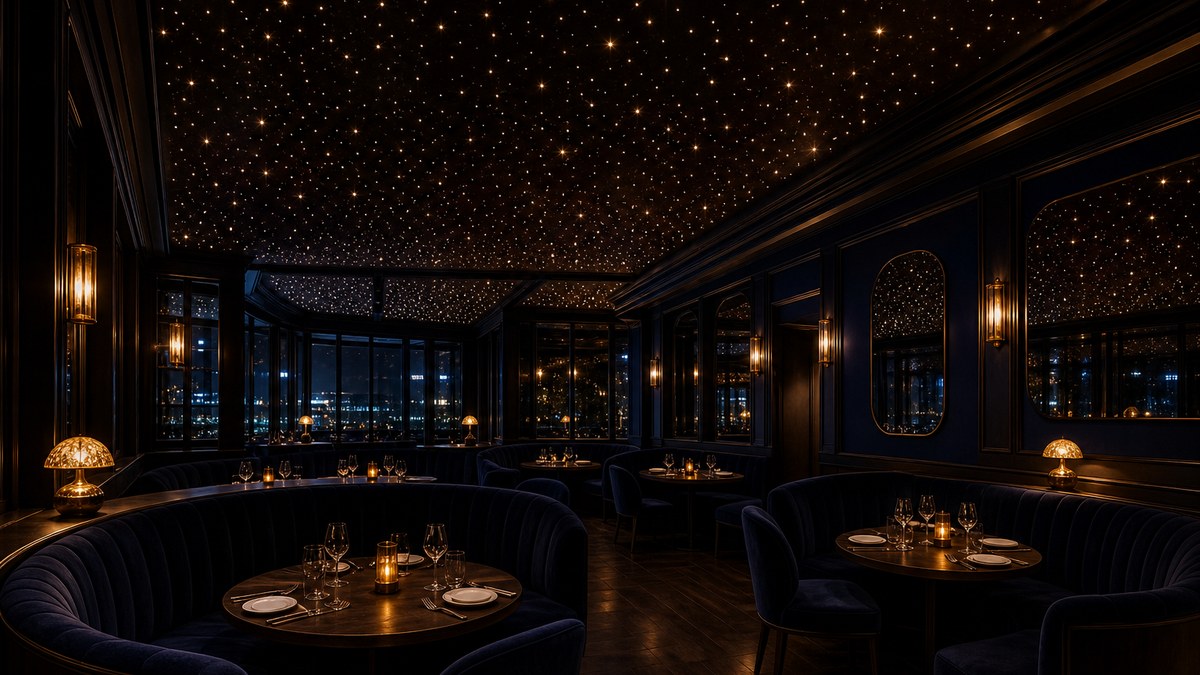
Commercial starlight ceilings create a signature atmosphere. Plan for larger areas split into zones, color scenes for different times of day, controls that staff can use without training, and coordination with fire, building and accessibility codes. Our partners at American Starlight Ceilings handle custom installations, and for whole-building and facade lighting our sister company WDM Lighting takes on large projects. See our commercial and architectural LED services for more.
Vehicles, yachts and specialty spaces
The same fiber optic principle is used in vehicle headliners, yacht cabins, wine cellars, chapels and event spaces. These projects have their own constraints, such as vibration, curved surfaces and tight access, so they benefit from a short planning conversation before ordering components.
How a starlight ceiling is installed
Installation steps vary by method, but a fiber optic star ceiling in an existing room usually follows this sequence:
- Survey the space: measure the ceiling, check access above (attic, joists, drop ceiling), find a location for the light engine and confirm power.
- Design the layout: decide star density, fiber size mix, constellations, Milky Way band, shooting star paths and effect zones.
- Size the system: match the number of fibers and the fiber lengths to the engine (or engines) and the route from the engine to the farthest stars.
- Mount the light engine: accessible for service, dry, ventilated and within reach of the harness.
- Mark and drill: small holes sized to each fiber diameter, following the randomized layout.
- Feed and shuffle the fibers: push fibers through from above (or into panels), mixing fibers from across the bundle.
- Secure the harness: support runs, avoid sharp bends and keep fibers away from heat sources and foot traffic in the attic.
- Trim, test and tune: trim fibers flush with the ceiling, power up, then set brightness, twinkle speed, color and effects.
Pre-made star panels and star tiles move most of the fiber work off-site, so the on-site job looks more like installing ordinary ceiling panels plus the light engine. For a closer look at what affects budget, read our guide to what drives star ceiling cost.
DIY kit or professional installation?
DIY fiber optic kits work well for small rooms if you are patient, comfortable in an attic and happy to spend time on layout. The most common DIY problems are running out of fiber length to reach far corners, using a single fiber size, drilling in a visible pattern and placing the engine where it is hard to service.
Professional installation is the better route for home theaters, large or vaulted rooms, finished ceilings without access, stretch ceilings, constellation mapping, Milky Way bands, multi-zone systems and any commercial space. A professional team also handles electrical connections, code requirements and clean fiber terminations. Our licensed installation partner has completed over 200 major sports and commercial projects across the US and Canada — NFL, NBA, NHL, MLS, NCAA and NASCAR.
| Question | Lean DIY | Lean professional |
|---|---|---|
| Room size | Small bedroom or kids' room | Theater, large or vaulted room |
| Access above | Easy attic or drop ceiling | Finished ceiling, no access |
| Effects | Twinkle, basic color | Shooting stars, Milky Way, constellations, zones |
| Controls | Remote | Theater, smart-home or DMX integration |
| Space type | Residential | Commercial, hospitality, wet areas |
Choosing starlight ceiling components
Light engine
Confirm the engine is rated for the number of fibers you plan to use, offers the effects you want, runs quietly enough for the room, and fits the control system you have in mind. For large ceilings, several engines on separate zones give more even brightness and more design flexibility than one oversized source.
Fiber harness
Ask for a mix of diameters and lengths that reach the farthest part of the ceiling with some slack. Measure the actual route through the attic or ceiling cavity, not just the room dimensions.
Ceiling materials
Choose the surface for the room: painted drywall for a seamless look, acoustic panels for theaters, grid tiles for basements and offices, and moisture-appropriate materials for spas and bathrooms.
Controls
Decide early how the sky will be operated. A remote is fine for a kids' room; a theater or restaurant usually needs wall controls, scene integration or DMX so the starlight ceiling works alongside the rest of the lighting.
Support
Buy from a supplier that helps size the system before you order and can supply replacement engines, extra fibers and add-ons later. Wiedamark LED brings 15+ years as an authorized architectural lighting dealer and project coordinator to component selection for contractors, designers and owners.
Care and maintenance
- Dust the ceiling occasionally with a soft brush or a vacuum on low; avoid soaking the surface.
- Keep the light engine's vents clear and the area around it dry and ventilated.
- If the stars dim or an effect stops, check the light engine and controls first; the fibers have no bulbs.
- When working in the attic later, avoid stepping on, crushing or sharply bending the fiber harness.
- Keep a note of the engine model and fiber layout so future service or expansion is simple.
Why work with Wiedamark LED
Wiedamark LED supplies fiber optic starlight ceiling components and kits, fiber optic lighting, and commercial and architectural LED products for contractors, designers, integrators and owners nationwide. We help you choose the right construction method, size the light engines and fiber harnesses, and plan effects and controls. For custom installation we work with American Starlight Ceilings, and for pools and architectural outlines see 360° fiber optic lighting.
Explore our starlight ceiling products, browse all product categories, see project inspiration, read about our Luminance design-build service, or visit fiber optic and architectural lighting on our commercial page. More guides are on the Wiedamark LED blog.
Frequently Asked Questions
What is a starlight ceiling?
How does a fiber optic star ceiling work?
Is a star ceiling the same as a starlight ceiling?
Can you add a starlight ceiling to an existing room?
Are fiber optic star ceilings safe in bathrooms and saunas?
How many stars does a starlight ceiling need?
Can a starlight ceiling change color or twinkle?
Should I install a star ceiling myself?
How much does a starlight ceiling cost?
Where can I buy starlight ceiling components?
Put a real night sky overhead
Tell us about the room, the ceiling and the effects you want, and we will follow up with component recommendations and a quote.
Related
Our lighting network: starlight ceiling installation, 360° fiber optic lighting, premium pool lighting, WDM Lighting large projects, Dallas commercial LED lighting, Texas LED lighting, Plano LED lighting, LED signage, modular building solutions and Dallas modular structures.