How Do Starlights Work? Fiber Optic Light Engines, Twinkle Wheels & Star Ceiling Illuminators Explained
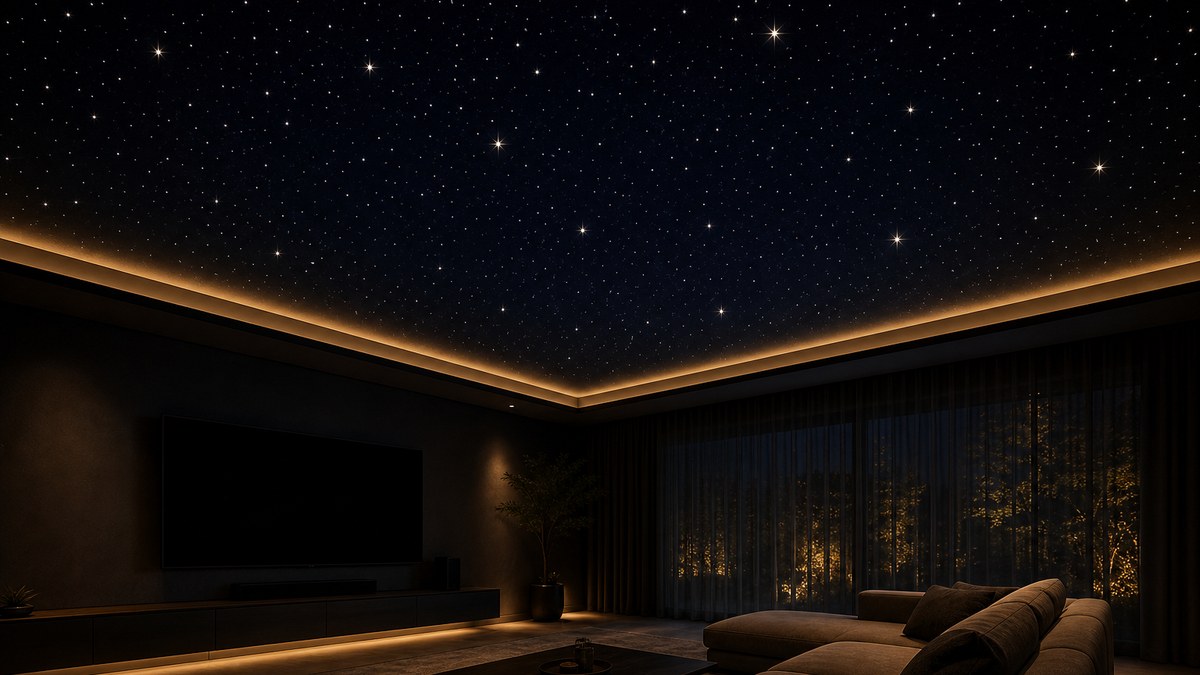
How do starlights work? A starlight ceiling looks like hundreds of tiny lights scattered across the ceiling, but in most professional systems there are no bulbs in the ceiling at all. Every star is the polished tip of a thin fiber optic strand, and every strand is lit by one hidden box called a light engine (also called an illuminator, light source or driver). Understand the light engine and you understand the whole star ceiling.
This guide goes one level deeper than our introduction to what LED star light ceilings are and how they work. It focuses on the part most buyers never see: what happens inside a fiber optic light engine, how twinkle is actually made, how color and dimming work, how one engine is matched to a fiber count and ceiling size, where the engine should live, and what to check before you choose one. It is written for homeowners, designers, AV integrators and contractors who want to buy the right components the first time.
Starlights work by sending light from one LED light engine through a bundle of fiber optic strands. Light travels down each fiber by total internal reflection and exits at the trimmed tip in the ceiling, which you see as a single star.
- Light engine: an LED source, a lens or mixing chamber, a fiber port, a driver and a cooling system, usually with a remote or control input
- Fibers: acrylic (PMMA) or glass strands in several diameters, so stars vary from bright to faint
- Twinkle: made by a rotating twinkle wheel in front of the LED, or electronically by varying the LED output
- Color: RGB, RGBW or tunable white LEDs mix colors at the source, so every fiber changes together
- No electricity at the ceiling: only light reaches the stars, which is why fiber starlights suit spas, bathrooms and pool houses
- Serviceable: the engine is the part that can be replaced; the fibers in the ceiling stay put
The three parts of every starlight system
Whether it is a small DIY kit over a child's bed or a large commercial ceiling, a fiber optic starlight system has the same three building blocks. Our complete starlight ceiling guide covers design and installation in detail; here is the short version as a foundation for the rest of this article.
- The light engine. A compact enclosure with an LED light source, optics, electronics and cooling. It sits out of sight in an attic, closet, soffit, equipment rack or above a drop ceiling.
- The fiber harness. A bundle of fiber optic strands gathered into a common end (a ferrule or collar) at one end and loose at the other. The common end plugs into the engine's port; the loose ends fan out across the ceiling.
- The ceiling surface. Drywall, acoustic panels, star tiles, stretch fabric or a wood plank ceiling. Each fiber passes through a small hole and is trimmed flush with the surface, so only its glowing tip is visible.
Everything you see as a "star" is created by the engine and delivered by the fiber. The ceiling itself is just the canvas.
How light travels through a fiber
A fiber optic strand is a flexible, transparent core surrounded by a material with a lower refractive index (the cladding). When light enters the end of the fiber at a shallow enough angle, it hits the boundary between core and cladding and reflects back inward instead of escaping. This is called total internal reflection, and it repeats along the entire length of the strand, bouncing the light from the engine to the ceiling with very little leaking out the sides.
Three practical consequences follow from this physics:
- The tip is the star. Light only exits where the fiber ends, so a clean, flat cut gives a crisp pinpoint. A ragged or crushed tip scatters light and looks dim or fuzzy.
- Diameter controls brightness. A thicker fiber accepts and carries more light, so it produces a brighter star. Mixing several diameters is the single most important trick for a realistic sky.
- Length and bends cost light. Every meter of fiber and every tight bend loses a little light. Very long runs and sharp kinks produce weaker stars at the far end, which is why engine placement matters.
Acrylic (PMMA) vs glass fibers
Most residential and many commercial star ceilings use end-glow PMMA (acrylic) fiber. It is flexible, easy to cut with a hot knife or sharp blade, forgiving to install and well suited to the short-to-medium runs of a typical room. Glass fiber transmits light very efficiently and holds up well in demanding environments, but it is usually supplied in factory-made harnesses and needs more careful handling. For most star ceilings, acrylic fiber in a mix of diameters is the practical choice.
End-glow vs side-glow
Starlights use end-glow fiber, which emits light only at the tip. Side-glow fiber is designed to leak light along its length and glows like a neon line. Side-glow is used for outlines, coves, pool perimeters and architectural accents rather than stars. If you are planning both, our fiber optic lighting page covers the architectural side.
Inside a fiber optic light engine
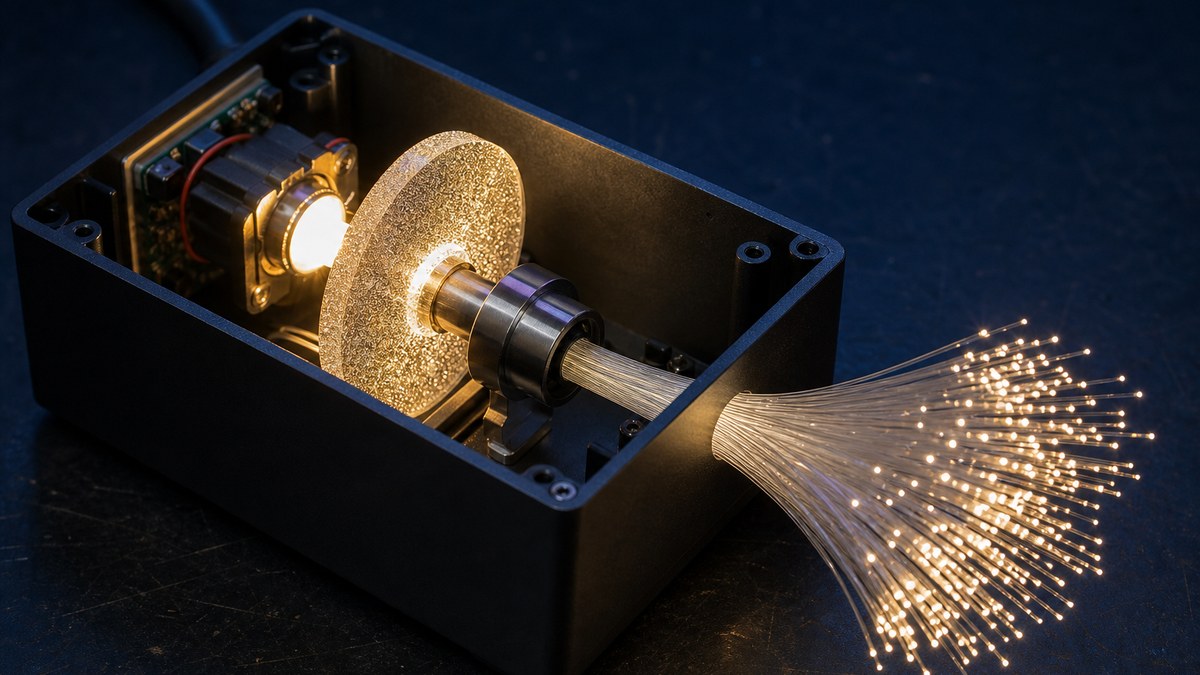
A light engine looks like a plain metal or plastic box with a power cord and a hole for the fiber bundle. Inside, it does five jobs.
1. The LED light source
Modern starlight engines use a high-output LED chip or a cluster of LEDs aimed at the fiber port. Older systems used halogen or metal halide lamps, which ran hot and needed regular lamp changes; LED sources run cooler, start instantly, dim smoothly and make color changing practical. When people search for "starlight LED lights" or "LED starlight," this is usually what they mean: an LED engine driving fiber stars, not LED bulbs in the ceiling.
2. Optics: lens or mixing chamber
Light from the LED has to be concentrated evenly across the face of the fiber bundle. A lens, reflector or mixing rod focuses it onto the common end so fibers in the center and at the edge of the bundle receive similar light. In color-changing engines, the optics also blend the red, green, blue and white LEDs so every fiber shows the same mixed color instead of separate colored dots.
3. The fiber port
The port is a socket sized for the harness's common end. A set screw or clamp holds the bundle at the correct distance from the light source. Some engines have one port; others have two or more so one engine can feed several harnesses, or a separate port for a shooting star or Milky Way harness. Port size is one of the first things to match when choosing components, because the bundle has to fit and sit at the right depth to be fully lit.
4. The driver and controller
The electronics convert line power to the low-voltage DC the LEDs need and control brightness, color and effects. This is where the remote control receiver, app connection or wired control input (such as a DMX, 0–10V or contact-closure input on some commercial engines) connects. The controller is also what runs electronic twinkle, color fades and timers.
5. Cooling
LEDs are efficient, but a high-output chip in a small box still produces heat, and heat shortens the life of LEDs and electronics. Engines are cooled by heat sinks, small fans or both. Fan-cooled engines need free airflow; fanless engines rely on larger heat sinks and are often preferred for bedrooms and theaters where any hum matters. Either way, the engine needs ventilation, not a sealed cavity packed with insulation.
How the twinkle effect is made
Twinkle is what turns "dots on a ceiling" into a sky that feels alive. There are two ways to create it.
Mechanical twinkle wheel
A twinkle wheel is a slowly rotating disc, often textured or patterned glass or plastic, mounted between the LED and the fiber port. As it turns, it varies how much light reaches different parts of the bundle, so individual fibers brighten and dim at different moments. Because the variation is spread across the bundle, neighboring stars twinkle out of sync, which looks natural. The wheel's speed is usually adjustable. A twinkle wheel adds a small motor, so its quietness is worth checking for bedrooms and theaters.
Electronic twinkle
Some engines create twinkle by modulating the LEDs themselves, and some multi-channel engines drive separate LED zones aimed at different parts of the bundle. Electronic twinkle has no moving parts, which can mean quieter operation and less to wear out, but the effect depends on how many independent zones the engine has. With only one zone, all stars pulse together, which reads as flicker rather than twinkle.
Why fiber shuffling matters
Whichever method the engine uses, the installer has to shuffle the fibers: mix strands from the center and edges of the bundle before spreading them across the ceiling. If fibers from one section of the bundle all land in one corner, that corner will twinkle in unison. Good shuffling is free and makes a bigger difference to realism than almost any upgrade.
| Feature | Twinkle wheel | Electronic twinkle |
|---|---|---|
| How it works | Rotating disc varies light across the bundle | LED output modulated by the controller, ideally in several zones |
| Look | Random, organic, star-by-star variation | Natural when multi-zone; uniform pulsing if single-zone |
| Moving parts | Small motor and wheel | None |
| Noise | Check motor and fan noise for quiet rooms | Usually quieter; fan noise still possible |
| Speed control | Typically adjustable | Typically adjustable, plus patterns |
| Best for | Classic star ceilings, theaters, bedrooms | Integrated control systems, color scenes |
How color, dimming and special effects work
White, warm white and tunable white
A white engine produces one color temperature: cool white for a crisp, blue-white sky or warm white for a softer, candle-like glow. Tunable white engines blend warm and cool LEDs so you can shift between them. For bedrooms, many people prefer warmer tones; for theaters and "deep space" looks, cooler white often reads as more realistic.
RGB and RGBW color
RGB engines mix red, green and blue LEDs to produce a range of colors. RGBW engines add a dedicated white LED, which gives cleaner whites and pastel tones than mixing RGB alone. Because color is mixed at the engine, every fiber on that harness changes color together. If you want some stars white while others shift color, you need a second engine and harness for that zone.
Dimming
Brightness is controlled at the engine, by remote, app, wall control or an automation system. Dimming matters more than most people expect: stars that look perfect in a dark theater can feel too bright in a bedroom at 2 a.m. Plan for a control you can reach easily, and consider a timer or scene that fades the stars down.
Shooting stars and Milky Way effects
Shooting stars are usually a separate harness: a line of fibers laid along a path and lit in sequence by a dedicated sequencing engine, so a point of light appears to streak across the ceiling. Milky Way bands are typically made with a denser cluster of fine fibers, sometimes on their own engine so the band can be dimmed independently. Both effects are planned at the design stage because the fibers have to be routed before the ceiling is closed. Our starlight effects guide walks through every effect and where it works best.
Not sure which light engine fits your ceiling?
Send us the room size, ceiling type and the effects you want. We will recommend matched engines and fiber harnesses and follow up with a project-specific quote.
Matching a light engine to fibers and ceiling size
The most common starlight problem is not a bad engine; it is a mismatched system. One engine can only light so much fiber well. Overload it and every star gets dimmer; stretch fibers too far and the far corners fade. These are the variables to balance.
Fiber count and total bundle size
Each engine is designed for a bundle of a certain size. What matters is not just the number of strands but their total cross-section: a few thick fibers can fill the port as quickly as many fine ones. Manufacturers rate engines by the bundle diameter or fiber mix they can light properly. Stay within that rating.
Mix of diameters
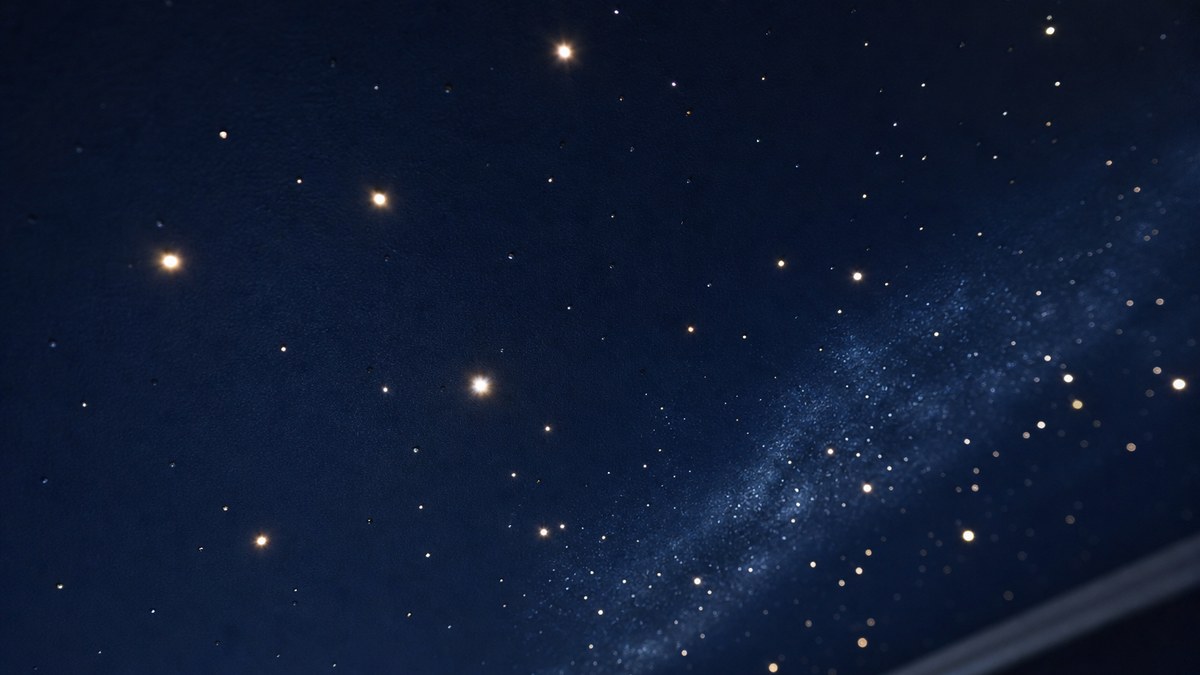
A realistic sky uses many fine fibers for faint background stars, a moderate number of medium fibers, and a small number of thick fibers for bright "anchor" stars. Because thick fibers use more of the port, the diameter mix and the engine rating need to be planned together.
Fiber length and engine placement
Measure the real route from the engine to the farthest star, including the path through joists, around ducts and down any soffit, then allow extra. On large ceilings, it is often better to use two or more engines placed in different locations than to run very long fibers from one central box. Multiple engines also let you create zones, such as a brighter Milky Way area or a separate color zone.
Ceiling height and room use
Higher ceilings need brighter stars to read clearly from the floor; low basement ceilings can look busy if stars are too bright or dense. Bedrooms usually call for a calm, moderate density; theaters and lounges can go denser. For room-by-room ideas, see our star light bedroom ceiling guide, our home theater star ceiling design guide and our basement ceiling star lights guide.
| Planning question | Why it matters | What to tell your supplier |
|---|---|---|
| Ceiling size and shape | Sets fiber count, layout and whether one engine is enough | Room dimensions, flat, vaulted, tray or cloud |
| Ceiling type and access | Decides drilling from above, star panels or a second layer | Attic, drop ceiling, open joists or finished with no access |
| Engine location | Determines fiber length and ventilation | Where a dry, ventilated, reachable spot exists |
| Effects | May need extra harnesses or engines | Twinkle, color, shooting stars, Milky Way, constellations |
| Controls | Affects engine type and inputs | Remote, app, wall control, smart home or theater system |
| Room use | Guides brightness, density and noise limits | Bedroom, theater, basement, spa or commercial space |
Where the light engine should live
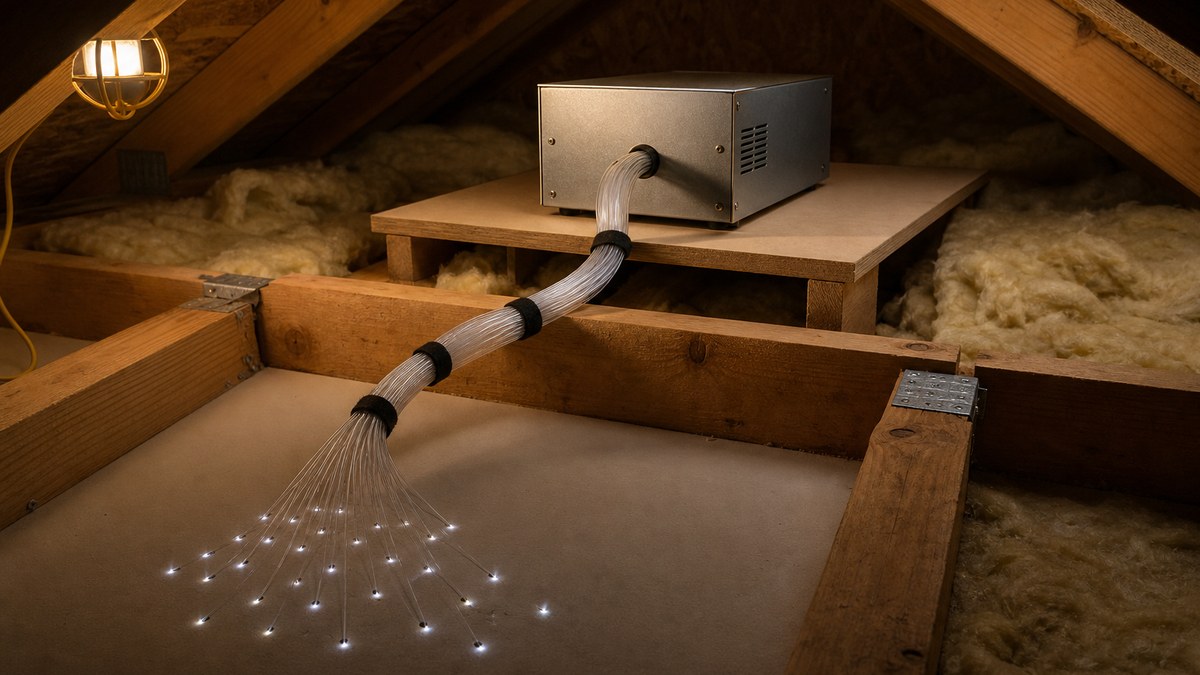
Engine placement affects brightness, noise, service and safety. Good locations share four traits:
- Dry. Keep the engine away from moisture. In bathrooms, steam rooms, saunas and pool houses, the engine belongs outside the wet area; only the fibers enter the humid space.
- Ventilated. Leave clear airflow around vents and heat sinks. Do not bury the engine in loose insulation or seal it in a tight cavity.
- Reachable. You will want to adjust settings, replace a remote receiver or swap the engine someday. A closet shelf, access panel, equipment rack or drop-ceiling tile is ideal.
- Close to the ceiling area. Shorter fiber runs mean brighter, more even stars. Central placement over the starfield is usually best, or several engines for large areas.
In bedrooms and theaters, also think about sound. A fan or twinkle motor that is inaudible in an attic can be noticeable if the engine sits in a closet next to the bed or in the theater's equipment wall. Isolating the engine on a soft pad and keeping it away from return-air paths helps.
Most residential light engines plug into a standard outlet. Adding an outlet, hard-wiring an engine or installing in a commercial space should be done by a licensed electrician following local codes, and commercial ceilings must also meet fire and building code requirements for the ceiling materials used.
Fiber optic starlights vs LED "star" products
Because "starlight" is used for many products, it helps to know how fiber systems compare with the alternatives you will see in search results.
- LED star panels: panels with fibers or micro-LEDs pre-installed. They still need a light source or power supply, but the fiber work is done before they arrive, which suits drop ceilings and finished ceilings without access.
- Plug-and-play kits: a matched engine and pre-bundled harness sold together. They are a practical way to do a small room, and "plug and play" usually means the engine plugs into an outlet and the harness drops into the port. The ceiling work is still drilling, threading and trimming. Our DIY star ceiling kit guide walks through it step by step.
- LED strips and mini downlights: each "star" is a small light fixture, so the points are larger and the ceiling carries electrical components.
- Projectors: no installation, but the stars are projected light that softens with distance and washes out in room light.
For a side-by-side comparison of these options, see our LED star ceiling lights guide.
Signs a light engine needs attention
Because the fibers have no bulbs, most starlight problems trace back to the engine, the connection at the port or the fiber tips. A quick troubleshooting order:
- All stars out: check power, the outlet or breaker, and the remote or control signal before anything else.
- All stars dim: check the dimming setting and scene, then confirm the bundle is fully seated in the port. Overheating from blocked vents can also cause some engines to reduce output.
- Color looks wrong or uneven: confirm the color mode, then check whether the bundle has slipped in the port, which can change how the color mix lands on the fibers.
- Twinkle stopped: check the twinkle setting; on wheel-type engines, a stalled motor can stop the effect while light still passes.
- Individual stars missing: a fiber may be broken, crushed or pulled back from the surface. These are usually local fixes and do not involve the engine.
- New noise: fans and twinkle motors can collect dust. Cleaning vents often helps; if not, the engine can be serviced or replaced.
Because the engine sits in an accessible spot, replacing it does not mean touching the ceiling. That is one of the biggest long-term advantages of fiber optic starlights.
What to check before choosing a light engine
- Port and bundle fit: the harness common end matches the engine port, and the bundle size is within the engine's rating.
- Light source type: white, warm white, tunable white, RGB or RGBW, chosen for the room and look.
- Twinkle method: wheel or electronic, and whether electronic twinkle has enough zones to look natural.
- Noise: fan and motor sound for bedrooms and theaters.
- Controls: remote, app, wall control or integration inputs for smart-home and theater systems.
- Cooling and mounting: space and ventilation where it will be installed.
- Expandability: whether you can add a second engine, a shooting star harness or a Milky Way zone later.
- Support: a supplier who can match components, answer installation questions and supply replacement engines.
If you are pricing a project, our guide to what drives star ceiling cost explains how engine count, fiber count, effects and installation affect a quote.
Why source starlight components from Wiedamark LED
Wiedamark LED supplies fiber optic starlight components and kits, fiber optic lighting and commercial and architectural LED products, with trade support for contractors, designers and AV integrators. We help you match light engines, harnesses and effects to the room before you order, so the system arrives balanced. Our team brings 15+ years as an authorized architectural lighting dealer and project coordinator.
For custom installation, we work with American Starlight Ceilings. For large hospitality, venue and facade projects, our sister company WDM Lighting takes on whole-building lighting. Our licensed installation partner has completed over 200 major sports and commercial projects across the US and Canada — NFL, NBA, NHL, MLS, NCAA and NASCAR. See our commercial and architectural LED services, browse starlight ceiling components, or learn about our Luminance design-build program.
Frequently Asked Questions
How do starlights work?
What is a fiber optic light engine?
How does the twinkle effect work on a star ceiling?
Is there electricity in a fiber optic star ceiling?
Why are some stars brighter than others?
How many fibers can one light engine power?
Where should the light engine be installed?
Can starlights change color?
Are LED starlights the same as fiber optic starlights?
Where can I buy a star ceiling light engine and fiber harness?
Get a matched starlight system for your room
Tell us your ceiling size, access and favorite effects. We will recommend light engines, fiber harnesses and controls, then follow up with a quote.
Related
Our lighting network: starlight ceiling installation, 360° fiber optic lighting, premium pool lighting, WDM Lighting large projects, Dallas commercial LED lighting, Texas LED lighting, Plano LED lighting, LED signage, modular building solutions and Dallas modular structures.