Basement Ceiling Star Lights: How to Plan a Star Ceiling for Drop Ceilings, Open Joists & Finished Basements
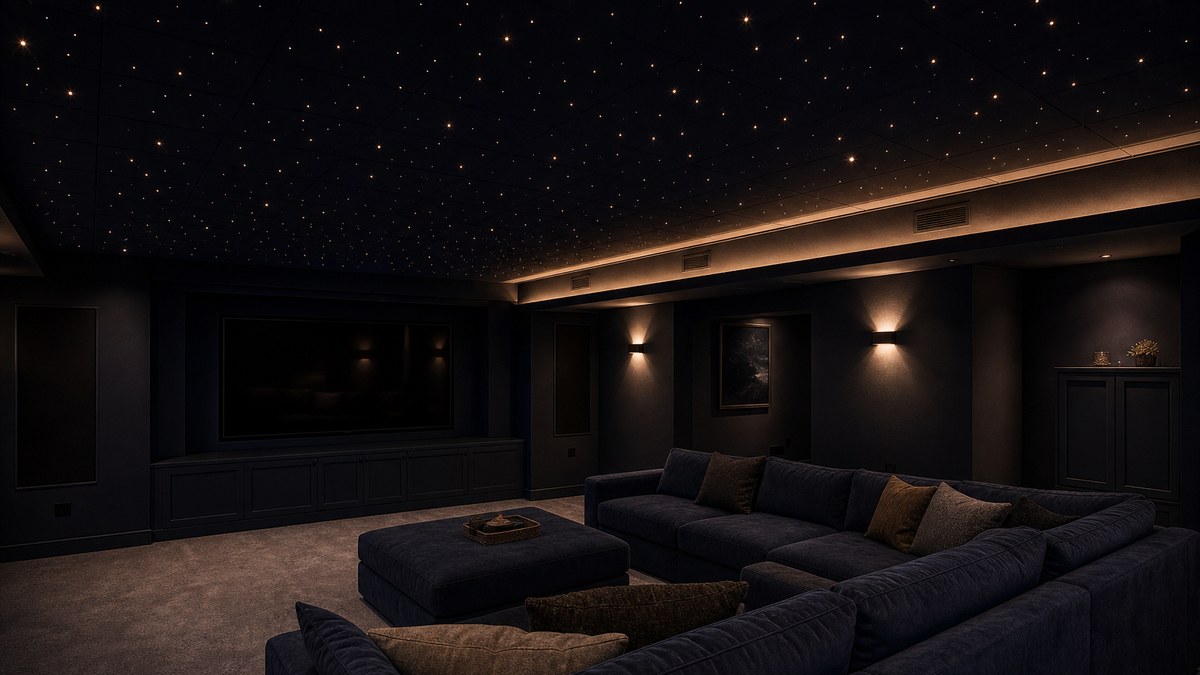
Basement ceiling star lights are one of the best upgrades you can make to a lower level. Basements are naturally dark, often have a drop ceiling or open joists overhead, and are usually where the home theater, game room or guest suite lives. All of that makes a basement the easiest room in the house to turn into a convincing night sky.
But basements also have their own challenges: low ceiling heights, ductwork and beams, sump pumps and dehumidifiers, and the occasional damp corner. This guide walks through how a basement star ceiling works, which installation method fits each type of basement ceiling, how to plan the layout around soffits and bulkheads, what to do about moisture, and how to get components or an installation partner. It is written for homeowners finishing a basement, remodelers and contractors, and theater and AV integrators.
The best basement ceiling star lights are fiber optic star lights: one LED light engine, hidden in a utility room or above the ceiling, feeds many fiber strands whose tips become pinpoint stars. How you install them depends on your ceiling.
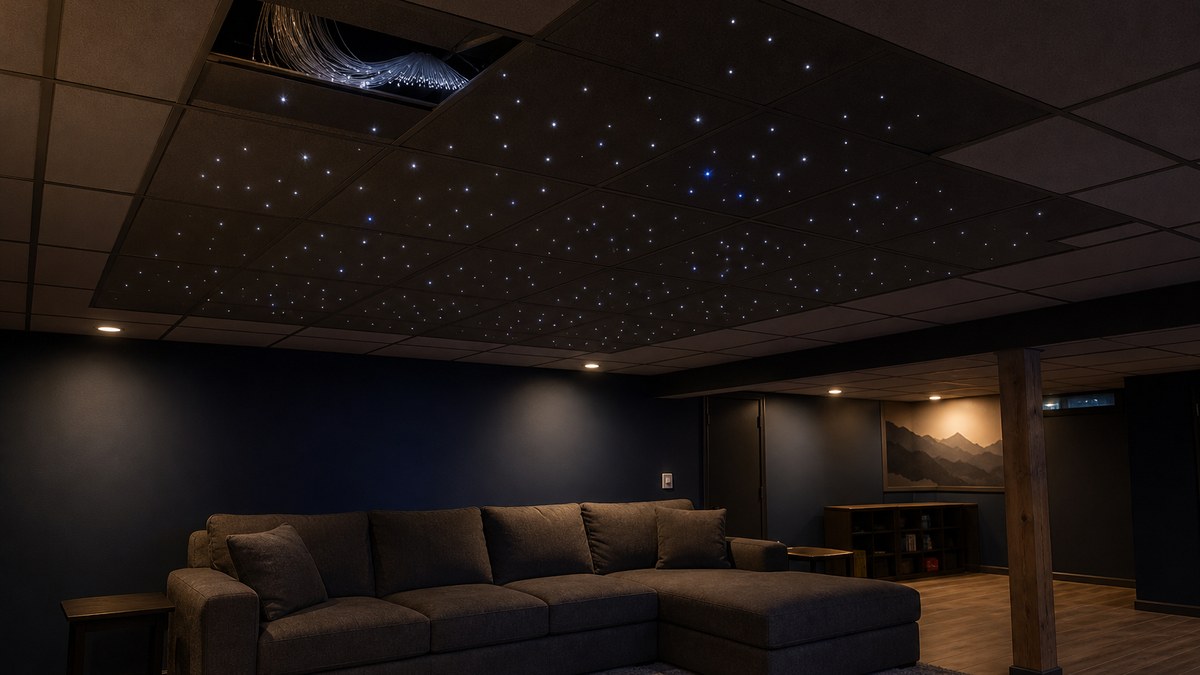
- Drop (suspended) ceiling: swap standard tiles for fiber optic star tiles, or drill your own tiles and thread fibers from above
- Open joists (unfinished): run fibers between joists before drywall goes up; the easiest time to install
- Finished drywall, no access: use surface-mounted star panels or a floating star "cloud" panel
- Low ceilings: fiber stars add no depth and look great at close range; keep density natural and brightness low
- Moisture: fibers carry no electricity; keep the light engine in a dry, ventilated, accessible spot
- Pricing: project-specific; depends on ceiling area, method, star density and effects. Request a quote.
Why basements are perfect for star ceilings
A star ceiling only looks real when the room is dark, and basements have little or no daylight. A few small window wells are easy to cover with blackout shades, so the stars read clearly even in the afternoon. That is the opposite of a sunny upstairs bedroom, where stars only come alive late at night.
Basements also tend to have the most forgiving ceilings for installation. Many have a suspended grid that lifts out tile by tile, or open joists that leave the whole cavity exposed. With access from above, a fiber optic installer can drill, thread and secure fibers without cutting into finished drywall from a ladder for hours.
Finally, the basement is where people go to relax: home theaters, media rooms, game rooms, bars, gyms, kids' play spaces and guest suites. A night sky overhead changes the feel of all of them, and it hides a plain or busy ceiling better than almost any other finish. If you are new to the idea, our complete starlight ceiling guide covers the basics of design and components, and how LED star light ceilings work explains the technology.
How basement star lights work
Nearly every permanent star ceiling uses fiber optics. The system has three parts:
- Light engine (illuminator): an LED light source that powers every star and holds the effects, such as twinkle, color change, dimming and shooting stars. In a basement it usually lives in the mechanical room, a storage closet or above the drop ceiling.
- Fiber optic strands: thin acrylic (PMMA) fibers in several diameters that carry light, not electricity, from the engine to the ceiling. Thicker fibers make bright "anchor" stars; thinner fibers make faint background stars.
- Ceiling surface: drop ceiling tiles, drywall, acoustic panels or stretch fabric. Each fiber passes through a small hole and is trimmed flush so its tip glows as a single point.
Because there is no voltage or heat at the ceiling, fiber stars suit basements that also house bathrooms, wet bars, saunas or home gyms. The light engine is the only part that needs power, ventilation and service access. For a look at the full range of effects, from twinkle to shooting stars and Milky Way bands, see our star light effects guide.
Choosing a method by basement ceiling type
The single biggest factor in a basement star ceiling is what is above your head right now. Here is how each common basement ceiling is handled.
1. Drop ceilings (suspended grid)
Drop ceilings are the most common finished basement ceiling, and they are the easiest to convert. Standard grids use 2x2 or 2x4 foot tiles that lift out, which gives you complete access to the space above. You have two options:
- Pre-made fiber optic star tiles: tiles with fibers already installed, sized to drop into a standard grid. You remove the old tile, set in the star tile, route its fiber tail to the light engine and you are done. This is the fastest route and keeps the work clean.
- Drill your own tiles: with a fiber optic kit, you can drill small holes in your existing (or new) tiles and thread fibers from above. Choose dense mineral-fiber or vinyl-faced tiles that drill cleanly, and pick a dark tile color so the holes disappear.
Mixing star tiles with plain tiles lets you create a "window" of sky over a seating area while leaving the rest of the room standard. Many basement theaters do exactly that: a field of star tiles over the seating, plain tiles near the screen and the bar.
One detail to watch: the metal grid is visible between tiles. Black grid and dark tiles make the sky continuous. White grid with dark star tiles reads as a checkerboard, so plan to paint or replace the grid if you want an uninterrupted sky.
2. Open joists (unfinished basements)
If your basement is unfinished, you are in the best possible position. Before drywall or ceiling panels go up, fibers can be run along and between the joists, secured, and left long below the joists. Once the ceiling is hung, each fiber is pushed through its hole and trimmed flush. This is the method professional installers prefer because it allows the densest, most natural layouts with the least effort.
Coordinate with the rest of the trades: plumbers, HVAC and electricians all work in the joist bays. Plan fiber routes around ductwork and drain lines, and keep fibers clear of anything that could pinch or heat them. Leave a labeled access point near the light engine.
3. Finished drywall with no access
A finished basement with a drywall ceiling and a finished floor above has no attic-style access. Opening the ceiling is possible but messy. The cleaner options are:
- Surface-mounted star panels: panels with fibers built in mount directly to the existing ceiling, with fibers routed inside the panel to an edge connection.
- A floating star cloud: a single large panel or framed section that hangs slightly below the ceiling, often with a soft perimeter glow that acts as a horizon.
- A second ceiling layer: furring strips or a thin framed layer below the existing drywall creates a cavity for fibers.
Each of these lowers the ceiling slightly, so check your available height first (see the next section).
4. Exposed, painted ceilings
Some modern basements leave joists and ducts exposed and paint everything black. Fibers can be installed into a dark panel or fabric "sky" stretched between joists, keeping the industrial look while adding stars in selected bays.
Basement star ceiling methods compared
| Method | Best for | Ceiling height used | Access needed | Realism |
|---|---|---|---|---|
| Pre-made star tiles | Existing drop ceilings | None beyond the grid | Lift-out tiles | High; dark tiles and black grid help |
| DIY kit in drop tiles | Small to mid rooms, hands-on owners | None beyond the grid | Lift-out tiles | High with mixed fiber diameters |
| Fibers before drywall | Unfinished basements, new builds | None | Open joists | Highest; fully custom layout |
| Surface star panels | Finished drywall, no access | A little (panel thickness) | None above | High |
| Floating star cloud | Theaters, lounges, a focal area | A little more (hang depth) | None above | High, with a horizon glow |
| Star projector | Renters, quick trial | None | None | Low to moderate; washes out |
Low ceilings, beams and bulkheads
Basement ceilings are often lower than the rest of the house, and they are interrupted by beams, soffits around ductwork and bulkheads around plumbing. The good news: fiber optic stars add essentially no depth to the ceiling surface, and they look beautiful at close range when the layout is right.
Mind your clear height
Building codes set minimum ceiling heights for habitable basement space, and many U.S. codes based on the International Residential Code use about seven feet as the general minimum, with some allowances for beams and ducts. If you are adding panels, a cloud or a second ceiling layer, measure first and check with your local building department so the finished height still complies.
Adjust density for a low ceiling
On a low ceiling you see the stars from closer than you would in a tall room, so each one looks a little larger and brighter. Use a natural, moderate density, more small-diameter fibers than large ones, and a dimmable light engine. A too-dense, too-bright layout on a low ceiling looks like a sparkle effect rather than a sky.
Use soffits as a frame
Instead of fighting a duct soffit, use it. Treat the soffit as the edge of the sky, add a soft LED perimeter glow along its face, and keep the stars on the flat field. The soffit becomes a "horizon" that makes the sky feel deeper. This is the same trick used in tray ceilings upstairs.
Beams and split fields
A central beam can split the ceiling into two fields. You can run the sky continuously across both fields, letting the beam read as a dark silhouette, or give each field its own character: a Milky Way band on one side and a calmer sky on the other. Keep the color and twinkle settings consistent so the fields feel like one sky.
Moisture, humidity and safety in basements
Basements can be damp, and lighting equipment should be planned with that in mind. Fiber optic systems have an advantage here because the ceiling itself carries only light.
- Locate the light engine in a dry spot: a mechanical room, storage closet or dry area above the drop ceiling, away from the sump pit, water heater relief lines and laundry.
- Ventilation: light engines produce some heat and need airflow. Do not bury them in insulation or seal them in a tight box.
- Service access: the engine is the part you may service or upgrade later. Put it where you can reach it without opening a finished ceiling.
- Control humidity: if the basement is prone to dampness, a dehumidifier protects the ceiling tiles and finishes as much as the lighting.
- Electrical work: plug-in engines need a nearby outlet; hard-wired connections, new circuits and any wet-area work should be done by a licensed electrician following local code.
- Ceiling materials: use ceiling tiles and panels that meet the fire and building requirements for your space, especially in commercial or rental basements.
Before you buy, measure the ceiling area, note the ceiling type (drop, open joists or drywall), the clear height, where the light engine could go and how far it is from the farthest corner. With those five facts, a supplier can size the system in one conversation.
Basement star ceiling ideas by room
Basement home theater
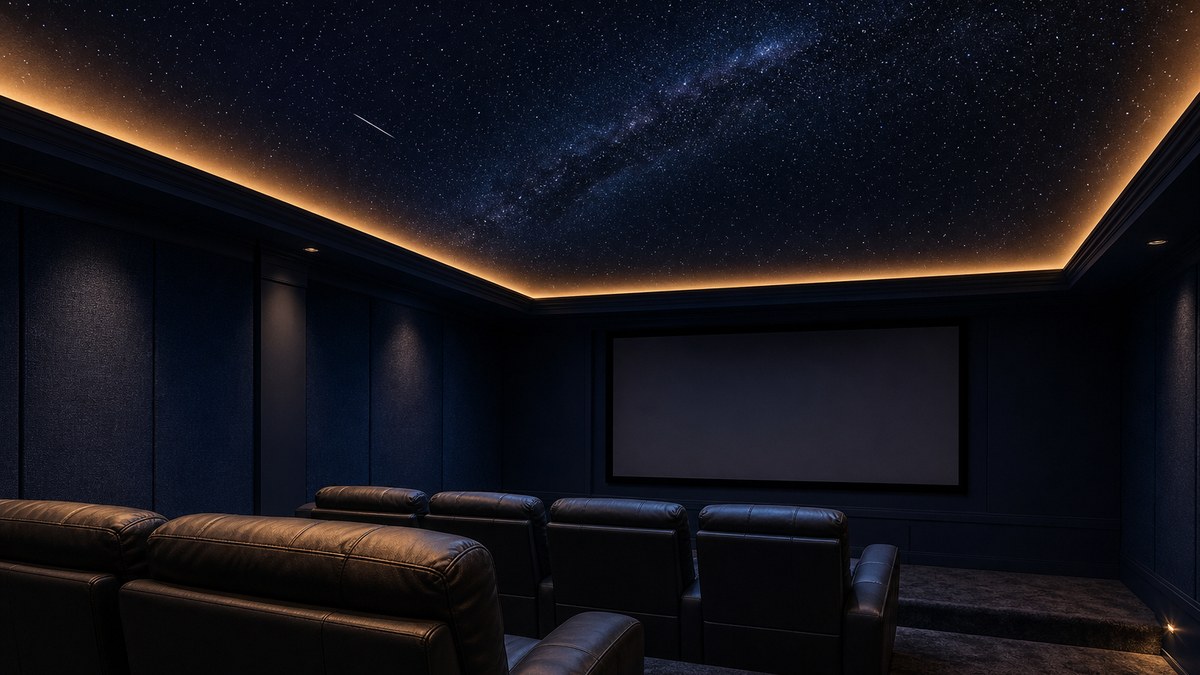
The basement theater is the classic star ceiling. Use a dense, multi-diameter field over the seating, a Milky Way band running diagonally, slow twinkle and occasional shooting stars kept away from the screen sightline. Acoustic star panels add sound absorption, which helps in basements with hard concrete walls. Integrate the light engine with your theater control so the sky dims when the movie starts. For more ideas, the theater section of our LED star ceiling lights guide compares panels, fiber kits and projectors.
Media room and family lounge
A family room needs a sky that works with the lights on and off. Keep density moderate, pick warm white or soft blue stars, and put room lighting on dimmers so you can lower it in the evening. A perimeter cove glow gives the room a calm, finished look.
Game room and basement bar
Bars and game rooms can take more color and movement. RGB light engines let you switch from a calm white sky to a colored party scene. Keep the star field over the lounge seating rather than directly above the pool table or bar task lighting, which needs to stay bright.
Guest suite and basement bedroom
A guest room under the stars is a memorable touch. Choose a natural, low-brightness sky and a remote or timer at the bed. Our star light bedroom ceiling ideas cover layouts, color and timers in detail.
Kids' play space
Kids love shooting stars and constellations. A section of star tiles over a reading corner or play mat is plenty. Keep the light engine and any controls out of reach, and set brightness low enough to double as a nightlight.
Home gym and spa areas
A star ceiling over a stretching area, sauna anteroom or spa bath turns a utilitarian space into a retreat. Fibers work well near humidity because they carry no electricity; keep the light engine outside the wet area.
Planning basement ceiling star lights with Wiedamark LED?
Send us your ceiling type, room size and the effects you want. We will recommend star tiles, panels, a fiber kit or an installation partner, with a project-specific quote.
Planning the layout step by step
- Map the ceiling: sketch the room, the ceiling type, beams, soffits, lights, sprinkler heads, vents and access panels. Stars go around fixtures, never through them.
- Choose the sky zone: the whole ceiling or a focused area over seating, the bed or the bar.
- Pick the effects: steady stars, twinkle, color, shooting stars, Milky Way, constellations. Each effect affects the light engine and fiber plan.
- Locate the light engine: dry, ventilated, accessible and within reach of the farthest star.
- Measure fiber runs: measure the actual route through the ceiling space, not the straight-line distance, and allow extra length.
- Plan density and diameters: a few bright anchor stars, many faint ones, no grid patterns, denser bands where you want a Milky Way.
- Plan controls: remote, wall control, app or integration with your theater or smart-home system.
- Confirm code and height: clear height, ceiling materials and electrical work.
Installing star lights in a drop ceiling
If you are converting an existing drop ceiling with a kit, the general process looks like this:
- Mount the light engine in its dry, ventilated location with power nearby.
- Remove the tiles in the sky zone and number them so they go back in the right place.
- Mark star positions on the back of each tile in a random, natural pattern, with denser areas for any Milky Way band.
- Drill small holes sized to each fiber diameter, working from the finished face to avoid chipping.
- Thread the fibers from the back, leaving a little extra below the face, and secure them on the back of the tile.
- Shuffle the bundle so neighboring stars come from different parts of the bundle and twinkle independently.
- Reinstall the tiles and route the fiber tails along the grid to the engine without sharp bends.
- Connect, trim and test: connect the bundle to the engine, trim fibers flush to the tile face, then set brightness, twinkle speed and color.
Pre-made star tiles skip steps 3 to 6: the fibers are already in place, so you drop the tile into the grid and route its tail. For a broader look at kits versus panels and professional installation, see what drives star ceiling cost.
DIY or professional installation?
A DIY fiber kit in a drop ceiling is a realistic weekend project for a careful homeowner, especially in a small to mid-size room. Professional installation makes more sense when:
- the basement has a finished drywall ceiling with no access;
- you want a dense theater sky, a Milky Way band, constellations or shooting stars;
- the ceiling is large or split by beams and soffits that complicate fiber routing;
- new circuits, hard-wired controls or theater integration are involved;
- the space is commercial or rented and has stricter code requirements.
For custom installation, we work with our partner American Starlight Ceilings. Our licensed installation partner has completed over 200 major sports and commercial projects across the US and Canada — NFL, NBA, NHL, MLS, NCAA and NASCAR.
Common basement star ceiling mistakes
- White grid with dark tiles: breaks the sky into squares. Use a black grid or paint it.
- Uniform star size: a single fiber diameter looks flat. Mix diameters.
- Grid-like placement: real skies cluster and thin out. Randomize.
- Too bright on a low ceiling: dim it down and lower the density.
- Light engine in a damp corner: move it to a dry, ventilated, accessible spot.
- Fibers too short: measure the real route and allow extra length.
- Ignoring fixtures: keep stars clear of sprinklers, smoke detectors, vents and access panels.
- Room lights on one switch: put recessed lights on dimmers or scenes so the sky can shine.
Care and maintenance
- Dust the ceiling occasionally with a soft brush or a vacuum on low.
- Keep the light engine's vents clear and check the area around it stays dry.
- If stars dim or effects stop, check the light engine first; the fibers have no bulbs.
- When lifting drop tiles later for plumbing or HVAC work, handle star tiles gently and avoid kinking fiber tails.
- Label the star tiles on the back so anyone working in the ceiling knows to take care.
Why source from Wiedamark LED
Wiedamark LED supplies fiber optic starlight components and kits, fiber optic lighting, and commercial and architectural LED products for homeowners, remodelers, designers and integrators nationwide. Our team brings 15+ years as an authorized architectural lighting dealer and project coordinator. We help size the light engine, fibers and effects for the ceiling you actually have. Browse our starlight ceiling products, our full product range and the project gallery, or learn about fiber optic lighting for commercial spaces.
Planning a whole-building or hospitality project? Our Luminance design-build program and our sister company WDM Lighting handle large projects. More reading on the Wiedamark LED blog.
Frequently Asked Questions
Can you put star lights in a basement ceiling?
Can I add star lights to a drop ceiling?
What if my basement has a finished drywall ceiling?
Do star ceilings work with low basement ceilings?
Is a fiber optic star ceiling safe in a damp basement?
Where should the light engine go in a basement?
When is the best time to install basement ceiling star lights?
Can I install a basement star ceiling myself?
How much does a basement star ceiling cost?
Where can I get star tiles or a star ceiling kit for my basement?
Put a night sky in your basement
Tell us your ceiling type, room size and the effects you want, and we will follow up with recommendations and a quote. Prefer to talk it through? Schedule a call.
Related
Our lighting network: starlight ceiling installation, 360° fiber optic lighting, premium pool lighting, WDM Lighting large projects, Dallas commercial LED lighting, Texas LED lighting, Plano LED lighting, LED signage, modular building solutions and Dallas modular structures.