Star Light Bedroom Ceiling: Ideas, Layouts & Planning Tips for a Night Sky Over Your Bed
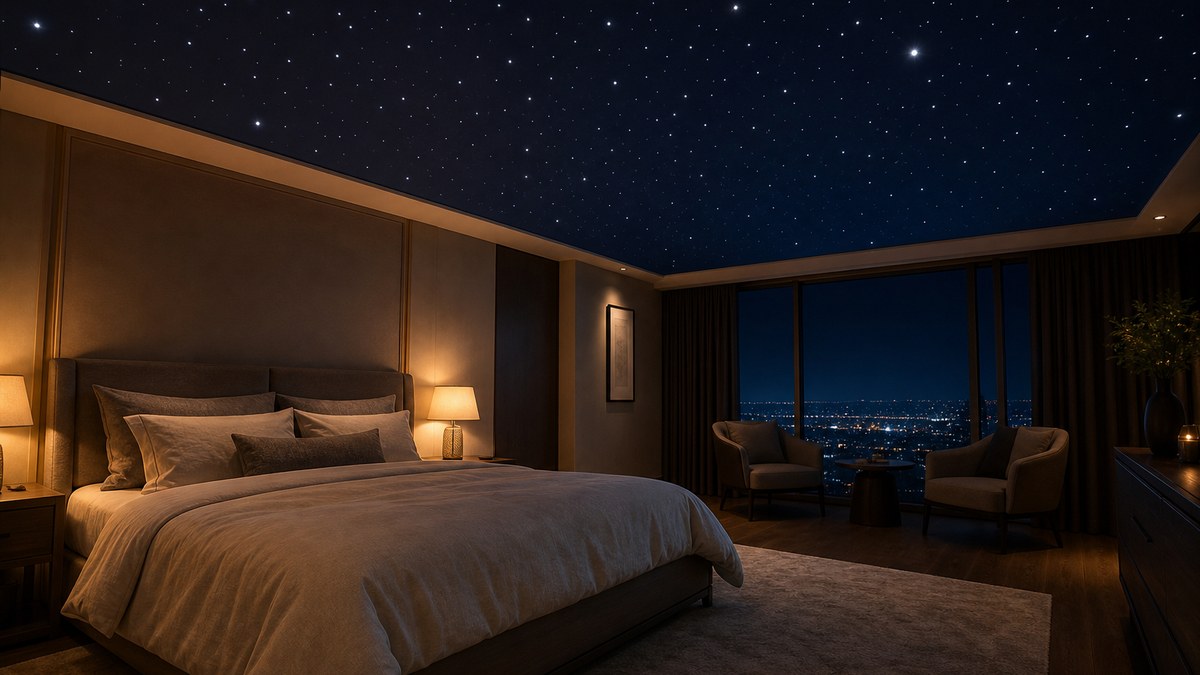
A star light bedroom ceiling is one of the most requested starlight projects, and for good reason. The bedroom is the one room where you look straight up every night, the lights are usually low, and a quiet field of stars overhead can make the space feel calmer and more personal than any light fixture. Done well, it looks like a real night sky. Done badly, it looks like a ceiling full of tiny bulbs.
This guide collects practical bedroom star ceiling ideas and the planning decisions behind them: which system type suits a bedroom, how dense the stars should be, which colors and effects feel restful, where to put the light engine so you never hear it, how to handle controls by the bed, and how ideas change for master suites, guest rooms, teen rooms and nurseries. It is written for homeowners, interior designers and contractors planning a bedroom starlight ceiling. For the full background on how fiber optic star ceilings are built, see our complete starlight ceiling guide.
The best star light bedroom ceiling is usually a fiber optic star ceiling with a natural, moderate star density, several fiber diameters, warm white or soft blue-white stars, slow twinkle and a dimmer or timer by the bed. Keep the light engine somewhere quiet and accessible.
- System: fiber optic for a permanent, realistic sky; star panels for faster installs; projectors only for trying the look
- Density: natural and uneven, heavier over the bed, lighter toward the walls
- Color: warm white or soft blue-white for sleep; save bold colors for scenes
- Effects: slow, gentle twinkle; few or no shooting stars over the pillow
- Controls: remote, wall dimmer or smart-home scene, with a sleep timer
- Pricing: project-specific — depends on ceiling size, access, star count and effects
Why the bedroom is the perfect room for stars
Most rooms are designed to be seen from eye level. A bedroom ceiling is different: you see it lying down, often in near darkness, for a few quiet minutes every night and every morning. That viewing angle and those lighting conditions are exactly where a starlight ceiling looks its best.
- Low ambient light: stars read most clearly when other lights are off or dimmed, which is normal in a bedroom at night.
- Long, relaxed viewing: you have time to notice subtle details such as faint stars, gentle twinkle or a soft Milky Way band.
- Personal meaning: a bedroom is private, so a constellation from a wedding date, a birthday or a favorite place feels natural rather than decorative.
- Doubles as a night light: a dim star field gives enough light to find the door without switching on a lamp.
Because the viewing is so close and so personal, bedroom starlight ceilings reward careful planning more than almost any other room. The ideas below focus on making the sky look real and keeping the room restful.
Choosing a system: fiber optic, panels or projector?
There are three common ways to put stars on a bedroom ceiling. Each has a place, but they are not equal for a room you sleep in. Our LED star ceiling lights guide compares them in depth; here is the bedroom-specific view.
| Option | How it looks in a bedroom | Noise & heat at the bed | Installation | Best for |
|---|---|---|---|---|
| Custom fiber optic ceiling | Pinpoint stars in the ceiling itself, bright and faint stars, true twinkle | No electricity or heat at the ceiling; light engine located elsewhere | Planned install; attic or ceiling access helps | Master suites, long-term homes, design-led bedrooms |
| Fiber optic kit | Realistic in small and medium rooms | Same as above if the engine is placed well | Careful DIY over a weekend, or a handyman | Guest rooms, teen rooms, smaller bedrooms |
| Star panels | Realistic; panel edges can be framed as a feature | Engine mounted above or beside the panel | Mount like ceiling panels; less ceiling work | Finished ceilings with no access, rentals you own long-term |
| Star projector | Soft dots and nebula clouds; washes out with lamps on | Device sits near the bed; some have fans or hum | None | Trying the idea, kids, renters |
For a bedroom you plan to keep, fiber optic is the standard. One LED light engine feeds hundreds of thin strands, and each strand ends flush with the ceiling as a single star. Because the fibers carry only light, nothing above your bed is powered or warm. If you are curious about the mechanics, read how LED star light ceilings work.
12 star light bedroom ceiling ideas
1. A natural sky over the bed
The simplest and most timeless idea: a random, uneven field of stars across the whole ceiling, slightly denser over the bed and thinning toward the walls. Mix a few bright "anchor" stars with many faint ones. This is the layout most people picture when they ask for a starlit bedroom.
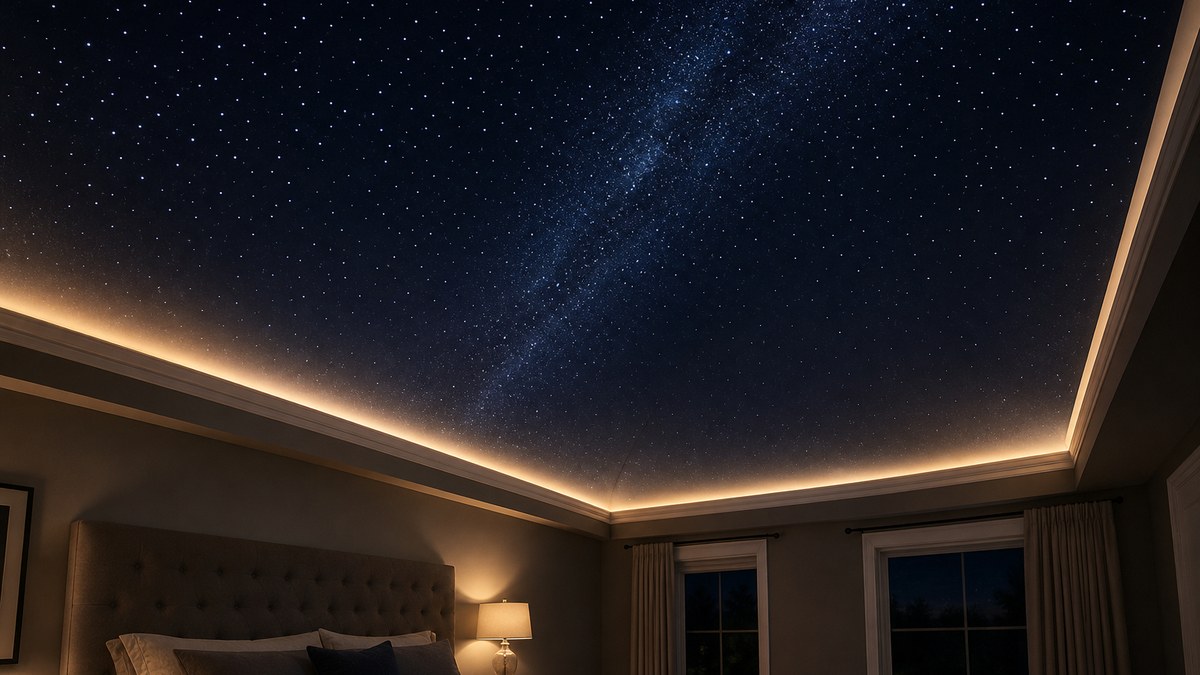
2. A soft Milky Way band
A diagonal band of dense, faint stars running across the ceiling instantly reads as a real night sky. In a bedroom, keep the band subtle and angle it so it runs past the bed rather than directly above the pillows, so it is something you notice rather than something that keeps you awake.
3. Your constellation
Map the sky from a meaningful night — a wedding, a child's birth, the night you moved in — and place those constellations accurately among a random background field. Slightly brighter fibers mark the main stars so the pattern can be found without looking like a diagram.
4. Tray ceiling with a horizon glow
If your bedroom has a tray or coffered ceiling, put the stars in the recessed center and add a warm, dimmable LED cove around the edge. The cove acts like a horizon at dusk and gives you a gentle reading-light level before you switch to stars only.
5. Floating star panel above the bed
A floating panel or "cloud" mounted over the bed concentrates the effect where you look, leaves the rest of the ceiling plain and avoids drilling the whole room. It works especially well in rooms without attic access or with a sloped ceiling elsewhere.
6. Sloped and vaulted ceilings
Vaulted bedrooms look dramatic with stars, but plan the layout from where you lie, not from the floor plan. Stars on a slope appear closer together near the ridge, so spread them a little wider at the top and plan fiber lengths carefully; the far end of a vault is often the hardest place to reach.
7. Dark navy ceiling finish
A deep navy, charcoal or black ceiling makes stars pop and hides fiber holes during the day. If you prefer a light ceiling, choose a matte finish and accept that stars will look a little softer; fibers still show clearly at night with the room dark.
8. Wall-to-ceiling sky
For a fully immersive room, carry a light scattering of stars a short way down the wall behind the headboard. It blurs the edge of the ceiling and makes the sky feel larger, which helps in smaller bedrooms.
9. Slow sunrise and sunset scenes
With an RGBW light engine and a cove, you can program a warm dusk scene that fades into stars, and a slow morning brightening scene. Keep the night scene simple; the more the ceiling changes, the more it pulls your attention.
10. Restful shooting stars — or none
Shooting stars are fun in theaters and kids' rooms, but in a master bedroom many people prefer one or two very slow, occasional paths placed away from the pillows, or none at all. They can usually be switched off when you want a calmer sky.
11. Starlit en suite
Continue the sky into the bathroom or over a freestanding tub. Fiber optic stars suit wet rooms because the fibers carry no electricity; the light engine simply has to sit outside the wet area in a dry, ventilated spot.
12. Star ceiling plus canopy or bed niche
In a guest room or a teen's room, a star field inside a bed niche, alcove or built-in bunk feels cozy and personal and keeps the project small. It is a good first star ceiling before committing to a full room.
Planning the layout: density, diameters and placement
The difference between a believable sky and "lights in the ceiling" comes down to a handful of layout choices. Each one is easy to get right on paper and hard to change after the fibers are trimmed.
Star density
There is no single correct star count. Ceiling height, room size, how dark the room gets and your own taste all matter. As a rule, bedrooms look best with a moderate, natural density — enough stars that the sky feels full when you lie down, but with darker gaps so it never looks like a pattern. Theaters often go denser; nurseries often go lighter.
Multiple fiber diameters
Real skies have a few bright stars and many faint ones. Using several fiber diameters creates that range. A layout built from a single diameter looks flat, no matter how many stars it has. Ask your supplier for a mix and a placement plan for the larger fibers.
Random, not regular
The eye is very good at spotting grids. Avoid measuring even spacing; instead, cluster some areas, leave others sparse, and step back often. Some installers use a printed star map or projected template to guide the drilling.
Mixing the fiber bundle
In a twinkling system, fibers from the same part of the bundle can twinkle together. Mix or "shuffle" fibers before routing so neighboring stars twinkle independently. This one step does more for realism than adding extra stars.
Where you look from
Plan the sky from the pillow. Lie on the bed (or mark its position) and decide where the bright stars, any constellation and the Milky Way should sit in your view. Keep the most active part of the ceiling slightly off-center so it does not sit directly in your eyeline when you are trying to sleep.
Color, brightness and effects for a restful bedroom
A bedroom star ceiling should help the room wind down, not compete for attention. Most bedroom owners end up using a small set of calm settings every night, with brighter or colorful scenes kept for special occasions.
Color of the stars
- Warm white: cozy and restful; reads as a soft, slightly golden sky.
- Neutral or blue-white: closest to how stars look outdoors; lovely, but keep it dim late at night.
- RGB or RGBW color: useful for scenes, parties and kids, but most adults turn color off at bedtime.
Many sleep and lighting guides recommend warmer, dimmer light in the hour before bed. A light engine with a good dimmer and a warm white mode gives you that option without giving up the look.
Brightness
Bedroom stars should be dim. The point is a gentle sky, not task lighting. Choose a light engine with smooth dimming down to very low levels so you can set a "falling asleep" level that is barely there.
Twinkle
Twinkle is what makes stars feel alive. In a bedroom, slow and subtle twinkle looks natural; fast twinkle can feel busy. Twinkle is created either by a rotating twinkle wheel in the light engine or electronically, depending on the system. Ask about both speed control and noise.
Shooting stars and motion
Keep motion effects rare and slow in a bedroom, and make sure they can be switched off independently. For more on every effect and where it works best, see our star light effects guide.
Planning a starlit bedroom with Wiedamark LED?
Send us the room size, ceiling type and the look you want, and we will recommend components, a kit or an installation partner, with a project-specific quote.
Quiet operation: where to put the light engine
The light engine (also called the illuminator) is the only powered part of a fiber optic star ceiling. In a bedroom, its location matters more than in any other room, because a fan hum or the click of a twinkle wheel that nobody notices in a theater can be noticeable at 2 a.m.
- Attic above the bedroom: the most common location. Keep it on a stable platform, away from insulation that could block vents, and within reach of the fiber bundle.
- Closet or adjacent room: a good choice where there is no attic. Fibers route through the wall or ceiling to the bedroom.
- Above a drop ceiling or soffit: common in basements and lofts; leave an access panel.
- Not directly over the bed: if possible, place it toward a hallway or closet side of the room.
Wherever it goes, the engine needs ventilation, a dry location and an access path so it can be serviced or replaced later without disturbing the ceiling. Ask your supplier about fan noise and fanless options when comparing engines for a bedroom.
Controls by the bed: remotes, dimmers and smart scenes
The best bedroom starlight ceiling is the one that is easy to use every night. Plan controls as carefully as the stars.
- Handheld or bedside remote: simple, and many light engines include one. Check the range from the bed to the engine location.
- Wall dimmer by the door and the bed: familiar and reliable for guests.
- Smart-home integration: a "goodnight" scene that turns off room lights and fades in the stars, with a timer that slowly turns them off after you fall asleep.
- Sleep timer: one of the most-used features in bedrooms; it lets the stars fade on their own.
If you use a home automation platform, check compatibility before choosing a light engine. For larger homes with whole-house lighting control, our commercial and architectural LED team can help coordinate controls.
Ideas by type of bedroom
Master bedroom and suites
Go for realism and restraint: a natural, multi-diameter sky, a subtle Milky Way, warm or neutral white stars, slow twinkle, a cove for dusk scenes and a sleep timer. Consider extending the sky into the en suite. This is the room where a professionally planned custom ceiling pays off most.
Guest bedrooms
Guests should be able to use the ceiling without instructions. Keep it simple: a wall dimmer, a warm white default and a remote on the nightstand. A smaller star field or bed niche is often enough.
Teen bedrooms
Teens often want color and a little drama. An RGBW engine with a few saved scenes, a few shooting stars and a dim night mode covers both "show it to friends" and "go to sleep." Fiber optic kits or star panels work well here.
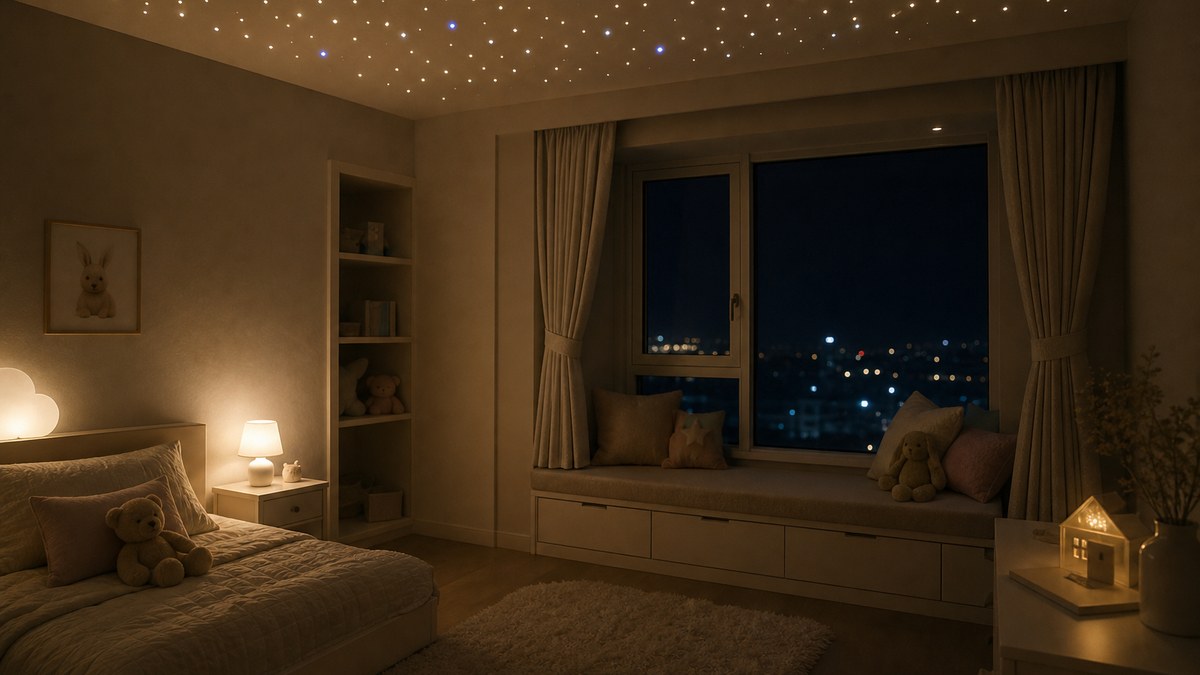
Kids' rooms and nurseries
Keep brightness very low so the ceiling works as a night light, use slow or no twinkle at bedtime, and keep the light engine, cords and remotes out of reach. A themed constellation or a small sky above the crib or bed is often more calming than a full ceiling. We will cover nurseries in more depth in a future guide.
Basement and loft bedrooms
Basement bedrooms often have drop ceilings or open joists, which make fiber routing easier; star tiles can replace standard tiles. Lofts with sloped ceilings may suit a floating panel. Basement guest rooms are a popular place to add a starlit ceiling because there is rarely any natural light to compete with it.
Installation basics for a bedroom ceiling
- Measure and photograph: room size, ceiling height and shape, and what is above (attic, floor, drop ceiling).
- Plan the sky from the bed: density, bright stars, constellation and any Milky Way band.
- Choose the engine location: quiet, dry, ventilated, accessible and within fiber reach.
- Confirm fiber lengths: measure the actual route to the far corners, not just the room.
- Protect the room: cover furniture and floors; drilling ceilings is dusty work.
- Drill and thread: small holes, fibers fed from above or into panels, bundle shuffled for twinkle.
- Connect, trim and test: secure the bundle in the engine, trim flush, then set brightness, twinkle and timer.
Small bedrooms with attic access are realistic DIY projects for patient homeowners. Finished ceilings without access, vaulted rooms, constellation mapping and hard-wired electrical work are better handled by a professional. Our installation partner American Starlight Ceilings handles custom residential starlight installations, and any hard-wired connections should follow local electrical codes.
Before you contact a supplier, lie on the bed and take a photo of the ceiling from your pillow. Add the room dimensions, what is above the ceiling and the effects you want. That single photo answers most of the questions needed to recommend a system.
Common bedroom star ceiling mistakes to avoid
- Too bright: stars that light the room defeat the purpose. Plan for deep dimming.
- Too even: grids and evenly spaced stars look artificial. Randomize and cluster.
- One fiber size: without bright and faint stars, the sky looks flat.
- Noisy engine in the wrong place: choose a quiet engine and keep it away from the bed.
- Busy effects at bedtime: fast twinkle and frequent shooting stars are better for theaters.
- No access to the engine: always leave a way to service it.
- Short fibers: measure the real route; running short in the far corner is the most common DIY problem.
- Ignoring other lighting: put lamps and downlights on dimmers so the stars can take over at night.
What affects the cost of a bedroom star ceiling
Wiedamark LED quotes every starlight project individually, because bedroom ceilings vary widely. The main factors are:
- System type: custom fiber optic, kit, or pre-made star panels.
- Ceiling area and shape: flat, tray, vaulted or sloped.
- Star count and fiber diameters: more stars and more variety mean more fibers and possibly more light engines.
- Effects: twinkle, color, shooting stars, Milky Way and constellations.
- Access: attic or drop-ceiling access makes installation simpler than finished ceilings.
- Controls: remote only, wall controls or smart-home integration.
- Installation: DIY, handyman or professional installation partner.
For a deeper breakdown of these factors, read what drives star ceiling cost, then request a project-specific quote.

Why plan your bedroom sky with Wiedamark LED
Wiedamark LED supplies fiber optic starlight components and kits, fiber optic lighting and commercial and architectural LED products, and helps homeowners, designers and contractors choose the right system for each room. Our team brings 15+ years as an authorized architectural lighting dealer and project coordinator. For custom installation we work with American Starlight Ceilings, and for whole-building and hospitality projects our sister company WDM Lighting handles large projects.
Browse our starlight ceiling products, see the full range of LED and fiber optic lighting, look at project inspiration, or learn about our Luminance design-build program. You can also schedule a call to talk through your bedroom.
Frequently Asked Questions
What is the best star light for a bedroom ceiling?
Are star ceilings good for sleeping?
How many stars should a bedroom ceiling have?
What color should bedroom ceiling stars be?
Can you hear a fiber optic star ceiling at night?
Can I install a star ceiling in a bedroom without attic access?
Is a star projector or a fiber optic ceiling better for a bedroom?
Can a bedroom star ceiling show my own constellation?
How much does a bedroom star ceiling cost?
Where can I get star ceiling components for a bedroom?
Fall asleep under your own night sky
Tell us about your bedroom and we will follow up with system recommendations and a project-specific quote.
Related
Our lighting network: starlight ceiling installation, 360° fiber optic lighting, premium pool lighting, WDM Lighting large projects, Dallas commercial LED lighting, Texas LED lighting, Plano LED lighting, LED signage, modular building solutions and Dallas modular structures. See all guides on the Wiedamark LED blog.