Home Theater Star Ceiling: How to Design a Fiber Optic Night Sky with Acoustic Panels, a Milky Way & Theater Controls
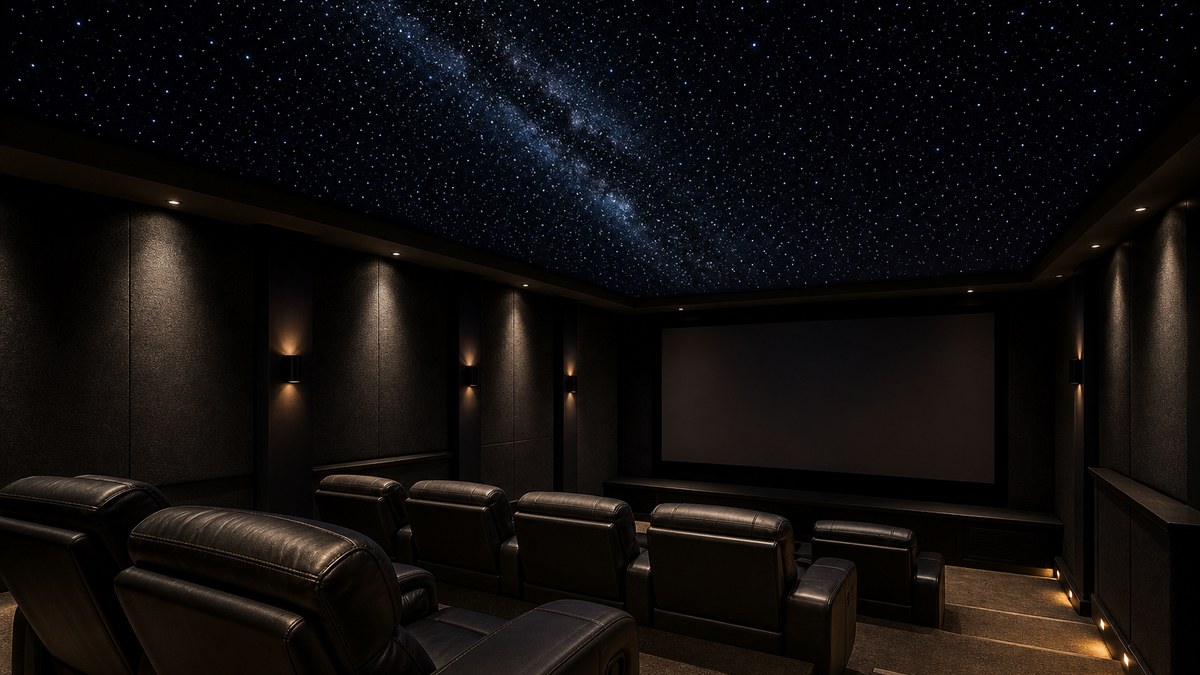
A home theater star ceiling is the finishing touch that makes a media room feel like a private cinema. When the lights go down, hundreds of pinpoint fiber optic stars appear overhead, a faint Milky Way drifts across the room and the occasional shooting star crosses the sky before the film starts. Done well, it looks like the roof has opened up. Done badly, it looks like a ceiling full of small lights that reflect on the screen and distract from the movie.
This guide is written for homeowners, theater designers, AV integrators and contractors planning a star ceiling for a dedicated home theater, a media room or a small commercial screening room. It covers how theater star ceilings work, how to choose between acoustic star panels and a drilled drywall ceiling, how to lay out stars around the screen and seating, where to put the light engine so you never hear it, how to tie the stars into your theater control system, and what drives the price of a project. If you are new to the topic, start with our complete starlight ceiling guide, then come back here for the theater-specific details.
The best home theater star ceilings use fiber optic stars set into acoustic ceiling panels, powered by a quiet LED light engine mounted outside the room. Fibers carry only light, so the ceiling stays cool and silent, and the panels absorb sound at the same time.
- Surface: acoustic star panels (sound absorption + stars) or a dark drywall or fabric ceiling
- Layout: several fiber diameters, random placement, a diagonal Milky Way band, fewer stars near the screen
- Effects: slow twinkle, occasional shooting stars kept out of the screen sightline, dimming
- Light engine: in an equipment room, closet, attic or soffit — never inside the seating area
- Control: stars dim or fade when the film starts, linked to the theater's lighting scenes
- Pricing: project-specific — it depends on ceiling size, star count, panels, effects and installation
Why star ceilings and home theaters belong together
Most rooms in a home are lit for activity. A theater is lit for darkness. That is exactly the condition in which a star ceiling looks its best: with the room lights off, every fiber tip reads as a distinct point of light against a dark sky. In a living room, ambient light from windows and lamps competes with the stars; in a theater, nothing does.
A star ceiling also solves a practical design problem. A dark theater ceiling can feel heavy and closed in, especially in basements or rooms with lower ceilings. A field of faint stars adds depth and makes the ceiling seem to disappear, which is why many cinema designers use a star ceiling as the main architectural feature of the room rather than chandeliers or decorative fixtures.
Finally, a theater star ceiling works as low-level "safety" lighting. Between films, during intermission or while guests find their seats, a dim sky gives enough orientation to move around without switching on lights that ruin dark adaptation.
How a theater star ceiling works
Almost every serious theater star ceiling is a fiber optic system. For a deeper explanation of the technology, see how LED star light ceilings work; here is the short version as it applies to a theater.
The light engine
The light engine (also called an illuminator) is an LED light source that sits away from the ceiling surface. One end of a bundle of fiber optic strands plugs into it. The engine creates every effect you see: brightness, color, twinkle and, on some systems, shooting star sequences. In a theater, the light engine's location matters more than anywhere else in the house, because any fan noise or light leak is noticeable in a quiet, dark room.
The fiber optic strands
Fibers carry light from the engine to the ceiling. Each fiber ends flush with the ceiling surface and glows as a single star. Using several fiber diameters is what makes a sky look real: a few larger fibers become bright "anchor" stars and many fine fibers become faint background stars.
The ceiling surface
In a theater, the surface is usually one of three things: acoustic star panels with fibers pre-installed, a drywall ceiling painted deep navy or black and drilled for fibers, or a stretch fabric ceiling. Each option is covered below.
Fibers carry only light — no electricity and no heat at the ceiling surface. The ceiling stays cool and silent, and the only component that ever needs service is the light engine, which sits outside the room where it can be reached without touching the ceiling.
Acoustic star panels vs drywall vs fabric: choosing the surface
The ceiling surface is the biggest design decision in a theater star ceiling, because it affects sound, appearance, installation and future access all at once.
| Surface | Acoustics | Look | Installation | Best for |
|---|---|---|---|---|
| Acoustic star panels | Absorb reflections from the ceiling; help control echo | Fabric-wrapped panels, very dark background, clean edges | Fiber work done before delivery; panels mount to the ceiling | Dedicated theaters, new builds and retrofits |
| Drilled drywall, dark paint | Hard, reflective surface; usually needs acoustic treatment elsewhere | Seamless, painted ceiling | Fibers threaded from above; attic or open-joist access helps | Media rooms with attic access |
| Stretch fabric ceiling | Can be paired with acoustic backing | Smooth, uniform, deep color | Specialist installation on a perimeter track | Large or curved ceilings |
| Drop ceiling star tiles | Depends on tile type | Visible grid unless dark grid is used | Tiles drop into an existing or new grid | Basement theaters with a suspended ceiling |
Acoustic star panels
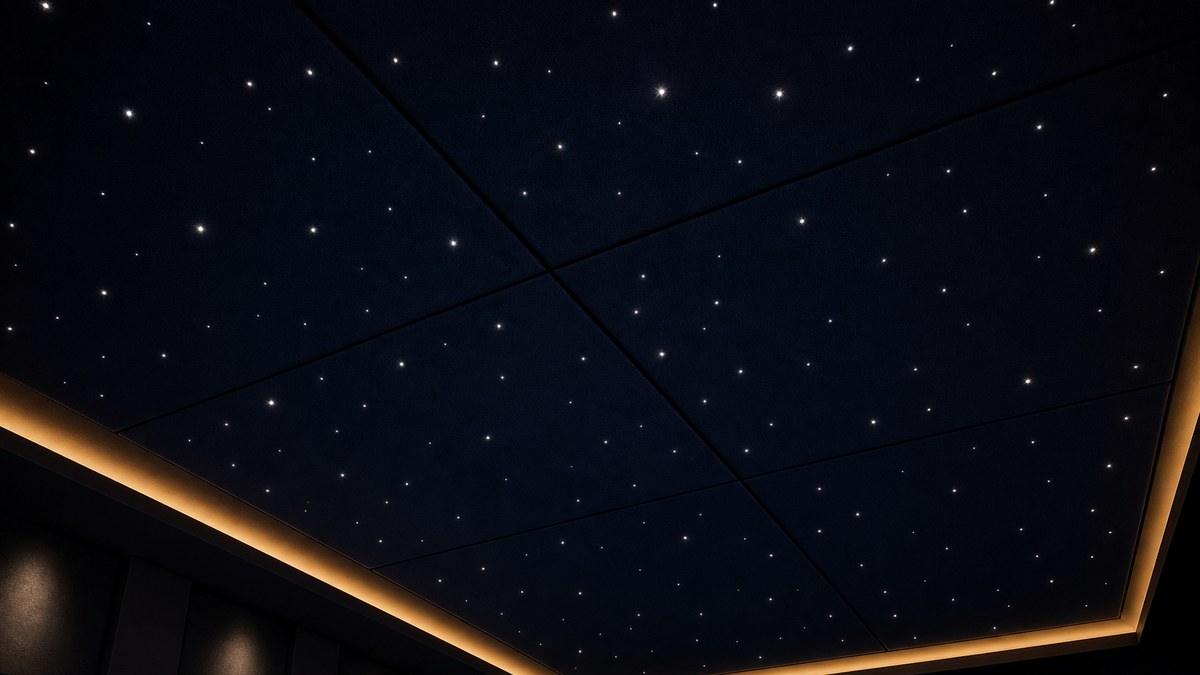
Acoustic star panels are the most popular choice for dedicated theaters for a simple reason: a theater needs ceiling acoustic treatment anyway. A hard drywall ceiling reflects sound from the speakers back down to the listening position, which can blur dialogue and make the room sound harsh. Panels with an absorptive core and an acoustically transparent fabric face reduce those reflections while carrying the fiber optic stars.
Because the fibers are installed into the panels before they arrive, on-site work is mostly mounting the panels and routing the fiber tails back to the light engine. That shortens time on the job and keeps drilling dust out of a finished room. Panels can cover the full ceiling, form a central "cloud" with a lit perimeter, or sit in the coffers of a tray ceiling.
Drilled drywall ceilings
If the theater sits below an accessible attic, or the ceiling is still open during construction, fibers can be threaded through small holes in the drywall from above. The ceiling is painted a deep, flat color so the holes disappear and the stars pop. This gives a seamless look, but the ceiling stays acoustically reflective, so plan absorption on the walls, rear wall and first reflection points. Our DIY star ceiling installation guide walks through the drilling and threading process step by step.
Stretch fabric ceilings
A stretch fabric ceiling creates a perfectly smooth, uniform surface and can cover curved or very large ceilings. Fibers pass through the fabric, and acoustic backing can be added behind it. It is a specialist installation, best handled by an experienced installer.
Basement theaters with drop ceilings
Many home theaters are in basements, and many basements have suspended ceilings. Star tiles can replace standard tiles, and a dark-colored grid helps the sky read as one surface. Our basement ceiling star lights guide covers drop ceilings, open joists and finished basements in detail.
Laying out the sky: star density, Milky Way and sightlines
A theater is a room with a fixed direction: everyone faces the screen. That changes how you should lay out a star ceiling compared with a bedroom or lounge.
Keep the screen wall calm
The area directly above and in front of the screen should be the quietest part of the sky. Fewer stars, no bright anchor stars and no shooting stars near the screen keep the audience's eyes on the picture. Reflections are a real issue with light-colored or high-gain screens; reducing star density near the front wall limits stray light hitting the screen surface.
Build density toward the back and sides
Move the denser star field over and behind the seating, where people look up before the film or during credits. This also places the most visual interest where it will be seen from the seats, rather than straight overhead where viewers would need to crane their necks.
Add a Milky Way band
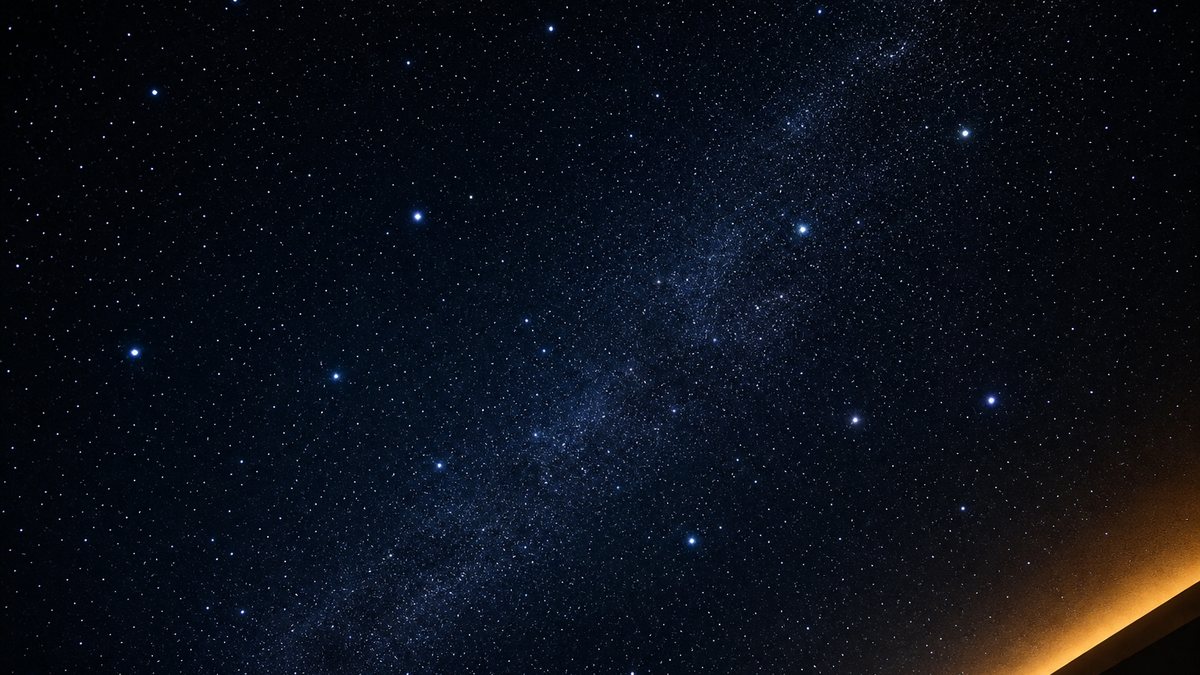
A Milky Way is a soft diagonal band of dense, fine stars, sometimes with a subtle glow. It is the single feature that makes a ceiling read instantly as "night sky." In a theater, run the band diagonally across the room or along the length of the ceiling over the seats, and keep it away from the screen end. See our starlight effects guide for how Milky Way, twinkle and shooting star effects are created.
Mix fiber diameters
Realism comes from variety, not just count. Use a small number of larger fibers for bright stars, a medium number of mid-size fibers and many fine fibers for the faint background. A ceiling built from one diameter looks flat, like a grid of identical dots.
Avoid patterns
The eye is very good at spotting rows and grids. Randomize placement, leave a few sparse areas and let stars cluster in places, the way the real sky does. When threading, shuffle fibers from different parts of the bundle so neighboring stars twinkle independently.
Constellations — use with restraint
A recognizable constellation or a sky map from a meaningful date is a popular personal touch. In a theater, place it toward the rear or over the seating area, not above the screen, and keep its stars only slightly brighter than the field so it reads as a discovery rather than a sign.
Effects that work in a theater — and ones to tone down
- Twinkle: a slow, gentle twinkle looks natural. Fast twinkle can feel busy, especially in peripheral vision during a film.
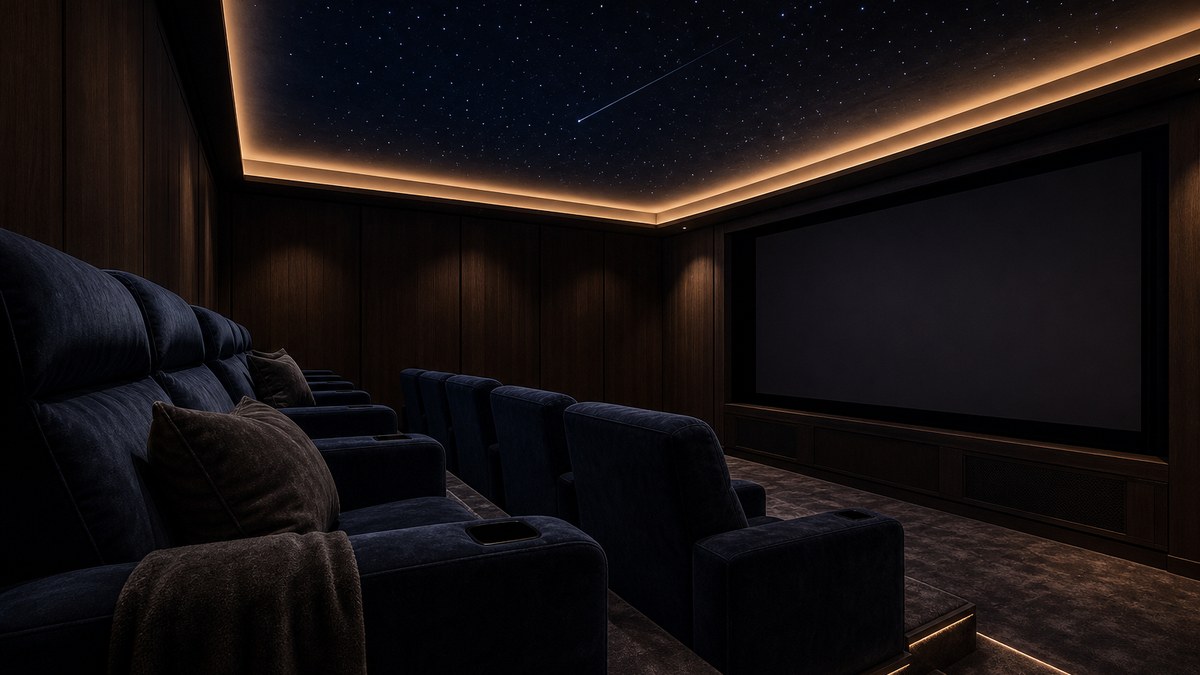
- Shooting stars: a highlight before the show. Keep the paths over the seats or rear of the room and set them to run rarely, or switch them off during playback.
- Color: cool white and soft blue read as night sky. Color scenes are fun for parties and game nights, but most owners return to white for films.
- Dimming: essential. You will want stars bright while guests arrive and very low — or off — during a film.
- Perimeter glow: a soft cove or perimeter light around the star field creates a "horizon" and frames the sky. Put it on its own dimmer channel.
Planning a theater sky with Wiedamark LED?
Send us the room dimensions, screen wall location, ceiling type and the effects you want, and we will recommend components, panels or an installation partner and follow up with a project-specific quote.
Where to put the light engine so you never hear it
A home theater is designed to be quiet. Many light engines use a cooling fan, and some twinkle systems use a small motor-driven wheel. In a bedroom you might never notice; in a theater during a quiet scene, you may. Plan the engine location early:
- Outside the room: an adjacent equipment room, closet, attic or mechanical space is ideal. Fibers run through the ceiling cavity to the star field.
- Ventilated and dry: light engines produce heat and need airflow. Do not seal them in an unvented cavity or insulation.
- Accessible: the engine is the serviceable part of the system. Put it somewhere you can reach without opening the theater ceiling.
- Within fiber reach: measure the real route from the engine to the farthest star, through joists and around obstacles, and allow extra length.
- No light leaks: make sure the engine housing and fiber bundle don't spill light into the room through gaps, vents or access panels.
- Electrical: plan a dedicated outlet or circuit at the engine location, installed by a licensed electrician following local code.
Large ceilings often use more than one light engine, each feeding a zone — for example, one for the main star field, one for a Milky Way band and one for shooting stars. Zoning also lets you dim or switch areas independently.
Integrating stars with theater lighting control
The best theater star ceilings are invisible as technology: you press "Watch Movie," the room lights fade, the stars come up briefly, then settle to a faint glow as the film begins. Getting there means planning control from the start.
Basic control
Most light engines come with a remote or wall control for on/off, brightness, twinkle speed and color. That is enough for a simple media room.
Smart-home and theater control systems
For a dedicated theater, ask whether the light engine can be controlled by your home automation or theater control system, through a relay, dimmer, DMX or another supported interface. That lets the stars become part of lighting scenes: "Pre-show," "Movie," "Intermission" and "Lights Up."
DMX for larger rooms
DMX is the standard lighting control protocol in entertainment venues. Where light engines support it, DMX allows precise, multi-zone control of stars, shooting star paths and perimeter lighting alongside other theatrical lighting. It is more common in screening rooms, commercial cinemas and larger private theaters than in small media rooms. Our architectural and commercial LED team can help with DMX and control questions.
Suggested lighting scenes
| Scene | Stars | Effects | Room lighting |
|---|---|---|---|
| Arrival / Pre-show | Medium brightness | Slow twinkle, occasional shooting star | Perimeter glow and step lights on, low |
| Movie | Very low or off | Twinkle off or minimal; no shooting stars | Off, except step lights at minimum |
| Intermission | Medium | Gentle twinkle | Perimeter and wall lights low |
| Credits / Lights up | Fade to low | Off | Room lights fade up slowly |
| Game night / Party | Bright | Color scenes, shooting stars | Accent lighting as desired |
Planning a home theater star ceiling step by step
- Measure the room: ceiling length, width and height, any soffits, beams, sprinkler heads, HVAC registers, speakers and projector mounts.
- Mark the screen wall and seating rows: this sets the calm zone near the screen and the denser zone over the seats.
- Choose the surface: acoustic star panels, drilled drywall, fabric or drop-ceiling tiles.
- Decide on effects: twinkle, shooting stars, Milky Way, color, constellations, perimeter glow.
- Locate the light engine(s): outside the room, ventilated, accessible and within fiber reach. Plan power.
- Plan control: remote, wall control or integration with the theater control system; define scenes.
- Coordinate trades: the AV integrator, electrician, drywall or ceiling installer and acoustic designer should all see the plan.
- Install and test: mount panels or thread fibers, connect the bundle, trim fibers flush, then set brightness, twinkle and scenes with the screen running.
Coordinate the star layout with ceiling speakers, the projector mount and HVAC registers before ordering. It is much easier to leave star-free zones around these items on paper than to work around them on site.
What drives the cost of a home theater star ceiling
"How much does a home theater star ceiling cost?" is one of the most common questions we receive. Every theater is different, so Wiedamark LED quotes each project individually. The main factors are:
- Ceiling area: larger ceilings need more fibers, more panels and often more than one light engine.
- Star count and fiber mix: denser skies and more varied diameters take more fiber and more installation time.
- Surface: acoustic star panels, a drilled drywall ceiling, stretch fabric or star tiles each have different material and labor requirements.
- Effects: twinkle, shooting stars, a Milky Way band, color and constellations each add components and setup.
- Control integration: a simple remote is different from multi-zone integration with a theater control system.
- Access and site conditions: attic or open-joist access makes fiber routing easier; finished ceilings without access may require panels.
- Installation: DIY kit, professional installation, or coordination with a full theater build.
For a broader look at pricing factors across all room types, read what drives star ceiling cost. When you are ready, request a project-specific quote with your room dimensions and the effects you want.
DIY or professional for a theater?
A small media room with attic access can be a reasonable DIY project with a fiber optic kit, if you are patient and comfortable working overhead. A dedicated theater is usually a different story. Acoustic panels, multi-zone light engines, Milky Way bands, shooting star paths and control integration all benefit from professional design and installation, and the work often needs to be coordinated with an AV integrator, electrician and acoustic designer.
For custom installations, Wiedamark LED works with our partner American Starlight Ceilings. Our licensed installation partner has completed over 200 major sports and commercial projects across the US and Canada — NFL, NBA, NHL, MLS, NCAA and NASCAR. For larger commercial screening rooms, hospitality cinemas and whole-building lighting, our sister company WDM Lighting handles large projects.
Common home theater star ceiling mistakes
- Light engine in the room: fan noise during quiet scenes and light leaks from the housing.
- Stars over the screen: distracting points of light in peripheral vision and stray light on the screen.
- One fiber diameter: a flat, artificial look instead of a sky with depth.
- Grid-like placement: rows of stars the eye picks up immediately.
- Too bright: stars should be subtle. Make sure brightness can go very low.
- No acoustic plan: a reflective drywall ceiling without treatment elsewhere in the room.
- Fibers too short: measure the real route from the engine to the far corner and allow extra.
- Control as an afterthought: stars that cannot join the theater's lighting scenes.
- No service access: a light engine sealed behind finished drywall.
Commercial screening rooms and cinemas
The same principles apply to commercial theater star ceilings in screening rooms, boutique cinemas, hotel media rooms and entertainment venues, with a few additions: larger ceiling areas and multiple light engine zones, durable controls staff can operate, integration with venue lighting control (often DMX), and coordination with fire, building and accessibility codes. Plan maintenance access to every light engine from day one. For commercial and architectural lighting supply, visit our commercial lighting services page, and see fiber optic lighting for related products.
Care and maintenance
- Dust acoustic panels occasionally with a soft brush or a vacuum on low; avoid wet cleaning on fabric.
- Keep the light engine's vents clear and the space around it dry and ventilated.
- If stars dim or an effect stops, check the light engine first — the fibers have no bulbs.
- Avoid crushing or sharply bending fiber bundles when working in the attic or ceiling cavity later.
- Recheck lighting scenes after any update to your theater control system.
Why plan your theater ceiling with Wiedamark LED
Wiedamark LED supplies fiber optic starlight ceiling components and kits, fiber optic lighting, and commercial and architectural LED products for homeowners, designers, AV integrators and contractors nationwide, with trade pricing for contractors, designers and integrators. Our team brings 15+ years as an authorized architectural lighting dealer and project coordinator. We help you size light engines, choose fiber mixes and surfaces, and connect you with the right installation partner.
Explore more: our LED star ceiling lights comparison (fiber optic vs panels vs projectors), star light bedroom ceiling ideas, our starlight ceiling products, product range, project gallery, and the Luminance design-build program. You can also schedule a meeting to talk through your theater.
Frequently Asked Questions
What is the best star ceiling for a home theater?
Do star ceilings affect home theater acoustics?
Will a star ceiling reflect on my projector screen?
Are fiber optic light engines noisy?
Can a star ceiling be controlled by my theater automation system?
Where should shooting stars go in a home theater?
Can I add a Milky Way to a theater star ceiling?
How much does a home theater star ceiling cost?
Can I install a theater star ceiling myself?
Does a basement home theater work with a star ceiling?
Put a night sky over your theater
Tell us your room size, screen location, ceiling type and the effects you want. We will recommend the right system and follow up with a quote.
Related
Our lighting network: starlight ceiling installation, 360° fiber optic lighting, premium pool lighting, WDM Lighting large projects, Dallas commercial LED lighting, Texas LED lighting, Plano LED lighting, LED signage, modular building solutions and Dallas modular structures.