Luxury Star Ceiling Cost: What Drives the Price of a Custom Fiber Optic Starlight Ceiling, and How to Get an Accurate Quote
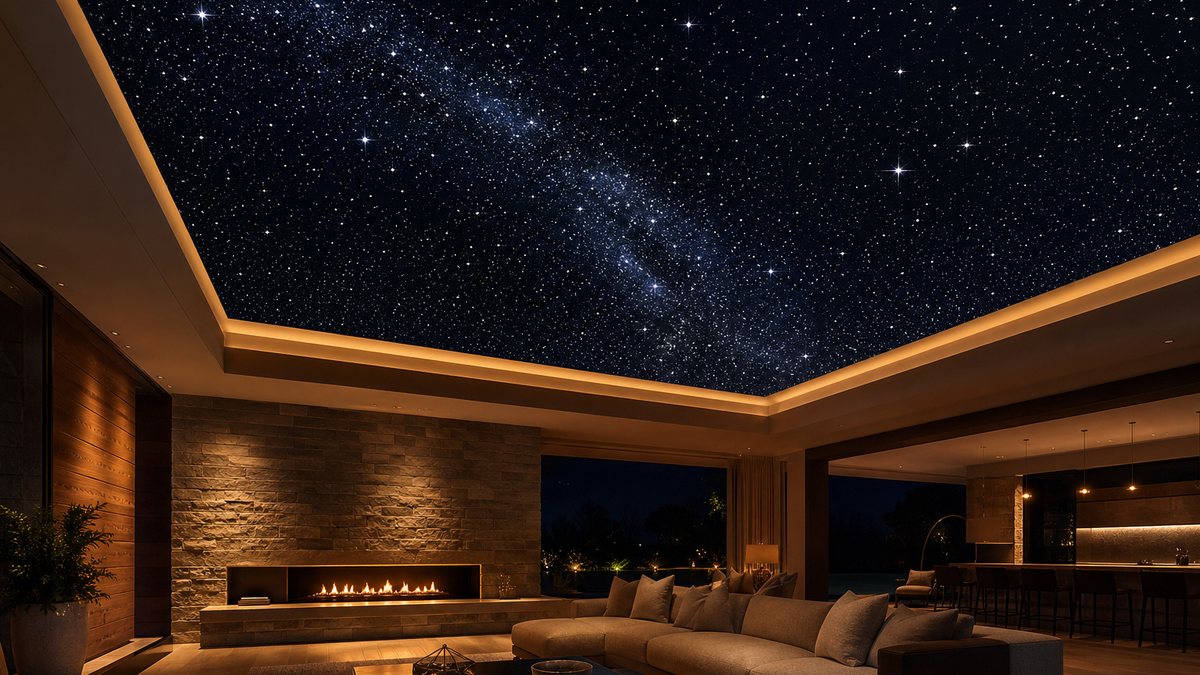
The luxury star ceiling cost question rarely has a one-line answer, because a custom fiber optic starlight ceiling is built to a room, not pulled off a shelf. Two ceilings of the same size can be quoted very differently: one might be a calm field of white stars over a bedroom, the other a dense theater sky with a Milky Way band, shooting stars, crystal sparkle fittings, acoustic panels and controls tied into a whole-home system.
This guide explains what actually drives the cost of a custom or luxury star ceiling, which upgrades make the biggest visual difference, where budgets usually go wrong, and exactly what to send a supplier so your quote is accurate the first time. Wiedamark LED works on a quote-only basis because every project is different, so you will not find price lists here. Instead, you will learn how to read a quote, compare options fairly and spend where it shows. For the basics first, start with our complete starlight ceiling guide.
A custom star ceiling is priced on the project, not the square foot alone. The biggest cost drivers are ceiling area and shape, star density and fiber count, the number and type of light engines, the effects you choose, the ceiling system (drywall, panels, fabric), access for installation and how the controls integrate.
- Scope: room size, ceiling height and shape (flat, tray, vaulted, curved)
- Stars: how many fibers, how many diameters, and whether crystal or sparkle end fittings are used
- Light engines: how many are needed to cover the area and the effects zones
- Effects: twinkle, color, Milky Way, shooting stars, constellations, perimeter glow
- Ceiling system: drill-through drywall, pre-made star panels, acoustic or stretch fabric ceilings
- Labor and access: attic, drop ceiling, open joists or a finished ceiling with no access
- Best next step: send dimensions, photos and a wish list for a project-specific quote
What makes a star ceiling "luxury" or "custom"?
Most people searching for a custom star ceiling cost have already seen the difference between a plug-in projector, a small DIY kit and a professionally designed ceiling. A luxury ceiling is not defined by one feature. It is the sum of choices that make the sky look real and feel built into the architecture:
- Designed, not random: the star field is planned around the room, the seating and the sightlines, with bright "anchor" stars placed deliberately and faint stars filling in.
- Several fiber diameters: a mix of fine, medium and larger fibers creates the depth of a real night sky instead of a flat dot pattern.
- Layered effects: independent twinkle, a soft Milky Way band, occasional shooting stars and color scenes that stay subtle.
- Architectural integration: tray ceilings, coves, soffits, floating clouds or acoustic panels that frame the sky with a horizon glow.
- Clean controls: stars that dim, fade and change scenes from the same keypad, app or theater system as the rest of the room.
- Serviceability: light engines placed where they can be reached, ventilated and replaced without touching the ceiling.
A custom ceiling can still be modest in size. A small powder room or reading nook with crystal sparkle stars and a carefully planned layout is just as "custom" as a large screening room. What changes the quote is the scope and the details, which we break down below.
The 10 factors that drive custom star ceiling cost
1. Ceiling area
Area sets the baseline. More square footage needs more fibers to keep the same density, longer fiber runs to reach the far corners and, past a certain size, more than one light engine. Measure the actual ceiling surface you want covered. A tray ceiling might only use the recessed center field, which can be much smaller than the full room.
2. Ceiling height and shape
Flat ceilings are the simplest. Vaulted, cathedral, barrel, domed and curved ceilings take more planning: fibers have to reach different heights, panels may need to be shaped, and installers may need lifts or scaffolding. Higher ceilings also change how dense the star field needs to be to read well from the floor.
3. Star density and fiber count
Density is the number of stars per area, and it is the factor most people underestimate. A sparse field reads as "lights in the ceiling"; a natural density reads as a sky. Each star is one fiber, and every fiber adds material and labor: a hole, a threaded strand, a trim and a finish. Bedrooms usually suit a calmer density; theaters and lounges often go denser with a Milky Way band.
4. Fiber diameter mix
Realism comes from variety. Mixing several diameters gives you a few bright stars, many medium ones and a haze of faint ones. More diameters means more planning and more varied drilling, but it is one of the most cost-effective ways to make a ceiling look premium.
5. End fittings: flush tips vs crystal sparkle stars
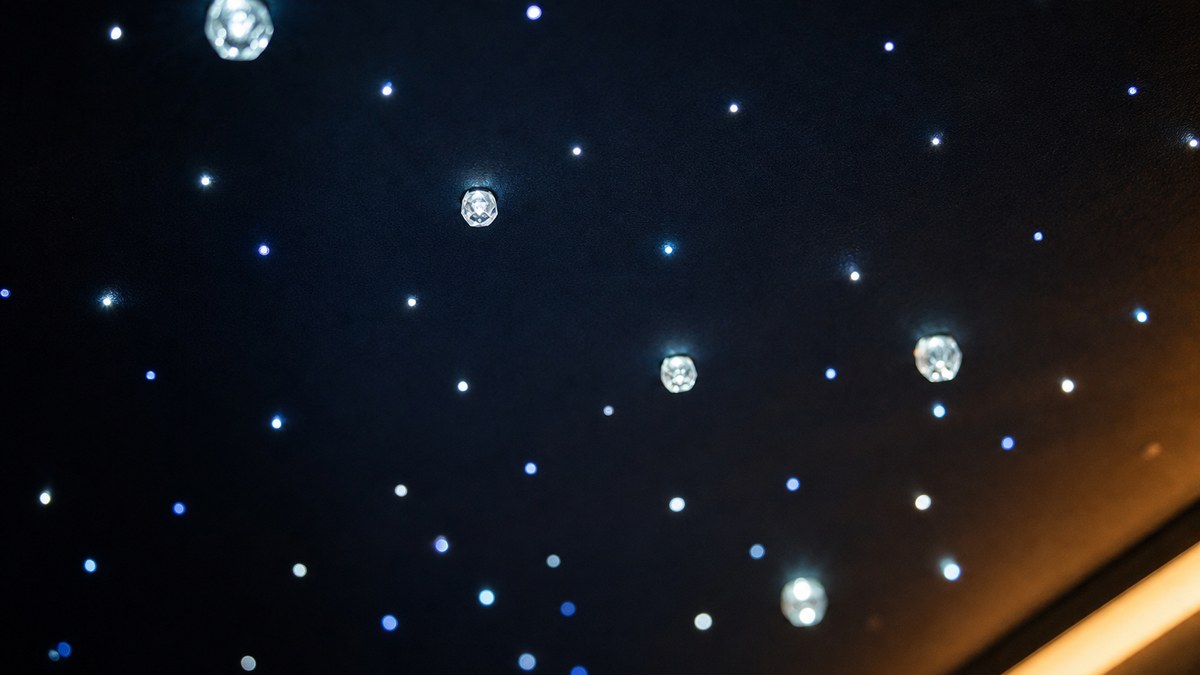
Most stars are bare fiber tips trimmed flush with the ceiling. Luxury designs often add crystal or faceted end fittings to a small number of stars so they throw tiny points of sparkle as you move through the room. These fittings add material and installation time per star, so they are usually used sparingly as accents rather than across the whole field.
6. Number and type of light engines
The light engine (illuminator) is the LED source that feeds the fibers and creates the effects. Each engine can drive a limited bundle of fibers, so bigger or denser ceilings need several engines, and separate effect zones (for example, a Milky Way band or a shooting star path) often need their own. Engine choice affects color quality, fan noise, dimming smoothness and control options. Our explainer on how starlights and light engines work covers the differences.
7. Effects package
Each effect has its own hardware and labor:
- Twinkle: a twinkle wheel or electronic twinkle that varies brightness star by star.
- Color: RGB or RGBW engines for color scenes, sunsets and fades.
- Milky Way band: a dense diagonal band of fine fibers, sometimes with a subtle painted or fabric nebula behind it.
- Shooting stars: a dedicated path of fibers lit in sequence by a separate driver.
- Constellations: mapped star positions for a birthday, anniversary or favorite place.
- Perimeter glow: LED cove or soffit lighting that creates a horizon around the sky.
See every effect explained in our star light effects guide.
8. Ceiling system
How the stars are mounted matters as much as how many there are:
- Drill-through drywall: fibers threaded from above through the existing ceiling; best with attic or open-joist access.
- Pre-made star panels: fibers installed in panels before they arrive; faster on site, a different cost profile. Compare them in our star ceiling panels guide.
- Acoustic star panels: fabric-wrapped panels that add sound absorption, popular in theaters.
- Stretch fabric or custom clouds: a floating or framed surface that hides fiber routing and creates a clean architectural edge.
- Drop ceiling tiles: star tiles that replace standard tiles in a grid.
9. Access and installation complexity
Labor is often the largest variable. An open attic directly above a new-construction ceiling is the easiest case. A finished ceiling with a second floor above and no access may need a build-down layer, star panels or careful surgical work. Our guide to a star ceiling without attic access walks through the options, and the star ceiling installation guide explains each stage of the job.
10. Controls and integration
A remote is simple. Integration with a theater processor, lighting control system, keypads or a smart-home platform takes interfaces, programming and coordination with your integrator. For premium rooms this is worth it: the stars fade when the film starts and come back during the credits, without anyone reaching for a separate remote.
Cost drivers at a glance
The table below shows how each factor tends to move a quote. It is a planning tool, not a price list; your quote depends on the full combination.
| Factor | Simpler scope | Luxury / custom scope | Impact on quote |
|---|---|---|---|
| Ceiling area | Small bedroom or nook | Large theater, great room or lounge | High |
| Ceiling shape | Flat, standard height | Vaulted, domed, curved, very high | Medium to high |
| Star density | Calm, natural field | Dense field plus Milky Way band | High |
| Fiber diameters | One or two sizes | Three or more sizes | Low to medium |
| End fittings | Flush fiber tips | Crystal sparkle accents | Medium |
| Light engines | Single engine | Multiple engines and effect zones | Medium to high |
| Effects | Steady or twinkle, white | Color, shooting stars, constellations, horizon glow | Medium to high |
| Ceiling system | Drill-through drywall | Acoustic panels, fabric clouds, custom framing | Medium to high |
| Access | Open attic or new construction | Finished ceiling, no access | High |
| Controls | Remote control | Theater, keypad or smart-home integration | Low to medium |
Luxury star ceiling cost by room type
Home theaters and screening rooms
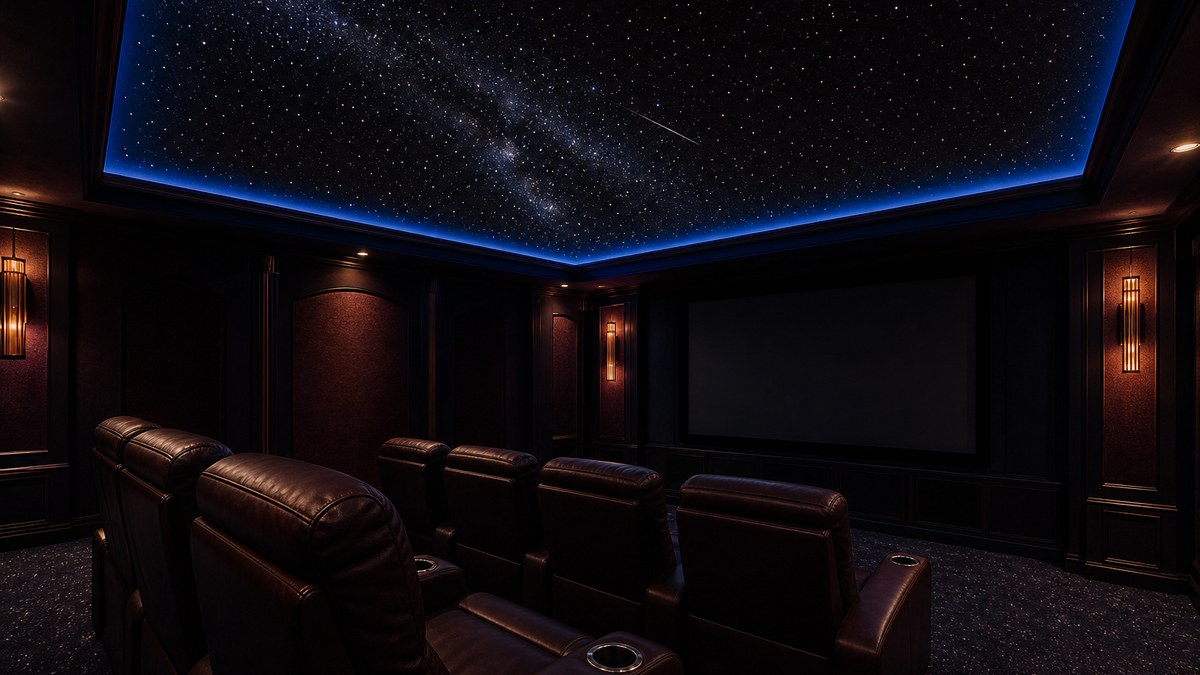
The theater is where luxury star ceilings are most common, and where scope tends to grow. Typical features include a dense multi-diameter field, a Milky Way band, shooting stars kept away from the screen, acoustic star panels and integration with the theater's control system. Acoustic treatment and controls are often the items that separate a theater quote from a bedroom quote. Our home theater star ceiling design guide and basement home theater star ceiling article go deeper.
Master bedrooms and suites
Bedrooms usually call for restraint: natural density, warm white or soft blue, slow twinkle and a timer. Luxury touches here are often a personal constellation, a few crystal sparkle stars and a tray ceiling with a soft perimeter glow. See layouts and ideas in our star light bedroom ceiling guide.
Great rooms, lounges and wine rooms
Larger open areas need more fibers and often several engines, but they rarely need the full theater effects package. Color scenes for entertaining and a soft cove glow tend to matter more than shooting stars.
Spas, steam rooms, pool houses and bathrooms
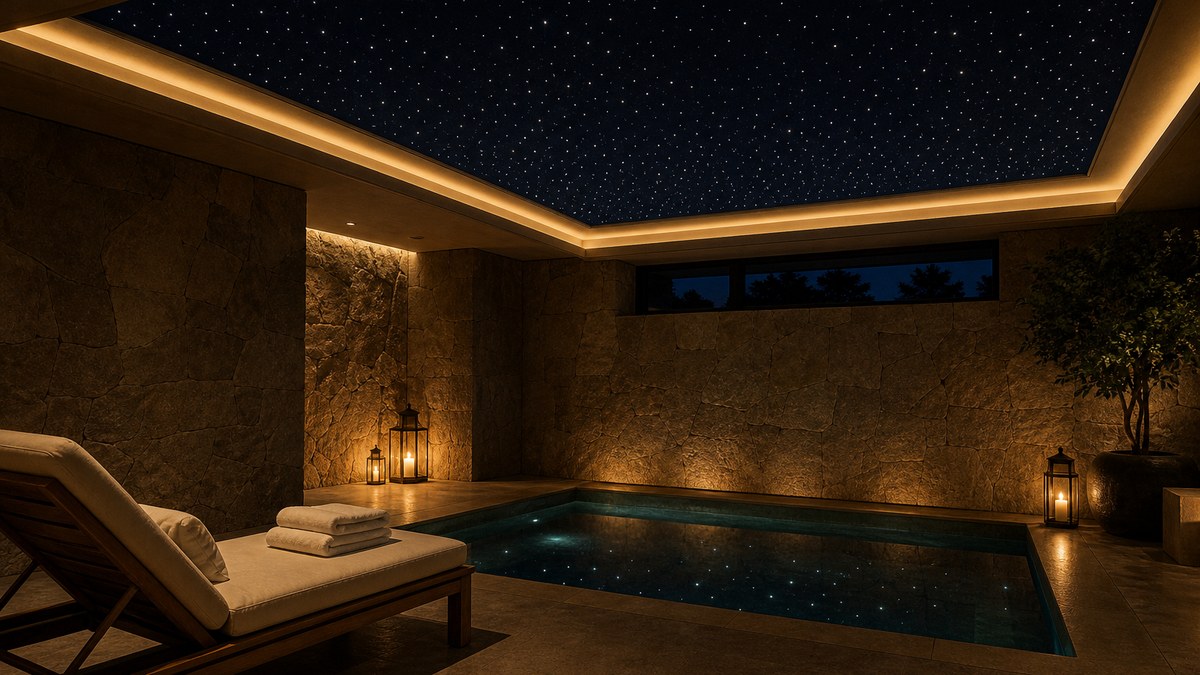
Fiber optic stars carry no electricity to the ceiling, which suits humid rooms. The cost drivers here are moisture-appropriate ceiling materials and a dry, ventilated, accessible location for the light engine outside the wet area.
Basements
Basements can be very efficient projects when joists are open or a drop ceiling is in place, and more involved when ductwork, beams and low heights need to be designed around. Our basement ceiling star lights guide covers drop ceilings, open joists and finished basements.
Restaurants, bars, hotels and commercial spaces
Commercial projects add code coordination, durable controls staff can operate, larger areas and scheduling around business hours. For large hospitality and venue projects, our sister company WDM Lighting handles project-scale lighting, and our commercial and architectural LED page covers what we supply for trade and commercial clients.
Want a quote for your ceiling?
Send us the room dimensions, a few photos and the effects you want. We will recommend the right components and send a project-specific quote.
Where to spend and where to save
A premium result does not mean maximizing every line item. These are the choices that make the most visible difference for the budget:
Worth spending on
- Natural density and a good diameter mix. This is the foundation of a realistic sky. Too few stars cannot be fixed later without reopening the ceiling.
- A quality, quiet light engine in the right place. Fan noise in a bedroom or theater is a daily annoyance, and an engine that is hard to reach is a future headache.
- Layout design. A planned field with anchor stars, sparse areas and a Milky Way band looks far more expensive than a uniform pattern with the same fiber count.
- A dark ceiling finish. Deep navy or black paint, fabric or panels make every star read sharper.
Where you can often save
- Effects you will rarely use. Many owners use one or two favorite scenes. A full rainbow color package is not essential in a bedroom.
- Crystal fittings everywhere. A handful of sparkle accents carries the effect; covering the whole field adds cost without much extra impact.
- Covering every inch. In a tray or coffered ceiling, starring only the center field and lighting the cove can look more intentional than covering the whole surface.
- Timing. Planning stars during new construction or a remodel, while the ceiling is open, avoids the most labor-intensive installation scenarios.
If budget is a concern, ask for the fiber layout and engine locations to be designed for the full vision, then phase the effects. Shooting stars or color can sometimes be added later if the fiber paths and engine space were planned in from the start, while adding more stars later usually means reopening the ceiling.
Custom ceiling vs kit vs panels: how the cost structure differs
People comparing diy star ceiling cost with a custom installation are really comparing different things. A DIY kit moves the labor to you; pre-made panels move much of the fiber work to the factory; a custom ceiling puts the design and installation in professional hands.
| Option | Where the cost goes | Best for | Trade-offs |
|---|---|---|---|
| DIY fiber optic kit | Components; your own time and tools | Small bedrooms, kids' rooms, accent ceilings | Limited effects, layout depends on your patience |
| Pre-made star panels | Factory fiber work, panels, shipping, mounting | Theaters, media rooms, drop ceilings, no-access ceilings | Panel seams and sizes shape the design |
| Custom drill-through ceiling | Design, components, skilled on-site labor | Bedrooms, great rooms, seamless drywall skies | Needs access above or an open ceiling |
| Luxury custom build | Design, multiple engines, effects, fittings, integration, finishes | Premium theaters, suites, spas, hospitality | Longest lead time; needs coordination |
For a step-by-step look at the do-it-yourself path, read our DIY star ceiling kit guide. For a general overview of what goes into any star ceiling price, see what drives star ceiling cost.
Hidden costs that catch people out
- Electrical work: a dedicated outlet or hard-wired connection for the light engines, done by a licensed electrician to local code.
- Ceiling repair and finishing: patching, painting or a new dark finish after installation.
- Insulation and attic conditions: moving insulation, working around trusses or HVAC, and restoring it afterward.
- Ventilation for the light engine: engines need airflow; a sealed closet may need changes.
- Integration programming: the time an AV or lighting integrator spends adding the stars to scenes.
- Lifts or scaffolding: for very high or vaulted ceilings.
- Shipping and lead times: custom panels and large fiber harnesses take time to produce and ship.
A good quote names these items clearly, even when some are handled by your contractor rather than the star ceiling supplier.
How to get an accurate custom star ceiling quote
The fastest way to a reliable number is to give the supplier everything they need in the first message. Here is what to send:
- Room dimensions: length, width and ceiling height, plus the area you want starred if it is not the whole ceiling.
- Ceiling type and shape: flat, tray, vaulted, coffered, drop ceiling or open joists.
- Access: attic above, second floor above, drop ceiling, or new construction with the ceiling still open.
- Photos: the ceiling, the room, and any attic or access space.
- Room use: bedroom, theater, spa, lounge, commercial space.
- Look and effects: density, white or color, twinkle, Milky Way, shooting stars, constellations, crystal sparkle accents.
- Ceiling system preference: drill-through, star panels, acoustic panels or stretch fabric.
- Controls: remote, keypad, app or integration with a theater or smart-home system.
- Timeline and project stage: planning, construction, remodel or finished room.
- Who installs: you, your contractor or integrator, or a referral to an installation partner.
With that list, a supplier can size the fiber count and engines, suggest where to spend and where to save, and avoid the back-and-forth that slows most projects down.
Questions to ask before you approve a quote
- How many stars (fibers) are included, and in how many diameters?
- How many light engines, where will they be mounted, and how are they ventilated and accessed?
- Which effects are included, and which can be added later?
- What controls are included, and how do they connect to the rest of the room?
- Who handles electrical work, ceiling repair and finishing?
- What is the lead time for components or panels?
- What support is available after installation, including replacement engines and parts?
Why plan your custom star ceiling with Wiedamark LED
Wiedamark LED supplies fiber optic starlight ceiling components and kits, fiber optic lighting and commercial and architectural LED, with trade pricing for contractors, designers and integrators. Our team brings 15+ years as an authorized architectural lighting dealer and project coordinator. When you need custom installation, we work with American Starlight Ceilings. Our licensed installation partner has completed over 200 major sports and commercial projects across the US and Canada — NFL, NBA, NHL, MLS, NCAA and NASCAR.
Not sure which system fits? Compare the options in our LED star ceiling lights guide, see how a fiber sky compares to a projector in fiber optic star ceiling vs LED projector, or read how LED star light ceilings work. You can also browse our starlight ceiling products, our full product range, the Luminance design-build program and the rest of the Wiedamark LED blog.
Frequently Asked Questions
How much does a luxury star ceiling cost?
What is the biggest factor in custom star ceiling cost?
Why don't star ceiling suppliers publish a price per square foot?
Are crystal star end fittings worth it?
Is a DIY star ceiling kit cheaper than a custom ceiling?
Do shooting stars and a Milky Way band add much to the cost?
Can I add more stars or effects later?
Does a finished ceiling with no attic access cost more?
What should I send to get an accurate star ceiling quote?
Does Wiedamark LED supply trade pricing for contractors and integrators?
Design a sky worth looking up at
Tell us about your room and the effects you want. We will follow up with component recommendations and a project-specific quote, or schedule a call.
Related
Our lighting network: starlight ceiling installation, 360° fiber optic lighting, premium pool lighting, WDM Lighting large projects, Dallas commercial LED lighting, Texas LED lighting, Plano LED lighting, LED signage, modular building solutions and Dallas modular structures.