Star Ceiling Panels: Pre-Made Fiber Optic Panels vs DIY Kits for Drywall, Drop Ceilings & No-Drill Installs
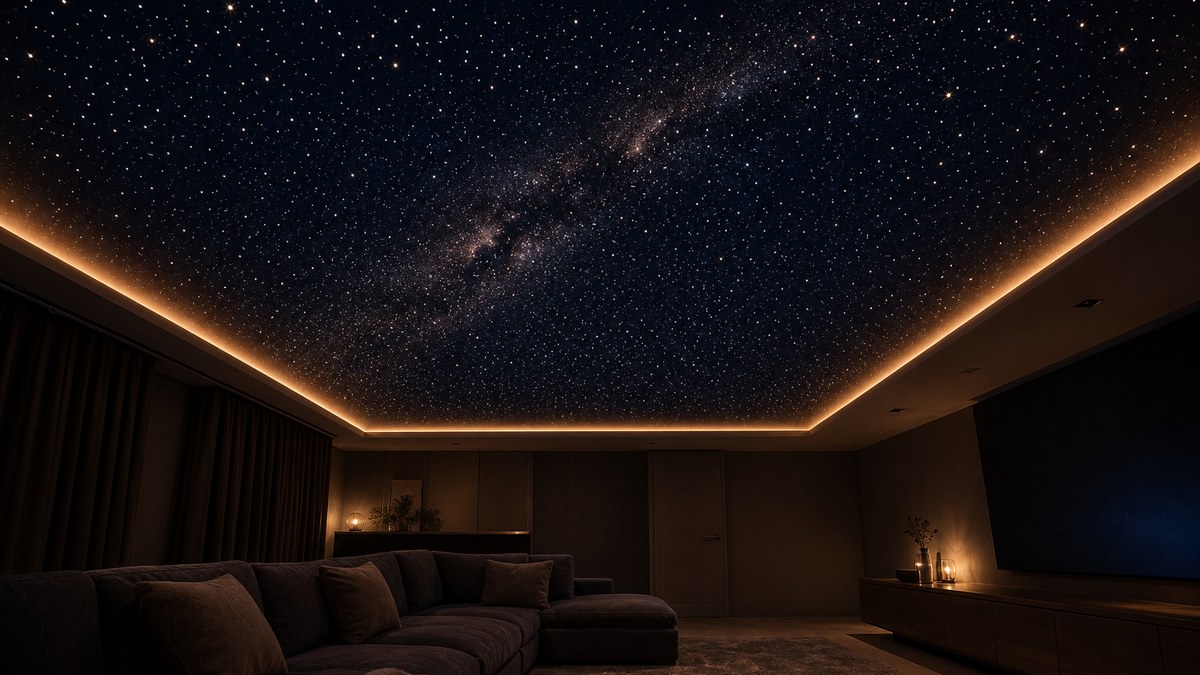
Star ceiling panels are the fastest way to get a real fiber optic night sky without drilling hundreds of holes into your ceiling. Instead of threading every fiber yourself, the fibers arrive already installed in finished panels, and the panels mount to the ceiling like any other ceiling product. That is why searches like "star ceiling without drilling holes," "star ceiling without drywall removal" and "DIY star ceiling vs premade panels" keep growing.
This guide explains what star ceiling panels are, the main panel types (surface-mount drywall panels, drop-ceiling star tiles and acoustic star panels), how they compare with a DIY fiber optic kit, how installation works step by step, and how to plan the layout so the finished ceiling looks like one continuous sky rather than a grid of squares. It is written for homeowners, theater and AV integrators, designers and contractors.
Star ceiling panels are ceiling panels with fiber optic stars pre-installed and wired back to a hidden LED light engine. You mount the panels and plug the fiber bundles into the engine, so there is little or no drilling into your existing ceiling.
- Surface-mount panels: fix to an existing drywall ceiling; best when there is no attic access
- Drop-ceiling star tiles: replace standard tiles in a suspended grid; popular in basements and offices
- Acoustic star panels: fabric-wrapped panels that add sound absorption; the theater favorite
- Panels vs DIY kit: panels install faster and cleaner; kits suit small rooms and patient DIYers with attic access
- Pricing: quote-based, depending on ceiling size, panel type, star density, effects and installation
What are star ceiling panels?
A fiber optic star ceiling always has the same three building blocks: an LED light engine (illuminator), a harness of fiber optic strands, and a ceiling surface that holds the fiber tips. Each tip glows as a pinpoint star. If you are new to the technology, our guide on how starlights work covers light engines and twinkle effects in detail, and our complete starlight ceiling guide covers the whole system.
With a traditional custom or DIY install, the ceiling surface is your existing drywall: someone drills a hole for every star, pushes a fiber through from the attic, glues it and trims it flush. With star ceiling panels, that work is moved off the ceiling. The fibers are installed into panels before they reach the room, the panel face is finished, and the fiber tails are gathered into bundles on the back. On site, the job becomes:
- mount the panels to the ceiling, grid or a framed "cloud";
- route the fiber bundles to the light engine location;
- connect the bundles to the engine and power it up.
The result looks the same as a hand-built fiber optic ceiling (sharp pinpoint stars, mixed brightness, twinkle and color) because it uses the same fiber optic principle. What changes is how much mess, time and ceiling access the installation needs.
The three main panel types
1. Surface-mount panels for drywall ceilings
Surface-mount panels attach directly to an existing finished ceiling. They are the usual answer to "how do I get a star ceiling without drywall removal?" The panel sits slightly proud of the ceiling, and a small number of openings (often one per panel, sometimes hidden along an edge or behind trim) let the fiber bundles pass through to the light engine. In rooms with no attic above, such as a lower-floor bedroom or a condo, bundles can be routed along a soffit, cove, bulkhead or closet instead.
Panels are often installed edge to edge to cover the whole ceiling, or as a centered field with a border of plain ceiling. A trim or a perimeter cove with a soft LED glow hides the panel edges and gives the sky a "horizon."
2. Drop-ceiling star tiles
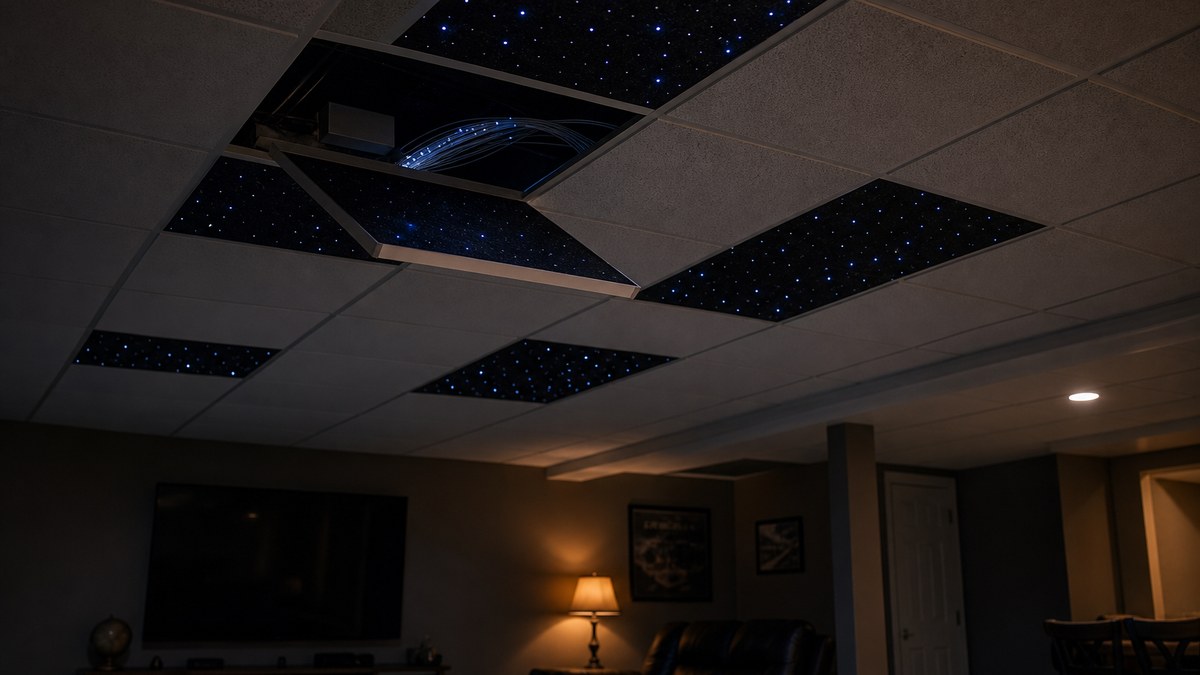
Basements, game rooms, offices and many commercial spaces have a suspended grid ceiling. Here, star tiles simply replace standard tiles in the grid. Because the space above the grid is open, the fiber bundles lie on top of the tiles and run straight to a light engine sitting above the ceiling, which keeps the engine accessible for service. This is the easiest panel install of all, and it is why "star ceiling panels for drop ceiling" and "install star ceiling panels in basement" are such common searches. Our basement star ceiling guide goes deeper on grid ceilings and open joists.
3. Acoustic star panels
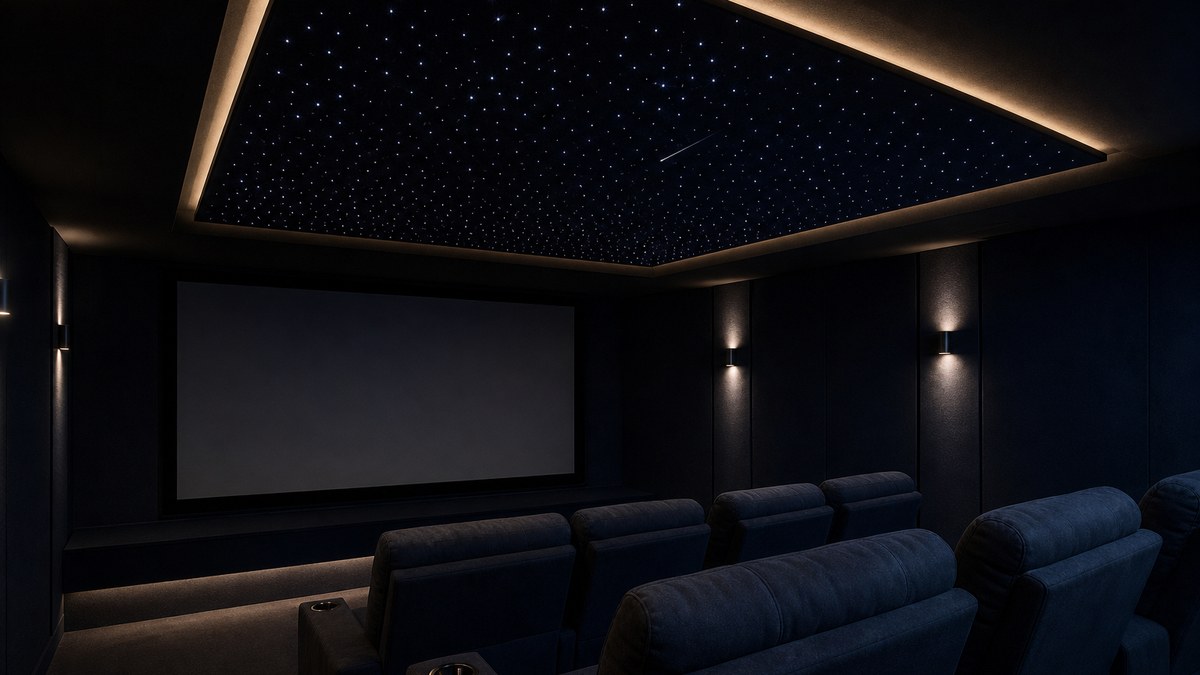
Acoustic star panels combine a fiber optic sky with a fabric-wrapped absorptive core. They are the standard in dedicated home theaters and media rooms, where hard drywall ceilings cause echo and flutter. The fibers pass through the acoustic core and fabric so the stars sit at the fabric face. They can cover the whole ceiling or form a floating cloud over the seating area. See our home theater star ceiling design guide for layout and controls.
Star ceiling panels vs a DIY kit
This is the decision most people are really making. Both use real fiber optics and can look excellent. The difference is where the labor happens and what your ceiling allows.
| Factor | Pre-made star panels | DIY fiber optic kit |
|---|---|---|
| Drilling into ceiling | Minimal — a few pass-throughs for fiber bundles, or none on a drop ceiling | One hole per star, often hundreds |
| Attic access needed | No — bundles can route through a soffit, cove or closet | Usually yes, to feed fibers from above |
| Install time on site | Short — mounting and connecting | Long — drilling, threading, gluing, trimming |
| Mess and dust | Low | High: drywall dust and attic work |
| Star layout control | Planned in advance; consistent spacing and brightness mix | Fully hand-placed; quality depends on patience |
| Acoustics | Acoustic versions absorb sound | No acoustic benefit |
| Removability | Panels can come down later | Holes stay in the drywall |
| Best for | Theaters, finished ceilings, basements, rentals, commercial | Small bedrooms, kids' rooms, accent ceilings with attic access |
If you have easy attic access, a small room and plenty of patience, a kit is a satisfying project; our DIY star ceiling kit guide walks through it step by step. If the ceiling is finished with no access, the room is large, you want acoustic treatment, or you simply do not want hundreds of holes in your drywall, panels are usually the better fit.
Can you have a star ceiling without drilling holes?
Mostly, yes. A true fiber optic ceiling always needs a path for the fiber from the stars to the light engine, but panels shrink that to very little:
- Drop ceilings: no drilling into the structure at all. Tiles drop into the grid and bundles stay above it.
- Surface-mount panels: typically a small number of bundle openings, which can be placed above a cove, inside a bulkhead or at the wall edge where trim hides them.
- Ceiling clouds and soffits: a framed cloud or bulkhead creates its own hidden cavity, so bundles and even the light engine can live inside the build-out.
The only options that need no openings at all are projectors and stick-on glow stars, and neither gives the sharp, permanent look of fiber optics. Our LED star ceiling lights comparison covers projectors, LED panels and fiber side by side.
Not sure if panels fit your ceiling?
Send us the room dimensions, ceiling type and a photo. We will recommend panels, tiles or a kit and follow up with a project-specific quote.
How star ceiling panels are installed
Exact steps depend on the panel system and the ceiling, so always follow the manufacturer's instructions and local electrical codes. A typical surface-mount or acoustic panel install looks like this:
- Survey the room: measure the ceiling, mark joists, lights, vents, sprinklers, smoke detectors and speakers, and note any slope, beams or soffits.
- Plan the panel layout: decide on full coverage or a centered field, and where cut or filler panels go so they land at the edges rather than the middle.
- Choose the engine location: dry, ventilated and serviceable: an attic, closet, equipment rack, soffit or the space above a drop ceiling, within reach of every bundle.
- Plan the bundle routes: mark where each panel's bundle passes through the ceiling or along a cove, keeping bends gentle and runs within the fiber length supplied.
- Mount the panels: fix them to the ceiling or framing with the specified hardware, keeping seams tight and lines straight.
- Connect the bundles: gather bundles into the light engine port, secure them and protect them from being crushed or kinked.
- Power, test and set effects: power the engine, check that every panel lights evenly, then set twinkle speed, color and dimming.
- Finish: add trim or a perimeter cove, and integrate controls with the room's lighting or theater system.
Drop-ceiling tiles are even simpler: lift out the old tiles, drop in the star tiles, lay the bundles on top and connect them to the engine above the grid. Make sure the grid is rated to carry the tiles and that any tile near sprinklers, lights or diffusers follows code clearances.
Planning a layout that looks like one sky
The quality gap between a good panel ceiling and an average one is almost entirely in the planning. Panels are made in sections, but the sky should not look sectioned.
- Hide the seams: dark panel faces and tight joints make seams disappear once the lights are down. Matching the surrounding ceiling color helps too.
- Randomize across panels: star placement should flow across panel edges. Avoid repeating the same pattern on every panel, which the eye picks up quickly.
- Mix fiber diameters: a few bright anchor stars and many faint ones give depth. A single diameter looks flat.
- Shuffle the fibers at the engine: mixing bundles so neighboring stars twinkle independently stops whole panels pulsing together.
- Plan Milky Way and constellations across the field: a diagonal band or a meaningful constellation should cross several panels, which means designing the whole ceiling before panels are made.
- Keep shooting stars out of sightlines: in theaters, place them away from the screen wall.
- Frame the field: a cove, tray or floating cloud edge with a soft glow gives the sky a horizon and hides the panel perimeter.
For more effect ideas, see our starlight effects guide, and for bedroom-specific layouts, our star light bedroom ceiling ideas.
Best rooms for star ceiling panels
Home theaters and media rooms
Acoustic star panels do two jobs at once: they create the classic theater sky and absorb reflections from the ceiling. Pair them with a dimmable perimeter glow and theater-system controls so the stars come up between films and settle when the movie starts.
Bedrooms and master suites
Surface-mount panels are ideal when the bedroom is on a lower floor or has no attic. Choose a calm density, warm white or soft blue, slow twinkle and a remote or timer by the bed. A centered field over the bed with a cove border is a popular look.
Basements and game rooms
Drop-ceiling star tiles are the simplest upgrade in a finished basement. You can convert the whole grid or just the area over the seating, and the light engine sits above the tiles where you can reach it.
Kids' rooms and nurseries
Panels avoid drilling a child's ceiling full of holes and can be removed later as tastes change. Keep brightness low enough to act as a nightlight, and keep the engine and wiring out of reach.
Spas, saunas and bathrooms
Fibers carry only light, with no electricity or heat at the star tips. That makes fiber optic panels a strong fit for wet-adjacent rooms, provided the panel materials suit the humidity and the light engine sits outside the wet area in a dry, ventilated location.
Restaurants, bars, lounges, hotels and offices
Commercial projects benefit most from panels: less disruption on site, faster installs, repeatable quality across large areas and acoustic benefits in loud rooms. Plan for fire and building code requirements, sprinkler clearances, durable staff-friendly controls and color scenes. For custom commercial installation we work with American Starlight Ceilings, and for whole-building lighting our sister company WDM Lighting handles large projects. See our commercial and architectural LED services as well.
What to check before you order
Ceiling type and structure
Note whether the ceiling is drywall, plaster, a suspended grid, open joists or a sloped or vaulted surface, and how panels will be fixed to it. Heavier acoustic panels need solid fixing into framing.
Access for the light engine
The light engine is the serviceable part of any fiber optic system. Choose a location you can reach later without removing panels.
Panel sizes and layout
Ask how the system handles edges, light fixtures, vents and speakers. A good layout plans cut-outs and filler sections in advance instead of improvising on the day.
Star density and diameters
Ask how many stars each panel carries and what mix of fiber diameters is used. Variety matters as much as count.
Effects and controls
Decide on steady stars, twinkle, color change, shooting stars or a Milky Way band, and how you want to control them: remote, app, wall control or integration with a smart-home or theater system.
Fire rating and codes
For commercial spaces and many residential applications, confirm the panel materials meet the fire rating your building code and inspector require, and follow sprinkler and smoke detector clearances.
Fabric, finish and color
Dark finishes make stars stand out and hide seams. For acoustic panels, check the fabric is acoustically transparent and suited to the room's humidity.
Support
Buy from a supplier who will help size the system up front and can supply replacement light engines or add-on effects later.
What drives the quote
Wiedamark LED quotes every panel ceiling individually, because two rooms of the same size can need very different systems. The main factors are:
- Ceiling area and the number of panels or tiles needed;
- Panel type: surface-mount, drop-ceiling tile, acoustic or custom-shaped cloud;
- Star density and fiber diameter mix;
- Effects: twinkle, color, shooting stars, Milky Way, custom constellations;
- Number of light engines and control integration;
- Fiber run lengths from the farthest panel to the engine;
- Installation: self-install, contractor or professional installation partner.
For a broader look at what moves star ceiling budgets, read our guide to what drives star ceiling cost. When you are ready, request a project-specific quote.
Care and maintenance
- Dust panel faces gently with a soft brush or a vacuum on a low setting; avoid wet cleaning on fabric panels.
- Keep the light engine's vents clear and the area around it dry.
- If a whole panel looks dim, check that its bundle is fully seated in the engine port before anything else.
- Avoid crushing or sharply bending bundles when working in the attic or soffit later.
- Because fibers have no bulbs, service usually means the light engine, which is why it must stay accessible.
Why work with Wiedamark LED
Wiedamark LED supplies fiber optic starlight components, panels and kits, fiber optic lighting, and commercial and architectural LED products, and helps you choose the right system for the space. Our team brings 15+ years as an authorized architectural lighting dealer and project coordinator. Our licensed installation partner has completed over 200 major sports and commercial projects across the US and Canada — NFL, NBA, NHL, MLS, NCAA and NASCAR.
Start with our starlight ceiling pillar guide, compare systems in how LED star light ceilings work, browse starlight ceiling options and our products, or explore the Luminance design-build program.
Frequently Asked Questions
What are star ceiling panels?
Are star ceiling panels better than a DIY kit?
Can I install a star ceiling without drilling holes?
Can star ceiling panels go on an existing drywall ceiling?
Do star ceiling panels work in a drop ceiling?
Will the panel seams show?
Are acoustic star ceiling panels worth it for a home theater?
Where does the light engine go with star panels?
Can star ceiling panels be removed later?
How much do star ceiling panels cost?
Get a night sky without the drilling
Tell us your room size, ceiling type and the effects you want, and we will recommend the right star ceiling panels and follow up with a quote.
Related
Our lighting network: starlight ceiling installation, 360° fiber optic lighting, premium pool lighting, WDM Lighting large projects, Dallas commercial LED lighting, Texas LED lighting, Plano LED lighting, LED signage, modular building solutions and Dallas modular structures.