Fiber Optic Star Ceiling vs LED Projector: Which Night Sky Is Right for Your Room?
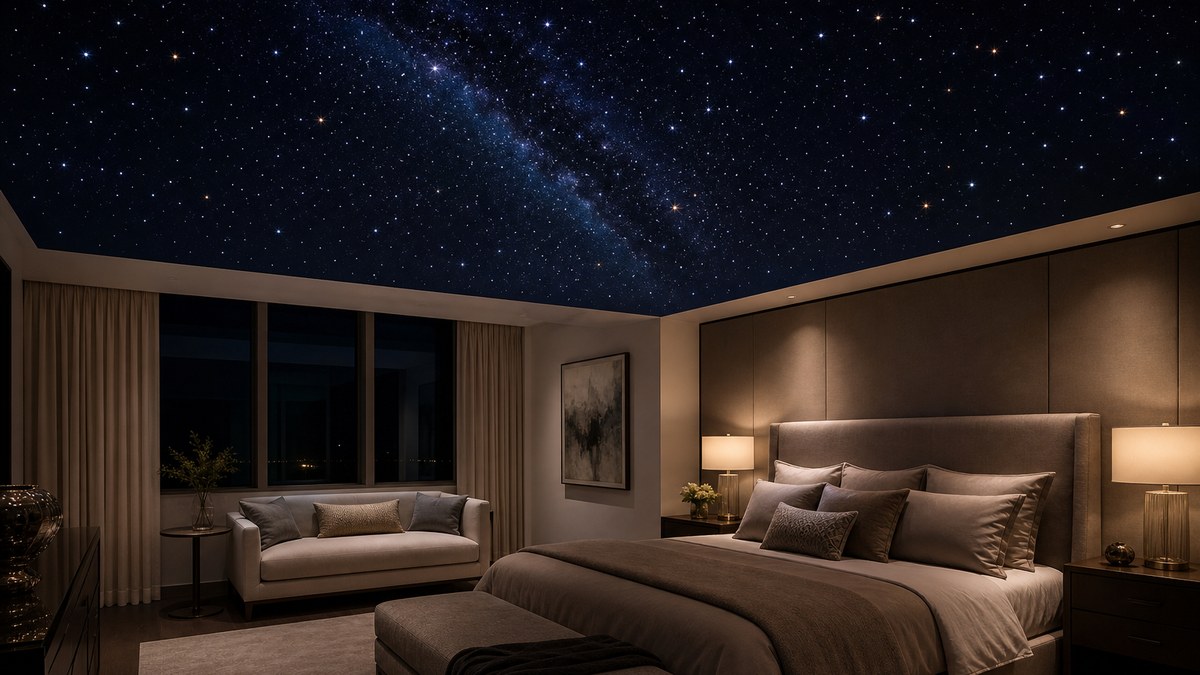
Choosing between a fiber optic star ceiling vs an LED projector is the first decision most people face when they want a night sky indoors. Both put "stars" on your ceiling, and online listings make them look similar. In a real room they are very different products: one is a permanent lighting system built into the ceiling, the other is a plug-in lamp that throws a pattern of light from across the room.
This guide compares the two side by side: how each one works, how they look in daylight and darkness, how they handle effects like twinkle and shooting stars, installation, safety, noise, maintenance and which rooms suit each one. We also cover the in-between options, LED star panels and LED "pixel" ceilings, so you can see the whole picture before you buy. It is written for homeowners, designers, home theater integrators and contractors.
A fiber optic star ceiling is the better choice for a permanent, realistic night sky: each star is a real point of light in the ceiling, it stays crisp at any distance and it works with the room's design. An LED or laser galaxy projector is the better choice for a temporary, renter-friendly, no-installation effect, especially in kids' rooms.
- Realism: fiber optic wins — sharp pinpoint stars in several brightness levels
- Installation: projector wins — plug it in and aim it
- Room light: fiber stars stay visible with dim lamps on; projections wash out
- Effects: both change color; fiber adds true twinkle, shooting stars and Milky Way bands
- Permanence: fiber is part of the room; a projector moves, gets bumped and is replaced
- Pricing: quote-based for fiber optic systems — depends on ceiling size, star density, effects and installation
How each one works
The two approaches create stars in opposite ways. A fiber optic ceiling puts the light in the ceiling. A projector puts light on the ceiling from somewhere else in the room.
Fiber optic star ceiling
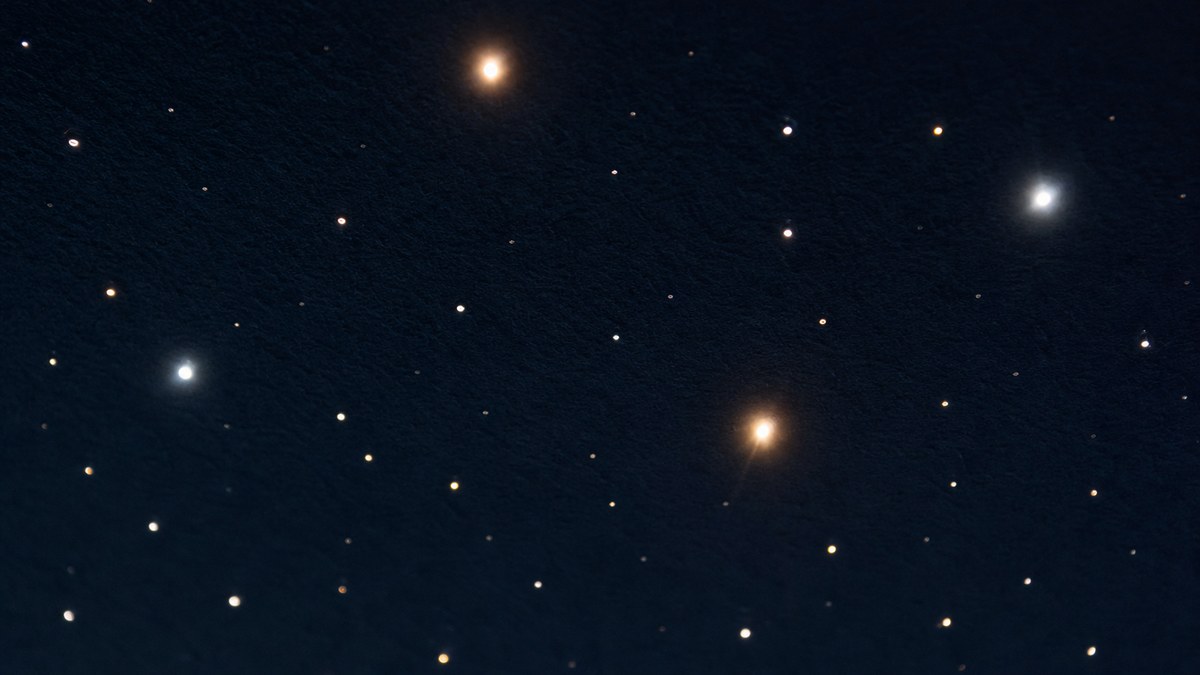
A fiber optic system has three parts. A hidden LED light engine (also called an illuminator) sits in the attic, a closet or above a drop ceiling. A bundle of fiber optic strands carries light from the engine to the ceiling. Each strand passes through a small hole in the ceiling surface — drywall, a star panel, an acoustic tile or stretch fabric — and is trimmed flush, so its tip glows as a single star. Using several fiber diameters creates bright "anchor" stars and many faint ones, just like the real sky. For a deeper look at the engine itself, see our guide on how starlights and fiber optic light engines work.
LED and laser star projectors
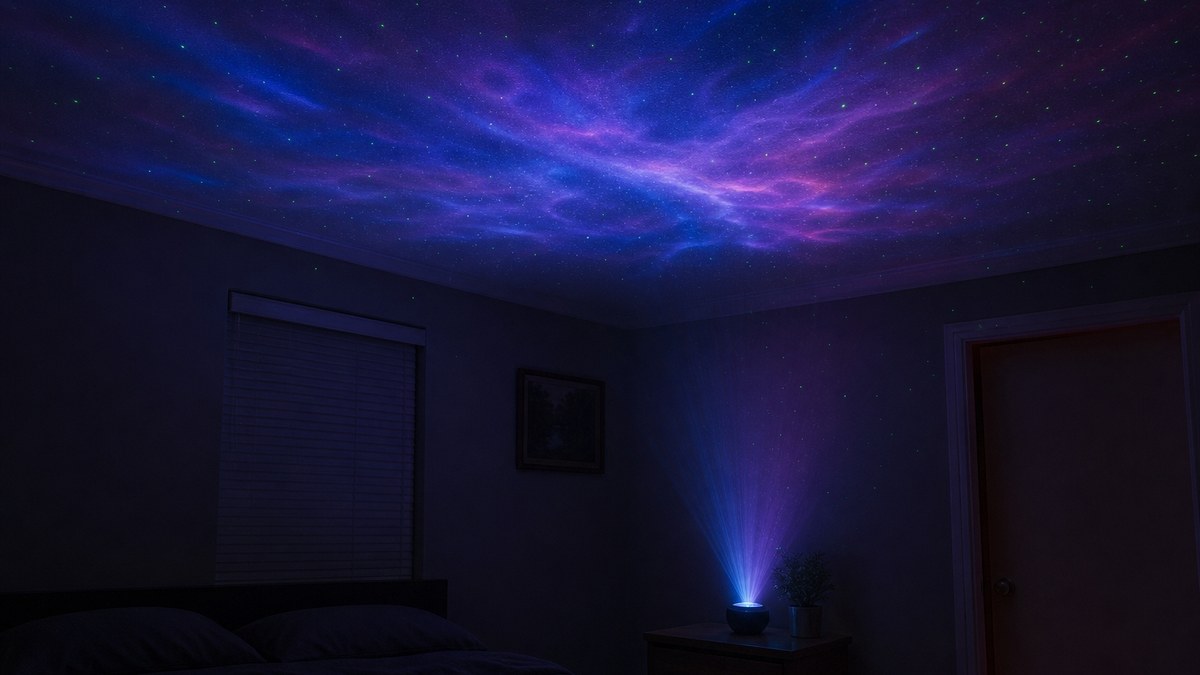
A star projector (often sold as a galaxy, nebula or sky projector) sits on a nightstand, shelf or wall mount. Inside, colored LEDs shine through a lens and patterned plate to create soft nebula clouds, and many models add a low-power laser passed through a diffraction element to scatter hundreds of small dots that read as stars. Motors rotate the pattern slowly. Everything you see is light reflected off the ceiling paint, so the image depends on distance, angle and how dark the room is.
The in-between options
- Pre-made fiber optic star panels: the same fiber technology, with fibers already installed in ceiling or acoustic panels. See our star ceiling panels guide.
- LED pixel or "matrix" ceilings: grids of tiny LEDs behind a fabric or panel surface. They can animate patterns, but each point is a small LED with electronics at the ceiling.
- LED downlights or strips sold as star lights: decorative, but each point looks like a small fixture rather than a star.
Fiber optic vs projector: side-by-side
| Factor | Fiber optic star ceiling | LED / laser projector |
|---|---|---|
| Star look | Sharp pinpoints in the ceiling surface, varied sizes | Soft dots and clouds; sharper laser dots on some models |
| With a lamp on | Stars stay visible at low room light | Image fades quickly as ambient light rises |
| Coverage | Exactly where you place fibers — corner to corner, vaulted or curved | A cone of light; edges distort on angled or high ceilings |
| Effects | Twinkle, shooting stars, color, Milky Way, constellations | Nebula clouds, rotation, color, some "aurora" modes |
| Shadows | None — light comes from the ceiling | People, ceiling fans and furniture cast shadows through the image |
| Noise | Engine sits outside the room; fanless or remote-mounted options | Rotation motor and fan in the room can hum |
| Installation | Planned install: drilling and threading, panels or tiles | None — plug in, aim, use the remote or app |
| Permanence | Built into the room and the home's design | Portable; moves with you |
| Serviceable part | Light engine, replaceable without touching the ceiling | Whole unit is replaced when it fails |
| Pricing | Project-specific quote | Retail consumer product |
Realism: why fiber stars look real
The real night sky is made of points, not blobs. When you look up away from city lights you see a handful of bright stars, many faint ones and a soft band of the Milky Way. Fiber optic ceilings reproduce this because each star is a physical point of light the size of the fiber tip. Mixing fiber diameters gives different brightness levels, and shuffling the fibers before they reach the engine means neighboring stars twinkle independently.
A projector spreads its pattern over the whole ceiling from one source. The farther the ceiling, the larger and softer each dot becomes. On flat, low ceilings close to the projector the effect can be pleasant; on high, vaulted or textured ceilings, dots stretch and blur at the edges. Nebula clouds look impressive in photos and videos, but in person they read more as colored light wash than sky.
Projected light also only works in near-total darkness. Turn on a reading lamp and the image fades. A fiber ceiling is the light source itself, so stars stay visible at low room light — useful in a bedroom where someone is still reading, or a lounge where guests need some light to move around. Our starlight effects guide shows how twinkle, shooting stars and color look on a real fiber ceiling.
Effects and control
What fiber optic systems can do
- Twinkle: mechanical twinkle wheels or electronic twinkle make stars shimmer at a speed you choose.
- Shooting stars: dedicated fiber runs light in sequence to create a meteor streak across part of the ceiling.
- Milky Way: a dense band of fine fibers, often with a subtle painted or printed backdrop.
- Constellations: fibers mapped to real star positions — a birthday sky, an anniversary or a favorite place.
- Color: RGB or RGBW engines shift from warm white to blue to slow color fades.
- Control: remotes, wall controls, timers and, on many systems, integration with smart-home or theater control so stars dim when the film starts.
What projectors can do
- Nebula and aurora: soft, moving colored clouds, which fiber ceilings do not imitate directly.
- Rotation: the whole pattern turns slowly; some people find it relaxing, others find motion distracting at bedtime.
- App and voice control: many consumer models connect to phone apps and smart speakers.
- Sleep timers and music modes: common on kids' and bedroom models.
If moving nebula color is the main thing you want, a projector does that well. If you want a sky that looks like a sky — still, deep and dotted with real stars — fiber optic is the stronger match.
Installation: plug-in vs built-in
This is where projectors win outright. A projector needs a shelf and an outlet. A fiber optic ceiling needs planning: where the light engine goes, how fibers reach every part of the ceiling, how many stars and which effects, and how the ceiling surface will be prepared.
- Plan the layout: density, bright-star placement, Milky Way band and shooting-star paths.
- Place the light engine: accessible, dry and ventilated, within reach of the fiber bundle.
- Prepare the ceiling: attic access above drywall, a drop ceiling, open joists, or panels if there is no access.
- Drill and thread: small holes for each fiber, fed from above or pre-installed in panels.
- Shuffle, connect and trim: mix fibers for independent twinkle, bundle into the engine, trim flush and test.
Small rooms can be a weekend project with a kit — our DIY star ceiling kit guide walks through it. Finished ceilings without attic access usually suit pre-made star panels, and larger or commercial rooms are best handled by a professional installer such as our partner American Starlight Ceilings.
If you cannot drill into the ceiling, a projector is the simple option. Surface-mounted star panels are a middle ground in some rentals because they attach as a unit — check your lease and with the property owner first.
Safety, heat and noise
Fiber optic ceilings
The fibers carry only light — no electricity and no heat at the ceiling surface. That is why fiber optic stars are used in bathrooms, steam rooms, saunas and pool houses, with the light engine kept outside the wet area in a dry, ventilated location. Hard-wired engines, new outlets and all commercial work should be handled by a licensed electrician following local codes.
Projectors
Projectors are low-voltage consumer devices, but many use a laser for the star dots. Follow the manufacturer's warnings: do not look into the aperture, keep the beam away from eye level, and position it where small children cannot stare into it. Projectors also sit in the room, so their motor and fan noise is right next to the bed or seats. In a quiet bedroom or a home theater, even a soft hum is noticeable.
Ready for a real fiber optic sky?
Send us your room size, ceiling type and the effects you want. We will recommend components, a kit or panels, or connect you with an installation partner.
Which is better for each room?
Master bedrooms
For a calm, permanent sky over the bed, fiber optic is the better fit: natural density, warm white or soft blue stars, slow twinkle and a timer that fades the sky after you fall asleep. A projector's rotation and motor noise can work against sleep. Ideas and layouts are in our star light bedroom ceiling guide.
Kids' rooms and nurseries
Projectors are popular here because they are quick and fun, and kids outgrow themes. If you choose one, keep laser apertures out of reach and away from eye level. A small fiber optic kit or star panel is a longer-term option that doubles as a gentle nightlight with no device near the bed.
Home theaters and media rooms
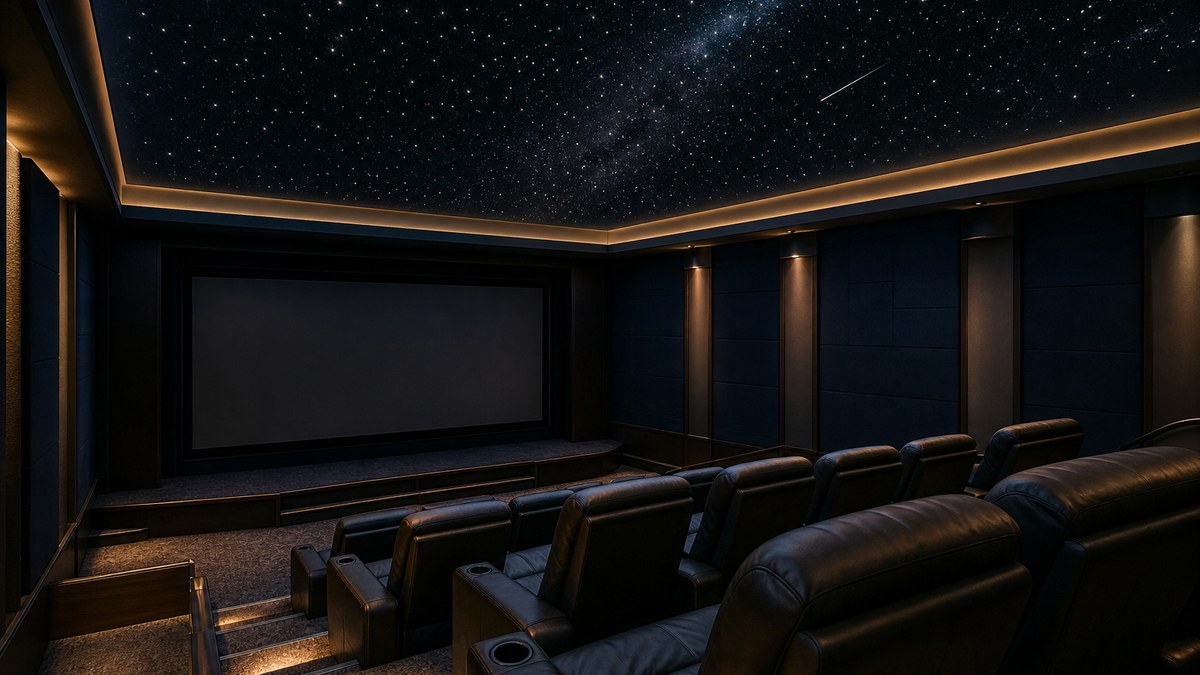
Fiber optic is the clear choice. A projector competes with the screen, casts shadows when people stand up and adds noise in the room. A fiber ceiling with acoustic star panels, a Milky Way band and theater-controlled dimming becomes part of the room's design. See our home theater star ceiling design guide.
Basements
Drop ceilings and open joists make fiber optic installation easier than most people expect: star tiles replace standard drop-ceiling tiles, and fibers can be routed before drywall. Our basement ceiling star lights guide covers each ceiling type.
Bathrooms, spas and saunas
Fiber optic only. Projectors are not designed for steam and humidity, while fibers carry no electricity at the ceiling.
Restaurants, bars, lounges and hotels
Commercial spaces need a ceiling that works every night for years, looks good with some room light on and does not depend on a device someone can bump. That points to fiber optic systems with durable controls and color scenes, coordinated with building and fire codes. For whole-building and facade lighting, our sister company WDM Lighting takes on large projects, and our commercial and architectural LED services cover fixtures and controls.
What drives the price
Wiedamark LED quotes fiber optic systems project by project, because no two ceilings are alike. A projector is a retail product with a fixed sticker; a fiber ceiling is a lighting system sized to your room. The main factors are:
- Ceiling area and shape: larger, vaulted or curved ceilings need more fibers, longer runs and sometimes more than one light engine.
- Star density and fiber mix: more stars and more diameters mean more fiber and more installation time.
- Effects: twinkle, shooting stars, Milky Way bands and constellation mapping each add components and labor.
- Ceiling type and access: attic or drop-ceiling access is simpler than a finished ceiling without access.
- Kit, panels or custom install: DIY kits, pre-made panels and fully custom installs each fit different budgets.
- Controls: a simple remote versus integration with smart-home or theater control.
For a full breakdown of these factors, read what drives star ceiling cost, then request a project-specific quote.
Pros and cons at a glance
| Pros | Cons | |
|---|---|---|
| Fiber optic star ceiling | Most realistic; visible at low room light; true twinkle, shooting stars, Milky Way; silent in the room; no heat or electricity at the ceiling; engine is replaceable; adds a design feature | Needs planning and installation; permanent; best results need attic, drop-ceiling or panel access |
| LED / laser projector | No installation; portable; renter-friendly; colorful nebula effects; app and voice control on many models | Soft image that washes out in room light; shadows; motor noise; distortion on high or angled ceilings; laser cautions; replaced rather than serviced |
Can you combine them?
Some people start with a projector to test whether they like a sky overhead, then move to fiber optic once they know they want it permanently. Others keep a projector for kids' play while the bedroom or theater gets a fiber ceiling. Running both on the same ceiling at once rarely helps: the projector's colored wash lifts the background and makes the fiber stars look less crisp.
How to choose: 5 questions
- Is this permanent? If you own the home and want the sky for years, choose fiber optic. If it is temporary or a rental, choose a projector.
- How dark is the room in use? If lamps will often be on, only fiber stars will stay visible.
- Is quiet important? Bedrooms and theaters favor a remote-mounted fiber light engine over an in-room motor.
- What is the ceiling like? High, vaulted or angled ceilings distort projections; fibers follow any shape.
- Which effects matter? Moving nebula color points to a projector; twinkle, shooting stars and a Milky Way point to fiber optic.
Before asking for a quote, note the room's length, width and ceiling height, whether you have attic or drop-ceiling access, the effects you want, and take a photo of the ceiling. That is enough for a supplier to recommend a kit, panels or a custom system in one conversation.
Why buy from Wiedamark LED
Wiedamark LED supplies fiber optic starlight components and kits, fiber optic lighting and commercial and architectural LED products, and helps you choose the right system for the space. Our team brings 15+ years as an authorized architectural lighting dealer and project coordinator. For custom installations we work with American Starlight Ceilings, and for pools and architectural outlines see 360° fiber optic lighting.
Start with our complete starlight ceiling guide, compare every system type in LED star ceiling lights: fiber vs panels vs projectors, or read how LED star light ceilings work. You can also browse our starlight products, product range, gallery, the Luminance design-build program and the full Wiedamark LED blog.
Frequently Asked Questions
Is a fiber optic star ceiling better than a galaxy projector?
Do star projectors look like a real night sky?
Can I leave a star projector on all night?
Are laser star projectors safe for kids?
Is a fiber optic star ceiling worth it?
Do I need attic access for a fiber optic star ceiling?
Can a fiber optic star ceiling change color?
What about LED pixel or matrix star ceilings?
Is a projector or fiber optic better for a home theater?
Where can I get fiber optic star ceiling components or a quote?
Skip the projector — bring the real sky indoors
Tell us about your room and we will follow up with recommendations and a project-specific quote.
Related
Our lighting network: starlight ceiling installation, 360° fiber optic lighting, premium pool lighting, WDM Lighting large projects, Dallas commercial LED lighting, Texas LED lighting, Plano LED lighting, LED signage, modular building solutions and Dallas modular structures.