Home Gym Star Ceiling: How to Plan Fiber Optic Stars for Garage Gyms, Basement Workout Rooms, Yoga & Recovery Spaces
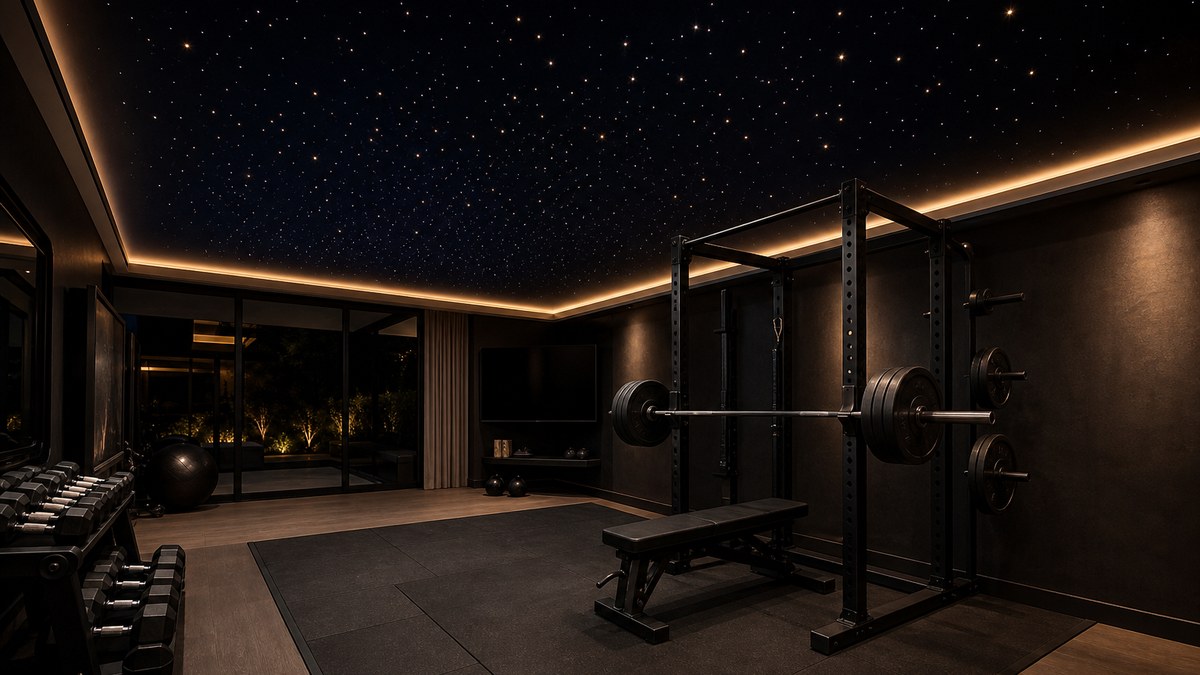
A home gym star ceiling turns the room you train in into a room you want to be in. Fiber optic stars glow softly overhead during a slow yoga flow, a late-night stretch or a cool-down on the bike, then step aside when bright task lighting comes on for heavy lifts. But a gym is not a bedroom. Barbells get pressed overhead, plates get dropped, garages swing from hot to cold, and the ceiling may already carry pull-up bars, fans and a garage door opener.
This guide covers how to plan a star ceiling that survives real training: where the light engine should live, how to keep fiber tips flush and out of the way, how to layer stars with workout lighting, and what changes in a garage gym, a basement gym and a dedicated yoga or recovery room. If you are new to starlight ceilings, start with our complete starlight ceiling guide, then come back here for the gym-specific details.
A home gym star ceiling works best as a fiber optic system: only light travels through the fibers, so the ceiling surface carries no electricity and very little heat, while the light engine sits in a protected, ventilated spot away from impact and vibration. Plan it this way:
- Mark the no-star zones first: rack uprights, pull-up bar mounts, overhead press clearance, fans and garage door tracks.
- Keep every fiber tip flush with the ceiling so nothing protrudes into lifting space.
- Mount the light engine away from the drop zone, on a solid surface with airflow and service access.
- Layer the lighting: bright, even task light for training and a separate star scene for yoga, stretching and recovery.
- In garages, plan around temperature swings, dust and garage-to-house fire separation rules before drilling.
- Choose the mounting system (drill-through kit, panels, drop ceiling tiles or a floating cloud) by what is above the ceiling.
Why a star ceiling works in a home gym
Most home gyms are lit like a warehouse: one bright fixture, every surface flat and harsh. That is fine for a working set, but it makes the room feel like a utility space the rest of the time. A starlight ceiling gives the gym a second personality without taking any floor space.
- Recovery and mobility work: stretching, foam rolling and breathing work feel very different under a dim, starry sky than under bright overhead light.
- Yoga and Pilates: floor work means you spend much of the session looking up. The ceiling becomes the view.
- Cardio sessions: a long ride or row in a darkened room with stars overhead (and a screen in front of you) is easier to settle into.
- Atmosphere for training partners: a garage gym that doubles as a hangout space benefits from a scene that is not just "on."
- Resale and wow factor: a finished gym with layered lighting reads as a designed room, not a converted garage.
The key is that stars are a scene, not the main light. Nobody should be loading a barbell by starlight. Our LED star ceiling lights guide compares fiber optic stars, LED panels and projectors if you are still deciding on the technology.
Fiber optic vs LED panels vs projectors for a gym
The right technology for a gym is driven by impact, heat, dust and how the room is used. Here is how the three common approaches compare in a workout space:
| Option | How it works | In a home gym | Watch out for |
|---|---|---|---|
| Fiber optic star ceiling | A remote light engine sends light through optical fibers; each fiber end is a star | Strong fit: no electrical parts at the ceiling, flush tips, the engine can be placed away from impact and dust | Needs access above, a panel system or a build-down; engine location must be planned |
| LED star panels | Panels with LEDs or fibers built in, mounted to the ceiling | Workable on finished ceilings with no access | Check whether the panel contains electronics, how it is fastened and whether edges sit in the lift path |
| Galaxy projector | A small projector throws a moving star and nebula pattern onto the ceiling | Fine as a temporary or rental-friendly option | Shadows from racks and bodies, fuzzy stars, a device sitting where it can be knocked over |
For a dedicated gym, a fiber optic system is usually the most durable answer because the part that can fail or get warm, the light engine, lives somewhere safe. For a deeper side-by-side, read fiber optic star ceiling vs LED projector, and if you want to understand what is inside the engine, see how starlights and fiber optic light engines work.
Step 1: map the no-star zones
In a bedroom you can put stars anywhere. In a gym, start by marking where stars should not go. Sketch the ceiling, or tape it out on the floor, and mark:
- Rack and rig footprints: uprights of a power rack, wall-mounted folding racks and any ceiling-tied rigs. Stars directly above a rack are hidden by the crossmember and hard to service.
- Pull-up bar and ring mounts: ceiling-mounted bars and rings bolt into framing. Keep fibers and holes well clear of the lag bolts and blocking.
- Overhead press and jump zone: wherever a barbell, kettlebell or wall ball goes overhead, keep the ceiling clean and flush. No crystal end fittings or decorative trims here.
- Fans, heaters and lights: ceiling fans, garage heaters, recessed lights and smoke or CO detectors all need clearance.
- Garage door hardware: the track, the opener rail and the open door itself cover a large part of many garage ceilings.
- Mirror walls: a mirror reflects the stars nearest it, which can double the effect. Plan the density near the mirror on purpose.
What is left is your star field. In many gyms that is the area over the open floor: the yoga mat zone, the cardio corner or the center of the room. A focused field over the right zone usually looks better than stars spread thinly over a whole garage.
Step 2: choose a mounting system by what is above the ceiling
The structure above your gym ceiling decides which install method is realistic.
Attic above (common in garage gyms)
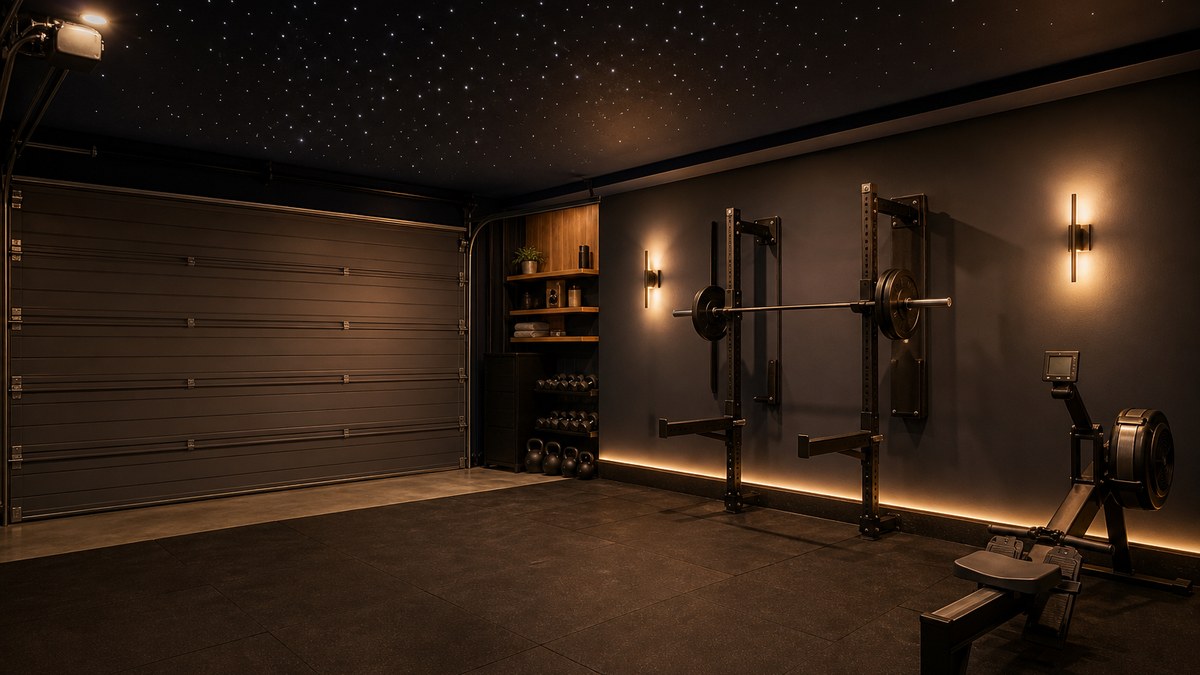
Many attached and detached garages have trusses and an attic above. That is the easiest case for a drill-through fiber kit: holes are drilled from below, fibers are threaded from the attic, and the engine is placed above or in an accessible spot nearby. Our DIY star ceiling kit installation guide walks through the threading process step by step.
Living space above (garage under a bedroom, basement gym)
If there is a finished room above, you cannot work from the top side. Options are pre-made star ceiling panels, a build-down ceiling with fibers run in the new cavity, or a floating star cloud over the training floor. All of these are covered in star ceiling without attic access.
Open joists (unfinished basement gym)
Open joists make fiber routing easy, but you will want to close the ceiling eventually to hide the fibers and engine. Many basement gyms use a suspended grid with drop ceiling star tiles, which keeps ductwork and plumbing accessible. See our basement ceiling star lights guide and the basement home theater star ceiling guide for low-ceiling and ductwork strategies that apply just as well to a gym.
Low ceilings
Ceiling height matters more in a gym than almost any other room. Before you lower a ceiling with a build-down or a grid, measure your overhead press, jump rope and pull-up clearance. In tight basements, a drill-through approach into the existing ceiling, or a cloud placed only over the mat area, often protects headroom better than lowering the whole ceiling.
Step 3: place the light engine where training cannot reach it
The light engine (also called an illuminator) is the only powered part of a fiber optic star ceiling. In a gym, where you put it matters more than what model it is.
- Away from the drop zone. Dropped weights and slammed balls send vibration through slabs and framing. Mount the engine on a solid surface away from the lifting platform, not on a joist directly above it.
- Ventilated. Engines need airflow. Avoid sealing one inside insulation or a tight soffit.
- Serviceable. Put it where you can reach it later: an attic near the hatch, a closet, a utility room or an access panel. Because the fibers carry only light, the engine can usually be serviced or replaced without disturbing the ceiling.
- Within the manufacturer's operating temperature range. This is the big one for garages. Attics over garages can get very hot in summer and very cold in winter. Check the engine's specified operating range and choose a location that stays inside it, which may mean a conditioned closet next to the garage rather than the garage attic.
- Protected from dust. Garage gyms collect chalk and dust. Keep the engine out of the dustiest area and plan to clean intake vents.
- Near power. The engine needs a power source. Have a licensed electrician add a receptacle or switched circuit where needed.
The fiber length in the kit must reach from the engine to the farthest star you plan, with gentle bends. Fix the engine location before you choose a kit so the fiber lengths are right.
When a garage is attached to a home, building codes require a fire-resistant separation between the garage and the living space. Under the International Residential Code (Section R302.6), a garage ceiling with habitable rooms above calls for specific fire-rated gypsum board, and penetrations through that separation need proper treatment. Before drilling star holes into a garage ceiling below a living space, or into any garage-to-house separation, check with your local building official and your installer. A build-down or a floating cloud below the existing rated ceiling is often the cleaner path.
Step 4: layer the lighting for training and recovery
A home gym star ceiling should be one layer in a small lighting plan, not the only light in the room. Think in scenes:
| Scene | Main light | Stars | Accent |
|---|---|---|---|
| Strength training | Bright, even, glare-controlled overhead light | Off or low | Optional |
| Cardio / ride | Dimmed | On, medium | Low cove or perimeter glow |
| Yoga / mobility | Off | On, low and slow twinkle | Warm, very low |
| Cool-down / recovery | Off | On, lowest dim level | Warm or off |
| Social / garage hangout | Low | On, optional color | Color or warm white |
A few practical rules make the layers work together:
- Separate circuits or zones. The training light and the star engine should be controlled independently.
- Glare-controlled task light. You look up during bench presses, pull-ups and floor work. Choose fixtures that do not shine straight into your eyes, and keep them away from the star field so they do not wash it out.
- Perimeter or cove glow. A soft LED cove or strip around the edge of the ceiling lets you see the room during a star scene without killing the effect. Our architectural LED range covers cove and linear options.
- Simple control. A wall keypad or scene button by the door gets used. A remote that lives in a drawer does not.
Planning stars over your training floor?
Send us your ceiling dimensions, a photo of the room, what is above the ceiling and where your rack and mats live. We will recommend the engine, fiber count, diameter mix and mounting system, then send a project-specific quote.
Step 5: pick the star design for the way you train
The same fiber optic components can produce very different skies. Match the design to the room's main use.
Yoga, Pilates and stretching rooms
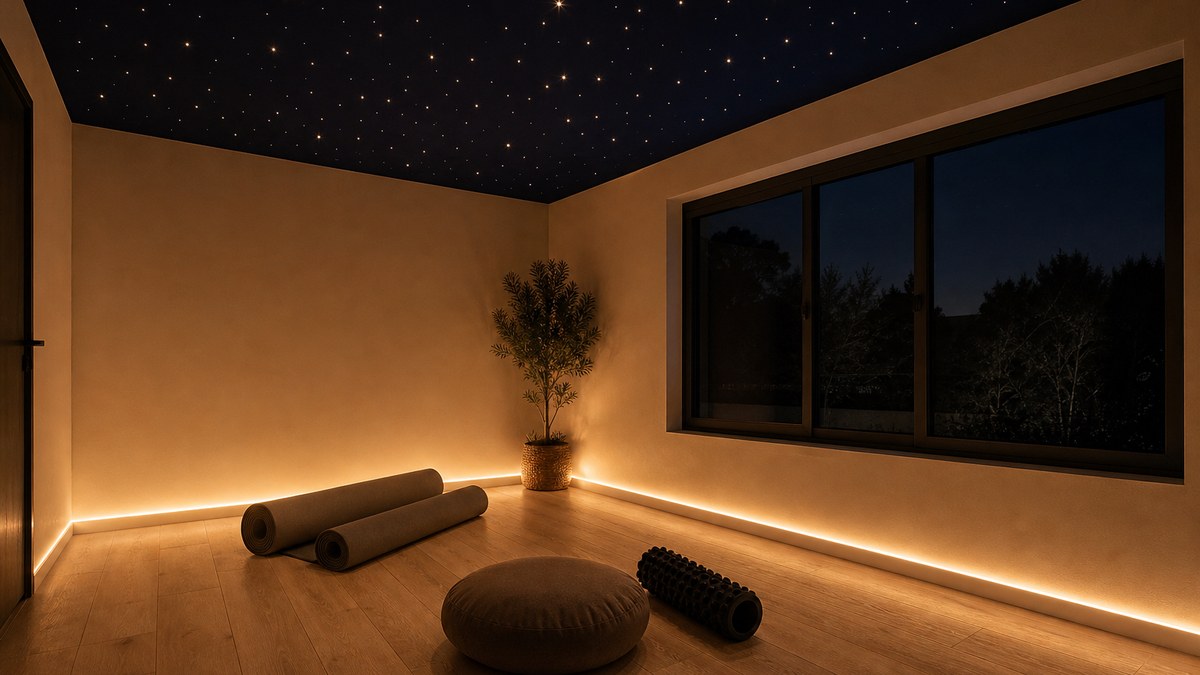
Calm, natural and warm. A moderate star density, a realistic mix of fiber diameters so a few stars stand out, a slow or very subtle twinkle and warm white engines suit floor work. Keep effects quiet: you will be looking straight up for long stretches.
Cardio and spin corners
More energy is fine here. A denser field, a gentle color-changing scene or a Milky Way band across the ceiling gives you something to look at during long sessions. A shooting star or Milky Way effect can be added as its own zone.
Garage gyms that double as hangout space
RGBW color-changing engines let you switch from a clean white sky after a workout to a colored scene when friends come over. If you want both, choose RGBW rather than RGB so the white stars stay clean. Our fiber optic star ceiling kit buyer's guide explains RGB vs RGBW and other engine choices.
Recovery rooms, sauna anterooms and cold-plunge areas
Recovery spaces near a sauna, steam shower or cold plunge face moisture and humidity. Fibers themselves carry no electricity, which is one reason fiber optics are used around wet areas, but the engine must stay in a dry, ventilated location outside the wet zone, and any product used near water must be rated for that location. For heat and humidity rooms, ask for a system specified for that environment rather than adapting a bedroom kit.
Durability details that matter in a gym
Gyms are hard on finishes. A few details keep a star ceiling looking right years later:
- Flush tips, no protrusions. Fibers should be trimmed flush with the finished ceiling. Decorative crystal end fittings are better kept to a lounge or bar, not over a lifting area.
- Secured fiber bundles above. Fibers should be supported above the ceiling so vibration does not pull them back through the holes over time.
- Gentle bends. Sharp bends reduce light output and can damage fibers. Leave sweeping curves at every turn.
- Paint and finish. Dark, matte ceiling finishes make stars pop and hide scuffs. Plan paint before trimming fibers, or protect tips during painting.
- Impact-resistant zones. If a wall ball or medicine ball can hit the ceiling, keep stars out of that zone or use a panel system designed to be replaced.
- Acoustics. Gyms are loud. Fabric-wrapped acoustic star panels can add stars and absorb sound in the same product, which helps with music and echo.
- Dust and chalk. Wipe fiber tips gently with a soft dry cloth if dust builds up, and keep the engine's vents clear.
Garage gym vs basement gym: what changes
| Factor | Garage gym | Basement gym |
|---|---|---|
| Access above | Often an attic over the garage; sometimes a bedroom above | Usually living space above; open joists if unfinished |
| Best mounting | Drill-through kit from the attic, or a build-down below a rated ceiling | Drop ceiling star tiles, a build-down, panels or a cloud |
| Engine location | Watch attic temperatures; a conditioned closet may be better | Utility room, closet or accessible soffit |
| Ceiling height | Usually generous; garage door hardware takes space | Often tight; ducts and beams compete for headroom |
| Environment | Temperature swings, dust, vehicle exhaust if shared | Moisture management, sound transfer to rooms above |
| Code check | Garage-to-house fire separation rules | Egress, ceiling height and general basement finishing rules |
DIY or professional install for a gym ceiling?
Plenty of homeowners install a fiber optic kit themselves, especially in a garage with easy attic access. A gym adds a few reasons to bring in help:
- The ceiling is part of a garage-to-house fire separation.
- There is a finished room above and no access.
- You want stars combined with acoustic panels, a cloud or integrated cove lighting.
- You need new circuits for the engine and task lighting.
- The star field must work around heavy rigs bolted into the framing.
Our star ceiling installation guide explains how a professional install runs and how to choose an installer. Wiedamark LED supplies the components and design help; for custom installation we work with our partner American Starlight Ceilings.
Common home gym star ceiling mistakes
- Using stars as the only light. Training needs bright, even light. Stars are the scene for everything else.
- Mounting the engine above the platform. Vibration, dust and heat in the wrong spot shorten its life and make service harder.
- Ignoring garage attic temperatures. Check the engine's operating range before you choose the attic.
- Drilling a rated garage ceiling without checking. Ask your building official first.
- Stars behind the rack. A crossmember or crossbar hides them. Put the field where you actually look up.
- Too thin a field over too big a ceiling. Focus stars over the mat or cardio zone instead of spreading them across the whole garage.
- Buying fiber that is too short. Fix the engine location first, then size the fiber lengths.
- No dimming. Recovery and yoga scenes need very low light levels. Choose an engine with smooth dimming.
What it costs and how to get a quote
Every home gym star ceiling is quoted per project because the variables change so much from room to room: the starred area, star density and fiber diameter mix, the number of engines, white vs color-changing engines, effects such as a Milky Way band or shooting stars, the mounting system, whether a build-down or acoustic panels are involved, and whether you install it yourself or hire an installer. Our star ceiling cost guide and luxury star ceiling cost factors explain each driver in detail.
For an accurate, project-specific quote, send us:
- The ceiling dimensions and height, plus the area you want starred
- What is above the ceiling: attic, living space, open joists or a drop grid
- Photos of the room, including racks, rigs, fans and garage door hardware
- Where an engine could live and whether power is nearby
- The look you want: calm white, color changing, Milky Way, shooting stars
- Whether you plan to install yourself or want an installer

Why choose components from Wiedamark LED
Wiedamark LED supplies fiber optic starlight ceiling components and kits, fiber optic lighting and commercial and architectural LED, with trade pricing for contractors, designers and integrators. Our team brings 15+ years as an authorized architectural lighting dealer and project coordinator. We help you size the engine, fiber count and diameter mix for your gym ceiling and plan where the engine should live, rather than selling a one-size-fits-all box. When you need custom installation, we work with American Starlight Ceilings. Our licensed installation partner has completed over 200 major sports and commercial projects across the US and Canada — NFL, NBA, NHL, MLS, NCAA and NASCAR. For large commercial fitness clubs, hotels and venues, our sister company WDM Lighting handles large projects.
Explore our starlight ceiling products, our full product range, the project gallery, fiber optic lighting, the Luminance design-build program, the guide to star light bedroom ceilings, how LED star light ceilings work and the rest of the Wiedamark LED blog.
Frequently Asked Questions
Can you put a star ceiling in a home gym?
Is a fiber optic star ceiling safe in a garage gym?
Will dropping weights damage a star ceiling?
Where should the light engine go in a home gym?
Can I have bright workout lighting and a star ceiling together?
What is the best star ceiling for a yoga or recovery room?
Can I install a star ceiling in a basement gym with a low ceiling?
Should a home gym star ceiling be color changing?
Can I add a star ceiling near a sauna or cold plunge?
How much does a home gym star ceiling cost?
Ready to put stars over your home gym?
Tell us about your garage, basement or studio ceiling and how you train. We will recommend the right fiber optic components and send a project-specific quote.
Related
Our lighting network: starlight ceiling installation, 360° fiber optic lighting, premium pool lighting, WDM Lighting large projects, Dallas commercial LED lighting, Texas LED lighting, Plano LED lighting, LED signage, modular building solutions and Dallas modular structures.