Acoustic Star Ceiling Panels: How Fiber Optic Star Panels Treat Sound in Home Theaters, Media Rooms & Private Cinemas
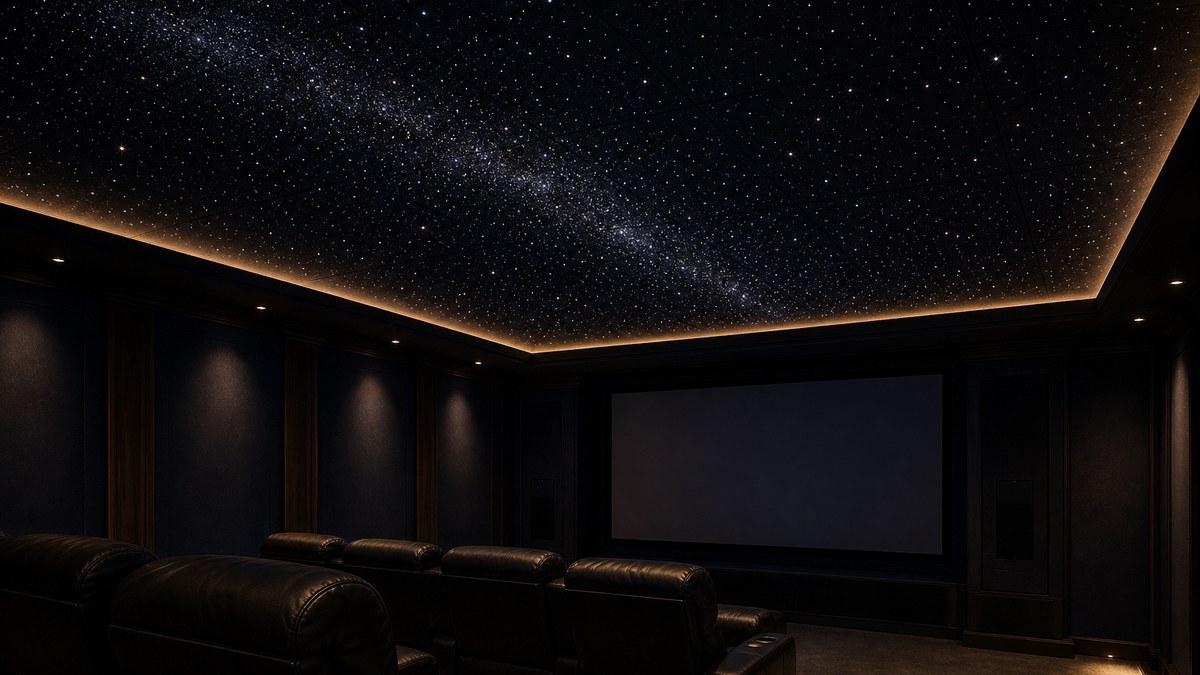
Acoustic star ceiling panels do two jobs at once. They put a fiber optic night sky over your seats, and they absorb sound that would otherwise bounce off a hard ceiling and muddy dialogue, music and surround effects. That combination is why they have become the go-to ceiling for dedicated home theaters, media rooms and private cinemas, and why so many people searching for a star ceiling for a theater room end up asking the same questions: do acoustic star panels actually help the sound, do they soundproof the room, how do they mount, and how do they work with ceiling speakers?
This guide answers those questions in plain language. It is the acoustic chapter of our complete starlight ceiling guide and builds on the home theater star ceiling design guide. We cover how acoustic star panels are built, the difference between absorbing sound and blocking it, where panels belong in a theater, how to plan around Atmos and other ceiling speakers, mounting and light engine placement, and what to send us for a project-specific quote.
Acoustic star ceiling panels are sound-absorbing ceiling panels, usually a porous core wrapped in acoustically transparent fabric, with fiber optic strands passed through the face to create stars. The fibers are lit by an LED light engine mounted out of sight. They reduce echo and ceiling reflections, which makes a theater sound clearer, but they are not soundproofing: they do not stop sound from traveling to other rooms.
- Absorb, not block: they tame reflections inside the room; isolation needs mass, decoupling and sealing in the ceiling structure.
- Best spots: the ceiling reflection zone between the front speakers and the seats, then the rest of the ceiling for a full sky.
- Plan the speakers first: leave cutouts or gaps for in-ceiling and height speakers before panels are ordered.
- Keep access: the light engine should sit where you can reach it, never sealed inside a soffit.
- Pricing: project-specific; it depends on panel count, star density, effects and engines. Request a quote.
What acoustic star ceiling panels actually are
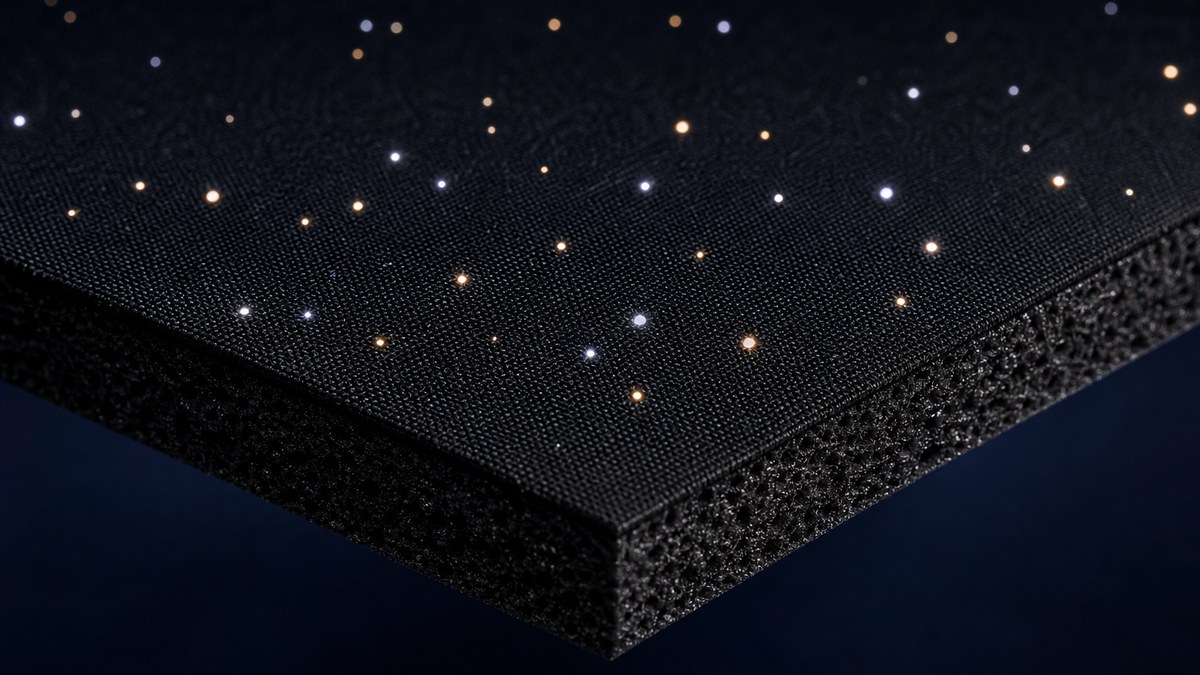
A standard star ceiling panel is a rigid board with fiber optic strands set through it. An acoustic star ceiling panel adds sound control to that idea. In most designs the panel has a frame, a porous sound-absorbing core (often a fiberglass or mineral wool board, or a similar acoustic material), and a stretched fabric face that sound passes through easily. The fiber optic strands are pushed through the core and the fabric so each tip sits flush with, or just proud of, the fabric surface. Behind the panel, the fibers are gathered into a tail that runs to the light engine.
The result looks like a dark fabric ceiling with a night sky in it. Because the fabric is usually black, charcoal or deep navy, it also helps the room disappear when the lights go down, which is exactly what you want in a theater. If you are new to how the stars themselves are made, our guide to how starlights and fiber optic light engines work explains illuminators, twinkle wheels and fiber sizes, and what LED star light ceilings are and how they work is a good primer.
The parts of an acoustic star ceiling
- Acoustic core: the porous layer that absorbs sound energy. Its thickness and density shape how well it absorbs lower and higher frequencies.
- Acoustically transparent fabric: the visible face. It needs to let sound through to the core while hiding it, and it must be dark enough for the stars to stand out.
- Frame and edges: a rigid perimeter that keeps the panel flat and gives a clean, crisp edge where panels meet.
- Fiber optic strands: usually a mix of diameters, so you get a few bright stars and many faint ones, set in a random pattern.
- Fiber tail: the bundle of strands leaving the back of each panel and running to the light engine.
- Light engine (illuminator): the LED source that lights the fibers and adds twinkle, dimming and, if chosen, color.
- Mounting hardware: clips, rails or cleats that hold the panel to the ceiling and allow it to come down for service.
Acoustic panels vs standard star panels
Standard rigid star panels look great and are often thinner, but a hard face reflects sound much like drywall. Acoustic star panels trade a little thickness for absorption. In a bedroom or a living room that already has soft furnishings, standard panels are usually fine. In a dedicated theater or media room, where clarity and immersion are the point, acoustic panels are usually the better choice. Our star ceiling panels guide compares panel types for drywall, drop ceilings and no-drill installs, and our star ceiling kit vs panels comparison helps if you are still deciding between panels and a DIY kit.
Absorption vs soundproofing: the most important distinction
The most common misunderstanding about acoustic star panels is that they will keep movie sound from reaching the bedroom upstairs. They will not, and no panel of this kind will. Two different things are going on in a room, and they need different solutions.
- Absorption (room acoustics): controls how sound behaves inside the room. Porous panels soak up some of the sound that hits them, so fewer reflections arrive at your ears a split second after the direct sound. This improves dialogue clarity, imaging and the sense of envelopment. It is usually described with an absorption rating such as NRC (noise reduction coefficient), where a higher number means more absorption across the speech range.
- Isolation (soundproofing): controls how much sound leaves the room. That depends on mass, airtight sealing and decoupling the ceiling from the structure above, for example with resilient channels or isolation clips, extra drywall layers and sealed penetrations. It is usually described with a transmission rating such as STC.
Acoustic star panels belong in the first category. If you also need isolation, it has to be built into the ceiling first, and the star panels go on top of the finished, isolated ceiling. This matters for planning: every hole you drill through an isolated ceiling for fibers or wiring is a potential sound leak, which is one reason surface-mounted acoustic star panels, with their fibers contained in the panel and their tails routed carefully, are popular in rooms that have been soundproofed.
| Goal | What solves it | Do acoustic star panels help? |
|---|---|---|
| Clearer dialogue | Absorbing early reflections from the ceiling and walls | Yes, especially in the ceiling reflection zone |
| Less echo and slap | Absorptive surfaces spread around the room | Yes, as part of a balanced treatment plan |
| Tighter surround imaging | Controlling reflections near the listening position | Yes, with side wall and rear treatment too |
| Controlling deep bass | Bass traps, thicker absorbers, room layout, subwoofer placement and EQ | Only partly; thin panels do little for low bass |
| Keeping sound out of other rooms | Mass, decoupling and sealing in the ceiling and walls | No; panels go on top of an isolated ceiling |
| Blocking noise coming in | The same isolation methods, plus quiet HVAC | No |
Where acoustic star panels do the most good
Not every square foot of ceiling matters equally for sound. Acoustic designers usually start with the reflection points: the places where sound from the speakers bounces once before reaching the listeners. On the ceiling, the most important zone is typically between the front speakers (left, center, right) and the main seating row. Sound from the screen wall hits that area and reflects down toward your ears. Absorbing it is one of the most noticeable improvements you can make to dialogue clarity.
A simple way to find the zone is the mirror method: sit in the main seat while a helper slides a mirror across the ceiling; wherever you can see a front speaker in the mirror is a first reflection point. In practice, many theater designs simply cover the front half to two-thirds of the ceiling with absorptive panels and treat the rest for appearance, which works perfectly with a star ceiling because the stars can continue across every panel.
Full sky or a treated field?
- Full ceiling of acoustic star panels: the most immersive look. Every panel carries stars, and the acoustic benefit covers the whole ceiling. Common in dedicated theaters and private cinemas.
- Acoustic field with a border: star panels in the center, with a soffit, cove or plain dark border around the edge. The border can hide speakers, ducts, the light engine and indirect lighting.
- Mixed panels: acoustic star panels over the reflection zone and standard star panels or a painted ceiling elsewhere. Useful in media rooms where the room is already fairly soft.
- Floating cloud: a suspended acoustic star cloud over the seating area, leaving the existing ceiling untouched. Clouds also add some absorption from their back face, and they are a good option when there is no attic access; see star ceiling without attic access.
Do not forget the walls. A star ceiling alone will not fix a room with bare, hard side walls. Most theaters benefit from side wall treatment at the first reflection points, some rear wall treatment and bass control in the corners. Think of the ceiling as one part of a balanced plan, not the whole plan.
Planning around ceiling speakers and Atmos
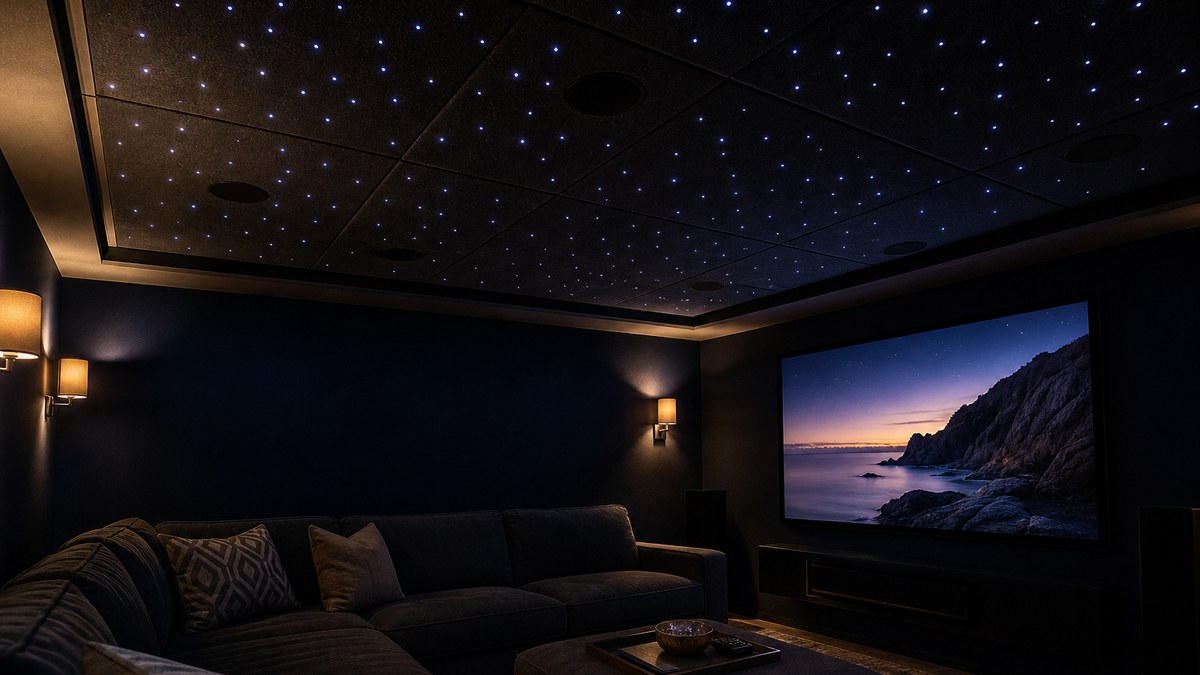
Modern theaters often have height or overhead speakers for immersive formats such as Dolby Atmos. Those speakers usually live in the ceiling, which is exactly where the star panels go. This is the single most important coordination step in an acoustic star ceiling project, and it should happen before any panels are made.
- Lock the speaker layout first: follow the speaker and format maker's placement guidelines for your room size and seating, then mark each speaker location on a ceiling plan.
- Choose how panels meet speakers: options include speaker cutouts in the panels with a matching grille, leaving a gap between panels for the speaker, or mounting speakers above acoustically transparent fabric so they are hidden behind the sky.
- Keep fibers clear of drivers: stars should not be placed where a speaker or its back box sits, and fiber tails must route around speaker cans and cables.
- Hidden speakers need transparent fabric: if speakers sit behind the panel face, that area needs fabric and construction that let sound through rather than absorb it.
- Plan cable paths: speaker wire, fiber tails and power for the light engine should each have a planned route so nothing gets pinched or crosses a panel joint awkwardly.
Send your integrator's speaker plan with your quote request and we will lay the star panels around it. If you do not have a plan yet, tell us the room size, seating rows and the immersive format you intend to use, and we can coordinate the star layout with whoever designs the audio.
Planning a theater ceiling? Let's lay out your acoustic sky.
Send us the room size, ceiling height, seating layout, speaker plan and a few photos. We will suggest a panel layout, star density and light engine setup, and send a project-specific quote.
Designing the sky on acoustic panels
The acoustic job and the visual job should work together. A panel ceiling can easily look like a set of tiles if the star layout is not planned across the whole surface. These are the details that make an acoustic star ceiling read as one sky.
- Random, continuous star field: stars should run right up to panel edges on both sides of every joint, so the eye does not see the panel outlines.
- Mixed fiber diameters: a few larger, brighter stars and many smaller ones create depth. A single fiber size looks flat.
- Milky Way band: a diagonal band of denser, finer stars that crosses several panels. It must be planned across the layout before panels are built.
- Constellations: real constellations or a meaningful date's sky can be mapped across panels; they need careful alignment at the joints.
- Shooting stars: a line of fibers lit in sequence. The path is fixed when the panels are made, so decide early.
- Fabric color: black gives the deepest sky; charcoal and navy can feel softer. Ask for a sample if the color matters to you.
For more design inspiration, see the starlight effects guide and our LED star ceiling lights guide, which compares fiber stars with LED panels and projectors. If you are weighing fiber against a projector for the theater specifically, read fiber optic star ceiling vs LED projector.
How many stars?
Star density is a matter of taste, viewing distance and room size. Theaters are viewed from a reclined position, so the whole ceiling is in view at once; a balanced density with clear variation in brightness usually looks more natural than a very dense, uniform field. Higher ceilings can carry more stars, and a Milky Way band naturally concentrates them. We will suggest a density for your room when we quote it, and we can adjust it to the look you want.
Mounting acoustic star panels and keeping access
Acoustic star panels are surface-mounted to a finished ceiling, a furred ceiling or a cloud frame. The exact hardware depends on the panel design, but the principles are the same for every project.
- Secure to structure: fasten rails, cleats or clips into joists or solid blocking, following the panel maker's instructions and local code.
- Removable panels: panels that hang on clips or cleats can come down for service, which makes fiber and speaker work much easier later.
- Pass-throughs for tails: each panel's fiber tail usually passes through a small opening in the ceiling or runs behind the panels to the light engine. In an isolated ceiling, seal every penetration.
- Air gap: some installs space panels slightly off the ceiling. A gap behind a porous absorber can improve absorption at lower frequencies; ask your acoustic designer whether it suits your room.
- Even joints: a straight, level layout with tight, consistent joints is what makes a panel ceiling look premium.
For step-by-step installation background, see our star ceiling installation guide. For basement theaters with low ceilings, ducts and soffits, the basement home theater star ceiling guide and star ceiling panels for drop ceilings cover the extra planning.
Where the light engine goes in a theater
The light engine is the one part of a star ceiling that needs occasional attention, and in a theater it is also a possible source of noise. Light engines usually have a cooling fan, and engines with a mechanical twinkle wheel have a small motor. In a quiet room during a soft movie scene, you want neither near your ears.
- Outside the room when possible: an adjacent equipment closet, mechanical room, attic or storage space is ideal. Fiber tails can run through the wall or ceiling to reach it.
- In a soffit or cloud with access: if it must be in the room, put it in a ventilated soffit with an access panel, away from the main seating.
- Never sealed in: the engine needs airflow and must be reachable. Do not bury it behind a fixed panel or drywall.
- Respect fiber reach: every panel's tail has to reach the engine without tight bends. Larger theaters may use two or more engines, which also allows separate zones.
- Plan power and control: include the outlet or circuit and decide whether control will be by remote, wall control, app or integration with your theater control system.
Our fiber optic star ceiling kit buyer's guide explains engine types, fiber counts, low-voltage options and color changing engines in more detail.
Effects and controls for a theater sky
Effects come from the light engine, so the same acoustic panels can deliver a calm static sky or a lively one. Theaters usually favor subtle, dimmable effects that do not compete with the screen.
- Dimming: essential. Many owners run the stars low or off during the film and bright before and after.
- Twinkle: mechanical or electronic twinkle adds life; keep it gentle in a theater.
- Warm or cool white: warm white feels relaxed and classic; cool white reads as a crisp night sky.
- Color: RGB or RGBW engines allow color scenes for game nights or intermissions.
- Scenes: pre-show, film, intermission and end-credits scenes are easy to set up when the engine is integrated with lighting control.
- Shooting stars: best used sparingly, for example during pre-show.
Acoustic star panels by room type
Dedicated home theaters
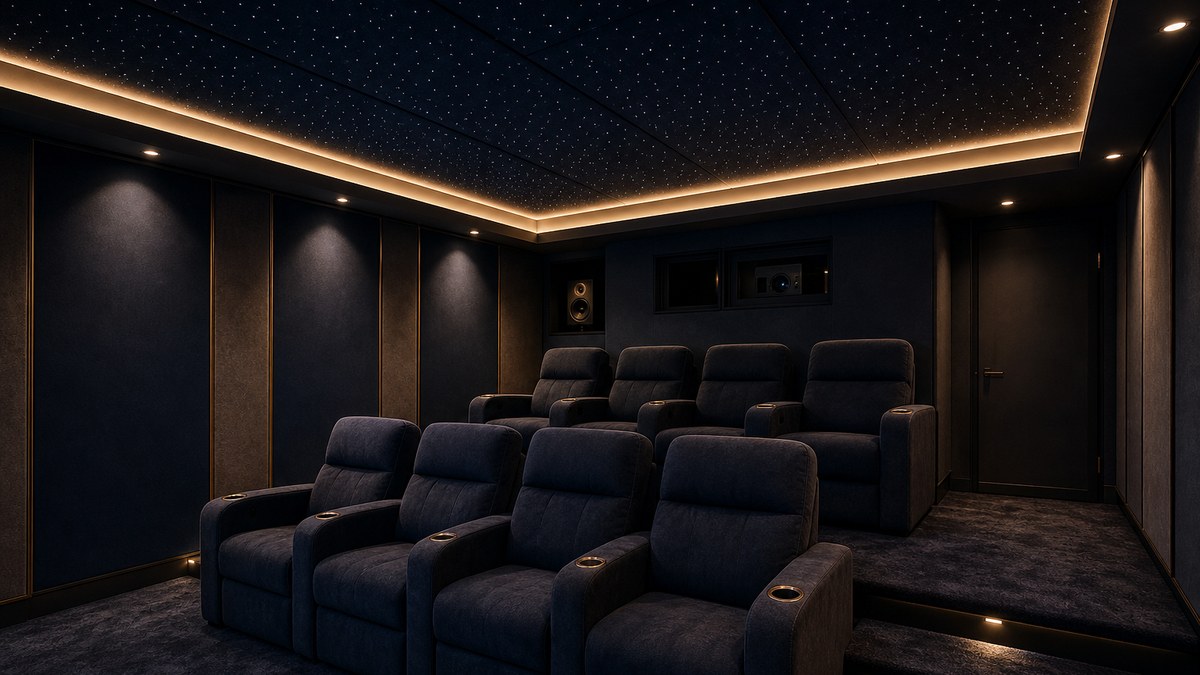
This is where acoustic star panels make the most sense. The room is dark, the seating is fixed and the audio is the priority. A full acoustic star ceiling with a border soffit for indirect light, speakers and the light engine is the classic layout. See our home theater star ceiling design guide for layout ideas.
Media rooms and family rooms
Media rooms are shared spaces with windows, open doorways and more furniture. They are already softer than a dedicated theater, so a partial acoustic field over the seating, or a floating cloud, often gives a big visual payoff with enough acoustic benefit. The stars will also shine best if the room's other lights are on dimmers.
Private cinemas and luxury screening rooms
Larger rooms with multiple seating rows benefit from several engines and zones, custom star mapping and careful integration with the room's control system. Our custom star ceiling cost factors explains what changes in high-end projects.
Basement theaters
Low ceilings, ducts and beams are common in basements. Thinner acoustic panels, soffits to hide obstructions and careful engine placement are the usual answers. The basement ceiling star lights guide covers the basics.
Commercial theaters, lounges and studios
Screening rooms, bars, lounges, podcast studios and listening rooms can all use acoustic star panels. Commercial spaces usually need materials that meet specific fire and flame-spread ratings, plus coordination with sprinklers, detectors and plenum rules, so confirm requirements with the building's design team. Our commercial lighting services page covers commercial supply, and for large venues and hospitality projects our sister company WDM Lighting handles large projects.
Common mistakes with acoustic star ceilings
- Expecting soundproofing: acoustic panels improve sound inside the room; isolation has to be built into the structure.
- Ordering panels before the speaker plan: speaker cutouts and gaps are hard to add later.
- Treating only the ceiling: bare side and rear walls will still cause reflections and echo.
- Engine in the wrong place: fan or twinkle-wheel noise near the seats is distracting; plan a remote or enclosed location with access.
- Repeating star patterns: identical panels side by side reveal the grid. Ask for a continuous, random layout.
- Leaky penetrations: unsealed holes in an isolated ceiling undo part of the soundproofing work.
- Too much ambient light: stars disappear under bright downlights; use dimmers and scenes.
What drives the quote for acoustic star ceiling panels
Wiedamark LED is quote-only, because every room, ceiling and audio plan is different. These are the factors that shape an acoustic star ceiling project:
| Factor | How it affects the project |
|---|---|
| Ceiling area and panel count | Full ceiling, partial field or cloud changes how many panels and fibers are needed |
| Panel construction | Core thickness, fabric choice and edge details differ between acoustic panel designs |
| Star density and fiber sizes | More stars and mixed diameters mean more fibers and more engine capacity |
| Features | Milky Way bands, constellations, crystal tips and shooting stars add detail and planning |
| Speaker coordination | Cutouts, grilles and hidden-speaker areas need custom panel work |
| Light engines and effects | Twinkle, color, zones and the number of engines |
| Controls | Remote, wall control, app or integration with theater and smart-home control |
| Installation | Your contractor, your integrator or a professional star ceiling installer; access and ceiling condition |
For general background, read what drives star ceiling pricing. For your theater, the fastest route is a project-specific quote.
DIY or professional install?
Acoustic star panels are more forgiving than threading a DIY kit through drywall, because the stars arrive already set in the panels. A handy owner or a general contractor can often mount them by following the panel instructions, especially on a flat ceiling with easy access to the engine location. Theaters with speaker cutouts, isolated ceilings, clouds or multiple engines usually benefit from a professional. For design and installation, our partner American Starlight Ceilings handles custom star ceilings, and our licensed installation partner has completed over 200 major sports and commercial projects across the US and Canada — NFL, NBA, NHL, MLS, NCAA and NASCAR. If you want to do it yourself, start with our DIY star ceiling kit installation guide.
Why plan your acoustic star ceiling with Wiedamark LED
Wiedamark LED supplies fiber optic starlight ceiling components and kits, fiber optic lighting and commercial and architectural LED, with trade pricing for contractors, designers and integrators nationwide. We bring 15+ years as an authorized architectural lighting dealer and project coordinator. Send us your room details and speaker plan and we will help you choose panels, star density and light engines that suit both the look and the sound. Browse our gallery, read more on the Wiedamark LED blog, see how our Luminance program works, or call (702) 738-2218.
Frequently Asked Questions
What are acoustic star ceiling panels?
Do acoustic star panels soundproof a home theater?
Where should acoustic star panels go in a theater?
Can acoustic star panels work with Dolby Atmos ceiling speakers?
Are acoustic star panels better than standard star panels?
Will the star ceiling light engine make noise in my theater?
How are acoustic star ceiling panels mounted?
Can I add acoustic star panels without attic access?
Do acoustic star panels come in color changing versions?
How much do acoustic star ceiling panels cost?
Better sound, and a sky to match
Tell us your room size, ceiling height, seating rows, speaker plan and the look you want. We will recommend acoustic star panels, star density and light engines, and send a project-specific quote.
Related
Our lighting network: starlight ceiling installation, 360° fiber optic lighting, premium pool lighting, WDM Lighting large projects, Dallas commercial LED lighting, Texas LED lighting, Plano LED lighting, LED signage, modular building solutions and Dallas modular structures.